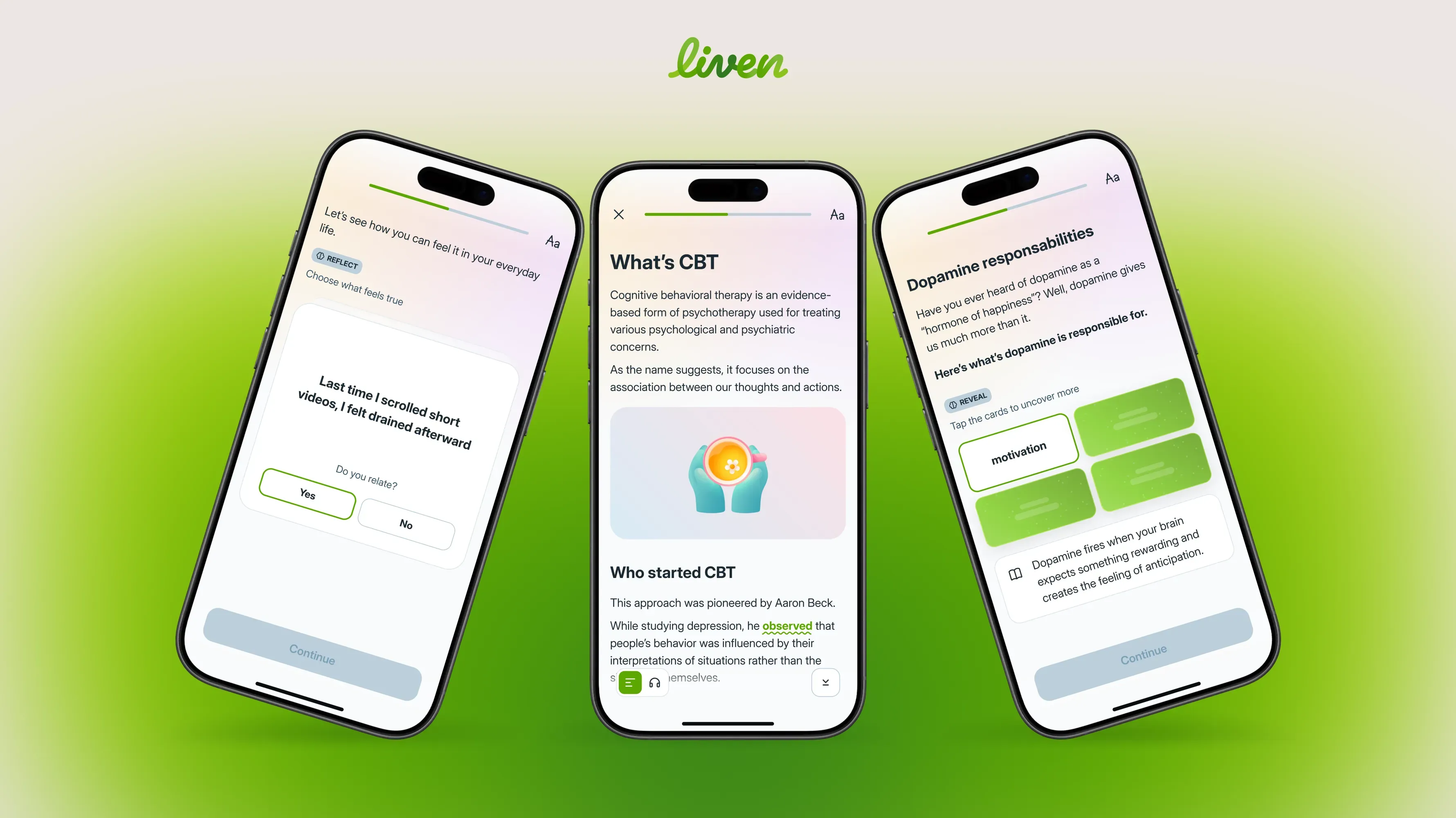


You've seen Liven mentioned alongside terms like CBT and emotional regulation, and you're trying to figure out what Liven therapy is before you download it or dismiss it. That's a fair question.
The quick answer:
Liven is not therapy. It's a self-discovery companion app built around daily mood check-ins, journaling, and a smart companion named Livie, with content co-developed with licensed health professionals and grounded in frameworks such as CBT, DBT, and Positive Psychology. It's designed as an everyday practice for noticing patterns and building emotional awareness, not a substitute for a licensed therapist.
Key Learnings
- Liven is a self-discovery app, not a licensed therapy service, and it doesn't diagnose or treat any condition.
- Its content is built on frameworks used in clinical settings, like CBT and DBT, but structured as daily self-guided practice.
- Liven is designed to complement therapy, not replace it, and many users report using it exactly that way.
- If you need diagnosis, treatment, or crisis support, a licensed professional is the right next step, not an app.

What Liven Is
Liven is a self-discovery and wellness app, not a clinical mental health app, built around one idea: understanding a pattern in your head and changing how you respond to it in the moment are two different skills.
Here's what that looks like day to day:
- Mood Tracker lets you log how you feel and add context.
- Journal gives you structured prompts for days when a blank page feels like too much.
- Livie is available for a conversation when you want to think something through out loud.
- Sounds offers audio for relaxation, focus, sleep, and mindful moments throughout the day.
- Self-Discovery Tests give you a self-assessment snapshot you can track over time.
Why People Ask If Liven Is Therapy
Searches for liven app therapy are common, and the confusion is understandable.
Liven's content is co-developed with a board of licensed health professionals, and its methodology draws on frameworks used in clinical settings, including CBT, DBT, and Solution-Focused Brief Therapy.
Livie is conversational in a way that can feel like talking to someone, which adds to the impression. None of that makes Liven a therapy service. It means the app is built on real clinical frameworks and delivered as daily self-guided practice, without the diagnosis or licensed clinical relationship that therapy involves.
The Methods Behind the App
Liven's core framework is the micro-cycle method: reflect through a short daily lesson, collect a real-time check-in, then act on one small, suggested step.
The gap between understanding a pattern and changing your response to it is mostly a timing problem. That's why brief daily practice tends to stick better than infrequent long sessions. The Journal's prompts draw on the same logic: writing about what's bothering you helps reduce stress.
Underneath sits Liven's approach to nervous system regulation. Naming an emotion, writing about it, and calming sounds are treated as tools to shift out of an activated stress state.
Liven's nervous system reset content frames these as ways to complete a stress response rather than let it linger. These are self-regulation practices, not clinical interventions. Liven is explicit that the app is not intended to diagnose, treat, or replace professional care.
Therapy works best when you bring something specific to work with, not just a general sense that things feel off. Naming an emotion and tracking it over time does exactly that: it turns a feeling into a pattern your therapist can actually see.
If you use the Mood Tracker or Journal, screenshot a pattern you keep noticing and bring it to your next session. Instead of opening with "I've been off lately," you're opening with what, when, and how often, and that's what a therapist can work with.
What Licensed Therapy Includes That Liven Doesn't
A therapist brings things no app can:
- Diagnosing a condition
- Building an individualized treatment plan
- Prescribing or coordinating medication where relevant
- Holding legal and ethical responsibility for your care
- Recognizing, as a live, trained clinician, when something needs a different kind of intervention than a coping tool
Liven doesn't do any of that. Its Self-Discovery Tests are self-assessment snapshots, not diagnostic instruments. Livie is a guide, not a clinician.
That distinction is exactly why Liven describes itself as a companion to therapy rather than a stand-in for it.
What Liven's Users Report
An internal survey looked at U.S. users with at least 14 days of meaningful engagement. Some shifts stood out across wellbeing:
- 49% reported an improved relationship with themselves
- 42% felt less on edge
- 41% felt less stressed or overwhelmed
- 40% reported less overthinking
- Only 4 to 7% reported any negative effects
Respondents also described real changes day to day: communicating more openly with partners, setting boundaries without guilt, catching themselves before reacting automatically to stress, and identifying specific issues to bring into their next therapy session.
Disclaimer: Based on self-reported responses from Liven users in the United States surveyed in March 2026. Results reflect individual experiences and are presented in aggregate. This is not a controlled clinical study.
Liven has also been recognized outside its own surveys, earning a Best Mobile App Silver Award and holding steady ratings across the App Store, Google Play, and Trustpilot. It's been featured in The Everygirl, Hello!, and Business Insider, among others, as people write more about wellness apps and how they fit into daily life.




Is Liven Worth Using Alongside Therapy?
For someone already in therapy, Liven can work as a between-session habit. A mood log surfaces a pattern worth raising with a therapist. A journal entry captures something in the moment, instead of reconstructing it a week later.
For someone not currently in therapy but managing everyday stress, Liven's short daily structure can fit into a commute, a break between meetings, or a wind-down before bed.
It's a different fit for someone who needs diagnosis, medication management, or trauma-focused clinical care. Those needs call for a licensed provider, not a self-guided app, and Liven says as much in its own materials.
When to See a Therapist Instead
Liven is a self-guided wellbeing tool, not a substitute for therapy, medical care, diagnosis, or crisis support. If symptoms are significantly affecting your daily functioning, if you need medication guidance, or if you want a diagnosis, a licensed professional is the appropriate next step. If you feel unsafe or may harm yourself or someone else, contact local emergency services or a crisis service in your country right away.
If you're curious whether Liven's kind of daily reflection fits what you're looking for, Liven's short quiz is a low-pressure way to start exploring your own patterns before you decide.
References
- Liang, J., & Lin, H. (2023). Current and lasting effects of affect labeling on late positive potential (LPP) amplitudes elicited by negative events. Brain and Behavior, 13(7), e3065. https://doi.org/10.1002/brb3.3065
- Linardon, J., Torous, J., Firth, J., Cuijpers, P., Messer, M., & Fuller-Tyszkiewicz, M. (2024). Current evidence on the efficacy of mental health smartphone apps for symptoms of depression and anxiety: A meta-analysis of 176 randomized controlled trials. World Psychiatry, 23(1), 139–149. https://doi.org/10.1002/wps.21183
- Lukenda, K., Sülzenbrück, S., & Sutter, C. (2023). Expressive writing as a practice against work stress: A literature review. Journal of Workplace Behavioral Health, 39(1), 106–137. https://doi.org/10.1080/15555240.2023.2240512
- Singh, B., Murphy, A., Maher, C., & Smith, A. E. (2024). Time to form a habit: A systematic review and meta-analysis of health behaviour habit formation and its determinants. Healthcare, 12(23), 2488. https://doi.org/10.3390/healthcare12232488
FAQ: What Is Liven Therapy
Is Liven therapy?
What is Liven therapy compared to a real therapist?
Can Liven replace my therapist?
What methods does Liven use if it isn't therapy?
Does Liven help with what a therapist would call emotional regulation?
Should I use Liven if I'm already in therapy?
When should I see a therapist instead of using Liven?
Is "Liven app therapy" accurate?
Is Liven a mental health app?