
How to Build Habits with Liven's Micro-Cycle Method


Written by
Nadine M., Editorial Team Lead at Liven


Understanding yourself and changing your behavior turn out to be two surprisingly different skills. Plenty of people have done serious work on the first one, such as the reading, the reflection, the self-inquiry, and still find the second one stubbornly out of reach.
Here's something fascinating that neuroscience has been quietly uncovering: the gap between knowing something about yourself and changing how you behave isn't a willpower problem, as we tend to think. It's more of a timing problem.
Habits live below the surface of conscious thought. By the time you've recognized a pattern in retrospect, e.g., journaled about it, reflected on it, maybe talked it through, the moment where change was possible has already passed. The brain's habit loop fires fast, and the window for a different choice is narrow.
That's the bridge Liven's micro-cycle method aims to close. Let's deep dive into how it works.
Key Learnings
- Habit change starts with catching patterns as they happen.
- Micro-cycle works in three steps: Reflect, collect, act.
- It's designed for self-improvers, people ready to act on what they already know about themselves.
- Real-time awareness is the critical bridge between insight and lasting behavior change.

How Habits Are Built
Let's start with the science, because it genuinely reframes everything. Neuroscientist Ann Graybiel's research at MIT helped reveal what's happening every time a habit runs: a structure in the brain called the basal ganglia chunks sequences of behavior into automatic routines with no conscious decision required.
The brain is, in effect, trying to free up cognitive space by automating whatever it sees you do repeatedly. Think of habits as an efficient neural code your brain wrote to help you.
In his book, The Power of Habit, Charles Duhigg later described this as the habit loop: a cue triggers a routine, which delivers a reward. The brain learns to anticipate that reward and eventually craves it, which is why habits feel so sticky once they're established.
BJ Fogg, behavioral scientist at Stanford, found something equally interesting: the size of the behavior matters less than the precision of the trigger. His Tiny Habits research showed that anchoring a new behavior to an existing moment — something you already do reliably — dramatically increases the chance it sticks.
James Clear, drawing on habit research in Atomic Habits, identified four stages in the loop: Cue, Craving, Response, Reward. Change any one of those stages consciously, and the whole pattern becomes workable.
For example, a study on habit formation by Phillippa Lally found that, on average, it takes 66 days to form a new habit. But that number only holds when you're practicing the right version of the behavior, consistently, in response to the right cue.
What is the common thread across all this research? Awareness at the right moment is everything. The most important thing is to catch the pattern as it runs, and make a different choice while the window is still open.
What Is the Liven's Micro-Cycle Method?
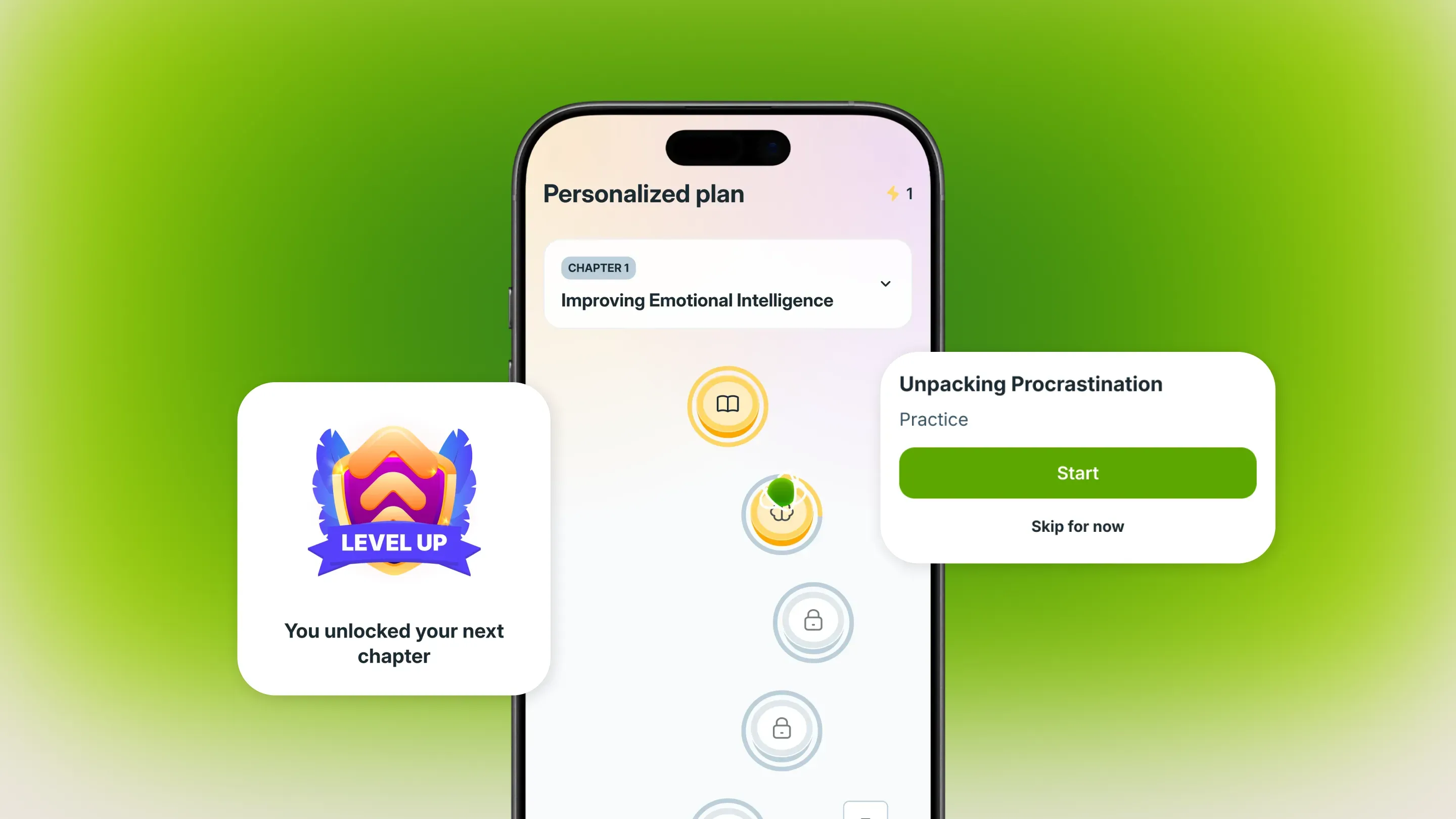
Micro-cycle is Liven's core habit-building framework. It operates in a three-step loop and runs in real time.
🧐 Step 1: Reflect
Each day starts with a short, interactive lesson. You tap through an idea, respond to a few questions about your own experience, and walk away with something that actually applies to your life. Every lesson is developed with certified health professionals and grounded in research-backed approaches.
🔍 Step 2: Collect
Then you check in with yourself. Log your mood, note what's happening around you, write down whatever's sitting on your mind. A single entry won't reveal much, but over days and weeks, a picture forms: the situations that drain you, the things that bring you back to yourself, the patterns you couldn't quite see from inside them.
🌱 Step 3: Act
Based on your check-in, Liven suggests one small thing to try, e.g., a meditation, a short video from one of our health experts, or a simple practice that meets you where you are and makes the next moment a little easier to move through.
How to Practice Habit Building with the Liven App
Here's what Liven's micro-cycle method example looks like in practice. It's built around one small commitment: a daily break, just for you.
1. Take a break.
Once a day, you open the Liven app and give yourself a moment to let go of some steam. Your mission here is simply to log your mood.
Think of it as a private, safe space to ask yourself:
- What got under your skin today?
- What made you anxious or scared?
- Do you feel needy or unsettled?
- How are you holding up?
It's the first step in the loop: bringing what's already running below the surface into the light, where you can actually work with it.
2. Learn something about yourself.
Based on how you feel, Liven suggests low-effort activities and content designed to help you understand what's happening and why.
Over time, this is where the learning accumulates. Each check-in adds a data point. You start to see which triggers keep showing up, which emotions tend to cluster together, and which moments are telling you something worth paying attention to.
3. Commit to a streak.
Try to stick to a 3-day streak. That's the anchor. Add the Liven widget to your home screen, so tomorrow's check-in is ready for you. The streak will give the loop enough repetitions to start becoming automatic.
Remember, the more consistently you show up, the sharper the picture of your patterns and your triggers gets.
For Those Who Want to Go Deeper
Micro-cycle is one part of a larger conversation about how people change. If you want to understand the science and thinking behind it more deeply, the resources below are worth your time:
Podcasts
- Huberman Lab by Andrew Huberman's neuroscience episodes on dopamine, habit formation, and behavior change are dense, credible, and worth the time.
- Hidden Brain, NPR's behavioral psychology series. Consistently surprising, always accessible.
- The Model Health Show by Shawn Stevenson on the intersection of lifestyle, behavior, and performance.
YouTube
- Kurzgesagt's brain and behavior content
- Andrew Huberman's habit and dopamine series
Plus, the books we mentioned in the first paragraphs: Atomic Habits, Tiny Habits, and The Power of Habits.
Final Thoughts: Building Your Habits Brick-by-Brick
If you're the kind of person who understands yourself well in theory but finds the distance between insight and behavior frustrating, the micro-cycle is worth trying. It doesn't ask for more reflection. It doesn't add to your to-do list. It gives you a daily moment to catch yourself in the act, understand what's driving it, and practice something different.
We suggest taking a Liven quiz as a first step to identify which patterns are running your life and learn what to start doing about them, in your own rhythm.



References
- Graybiel, A. M. (2008). Habits, rituals, and the evaluative brain. Annual Review of Neuroscience, 31, 359–387. https://doi.org/10.1146/annurev.neuro.29.051605.112851
Phillippa Lally, Cornelia, Potts, H. W. W., & Wardle, J. (2010, October). How are habits formed: Modeling habit formation in the real world. ResearchGate; Wiley. https://www.researchgate.net/publication/32898894_How_are_habits_formed_Modeling_habit_formation_in_the_real_world