
How to Use the Liven App to Improve Your Well-Being


Written by
Nadine M., Editorial Team Lead at Liven


Many of us know our triggers, our patterns, the stories we tell ourselves under stress. What's harder is changing how we respond when emotions run high. That's why having a toolbox for those moments matters.
The Liven app is exactly that. It offers daily self-regulation practices grounded in Cognitive Behavioral Therapy(CBT) and Positive Psychology. Getting value from Liven comes down to two things: fitting it into the natural rhythms of your day and showing up consistently for at least three days in a row.
This article covers how Liven's methodology works, where it fits into real life, and what changes when you stick with it.
Key Learnings
- Liven's core methodology, the microcycle, works through three real-time steps: Reflect, Collect, and Act.
- The app works best in the ordinary gaps of your day: commutes, transitions, wind-downs.
- Consistency of two minutes daily can outperform a 30-minute session done once a week.
The Methodology Behind the App
Knowing yourself isn't always the same as changing yourself. You can understand that you tend to shut down under pressure, have read the books on attachment theory, and still find yourself in the same reaction pattern on a Tuesday afternoon.
The gap between insight and behavior change is a timing problem. Habits run below conscious thought. By the time you recognize a pattern in retrospect, the moment where a different choice was available has already passed.
Liven's microcycle method is built to close that gap. It operates in a three-step loop:
🧐 Step 1: Reflect
You start with a short, interactive lesson. You tap to uncover an idea, answer a few questions about your own life, and what you learn has somewhere to land. Every lesson is built with certified health professionals using research-backed approaches.
🔍 Step 2: Collect
You check in. Track how you feel, add a note about what's going on around you, and journal whatever's on your mind. One entry won't tell you much, but day after day, patterns start to surface: what sets you off, what steadies you, what keeps coming back. Understanding yourself isn't a single breakthrough moment. It's what shows up when you keep paying attention.
🌱 Step 3: Act
Based on what you shared, Liven offers one small thing to do right now: a meditation, a short expert video, or a simple to-do to meet you in it, and help take a little of the weight off.
Then tomorrow, the loop begins again.
Neuroscientist Ann Graybiel's research at MIT showed that the brain chunks repeated behavior into automatic routines via the basal ganglia, essentially writing neural code to free up cognitive space. According to Liven's internal survey, 68% of users report building better daily self-awareness through this approach.
BJ Fogg's behavioral research at Stanford found that anchoring a new behavior to an existing moment is one of the most effective ways to make a habit stick. Liven's check-in structure is built on exactly this: a brief daily moment anchored to your existing routine.
How to Integrate Liven into Your Life
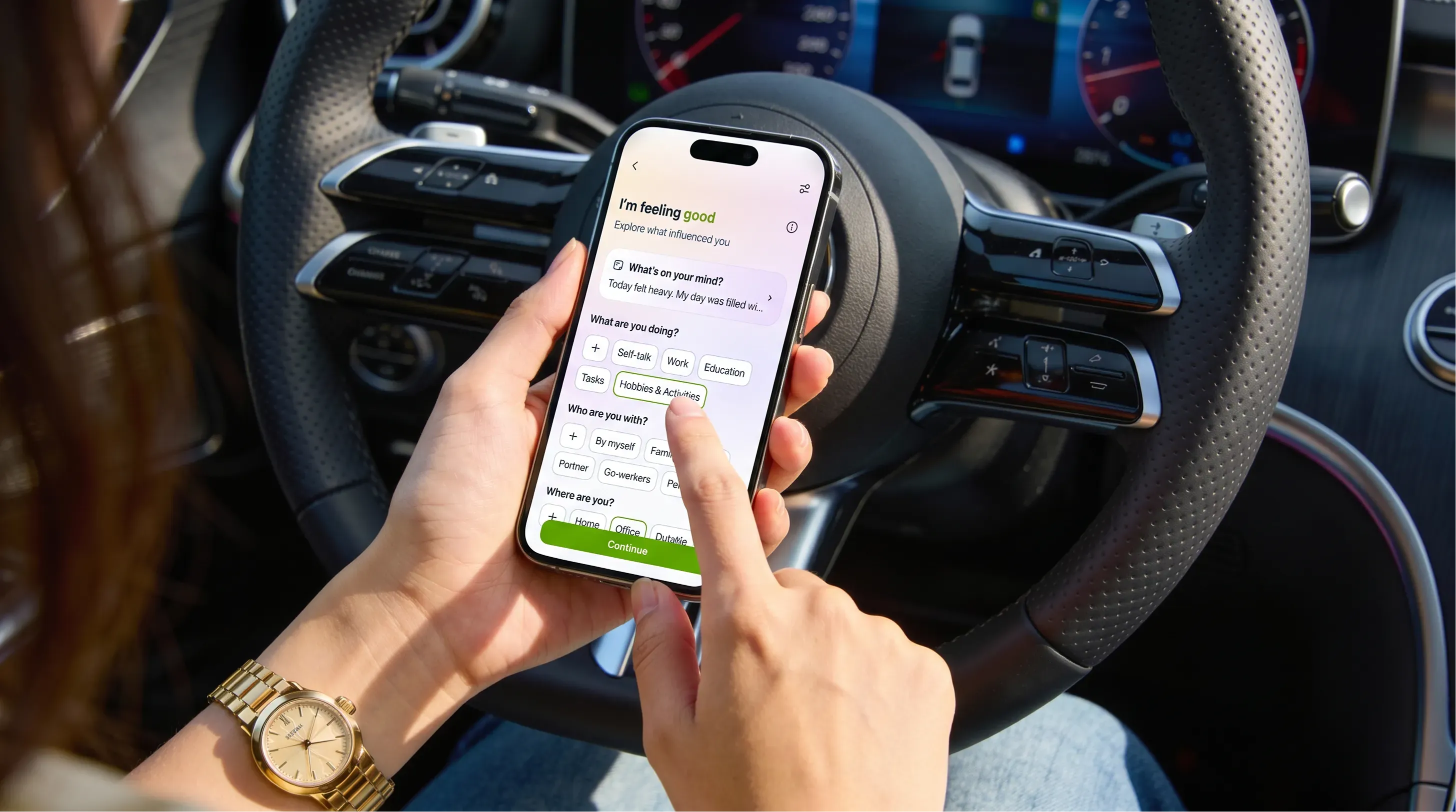
🚗 Using Liven During Your Commute
The morning commute is one of the most underused windows for mental health in most people's day. You're in transit, usually passive, and the day hasn't fully landed yet.
That's the right moment for a check-in. Opening the Liven app on the way to work and logging how you're feeling takes less than two minutes. The Mood Tracker prompts are specific enough to get past the default "I'm fine": what got under your skin yesterday, what feels unsettled, what you're carrying into the day.
That log does something quiet but important. Labeling an emotion with precision reduces activity in the amygdala, the brain's threat-detection center, and shifts processing toward the prefrontal cortex. So by journaling, you're making it physiologically easier to think clearly for the rest of the morning.
On the return trip, the Sounds library is worth a try. Binaural beats in the theta range (4–8 Hz) have been studied for their effects on parasympathetic activation, and research has found significant reductions in anxiety with consistent use.
🌱 Using Liven for Habit Building
Habits form from repetition in response to a reliable cue. It takes an average of 66 days to build a new habit, but that figure holds only when you're practicing the right behavior consistently in response to the right trigger. That's the logic behind Liven's streak feature. Liven asks for a daily moment, anchored to a cue, repeated enough times that the loop becomes automatic.
Adding the Liven widget to your home screen puts tomorrow's check-in one tap away. The aim is to remove friction entirely, because the nervous system rarely responds well to complexity when it's already activated. The easier it is to start, the more likely you are to reach for it when you need it.
Over time, the Mood Tracker becomes a longitudinal dataset of your own patterns. You start seeing which days consistently spike, which environments reliably pull you out of regulation, and which emotions tend to cluster together before a difficult week.
Your data is private, stored securely, and visible only to you. What it gives you is the ability to recognize a pattern as it's happening, while the window for a different choice is still open.
☀️ Using Liven for Emotional Regulation During the Day
Sometimes, emotional dysregulation can show up as a short fuse by mid-afternoon or a flatness that makes everything feel heavier than it should. This is what an incomplete stress response looks like. The nervous system mobilized, the activation didn't complete, and now it's sitting in the background, making ordinary tasks take up more energy.
Liven's tools are grounded in Cognitive Behavioral Therapy (CBT), one of the most well-studied frameworks for emotional regulation. CBT helps identify and restructure the thought patterns that feed reactive states.
In practice, this might look like:
- A 3-minute journal prompt between meetings, when something snagged your attention, and you're not sure why. Writing about emotionally significant events, even briefly, has been found to reduce self-reported distress and physiological markers of stress.
- A sound session for five minutes after a difficult call. Certain audio frequencies directly activate the vagus nerve, the primary channel of the parasympathetic system, signaling the nervous system that the threat has passed.
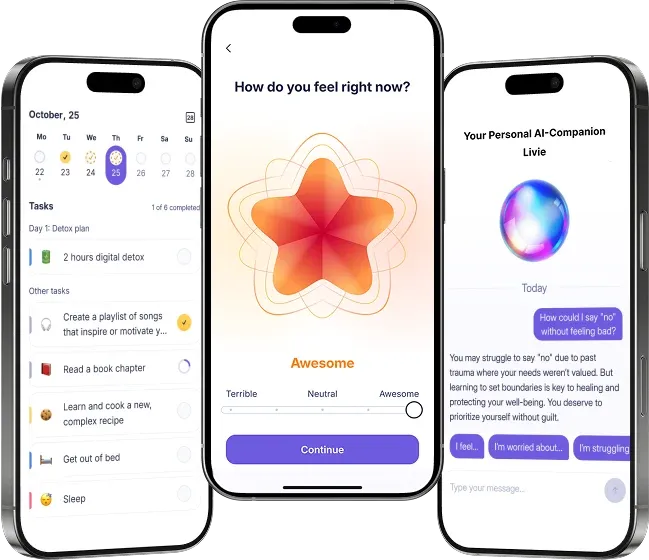
- A check-in with Livie, Liven's smart companion, when you need to externalize the noise. Livie doesn't replace professional support, but it provides a consistent, available, non-judgmental presence that asks the right questions and adapts over time to what it learns about your patterns.
🌘 Using Liven at the End of the Day
The evening is where most people try to regulate and fail — because by then, the activation has been running for hours.
The most effective use of Liven in the evening is not a long session. It's a short, consistent one. James Pennebaker's research showed that five minutes of daily expressive writing outperforms a thirty-minute session done infrequently. The same principle applies across all of Liven's tools: frequency matters more than duration.
A brief mood log before sleep closes the microсycle loop for the day. It surfaces what you actually carried through the hours, not what you think you felt in retrospect. Combined with a Sounds track calibrated for sleep, it gives the nervous system what Dr. Stephen Porges describes as signals of safety: the inputs the autonomic system needs to shift from sympathetic activation into the ventral vagal state, the state associated with rest, recovery, and genuine calm.
Try Liven Free for 3 Days, and See What Shifts
What Liven offers is a daily practice with a structure that holds. Three consistent days give the microcycle loop enough repetitions to start feeling natural. The best way to start is with Liven's introductory self-discovery quiz. It takes a few minutes and gives the app enough context to build a personalized in-app plan around your specific patterns, whether that's overthinking, emotional reactivity, or something else entirely.
Disclaimer: Liven supports your daily wellbeing practice and is not a substitute for professional mental health care. If you're in crisis or need clinical support, please contact a licensed mental health professional.
References
- Graybiel, A. M. (2008). Habits, rituals, and the evaluative brain. Annual Review of Neuroscience, 31, 359–387. https://doi.org/10.1146/annurev.neuro.29.051605.112851
- Lally, P., van Jaarsveld, C. H. M., Potts, H. W. W., & Wardle, J. (2010). How are habits formed: Modelling habit formation in the real world. European Journal of Social Psychology, 40(6), 998–1009. https://psycnet.apa.org/record/2010-22273-010
- Lieberman, M. D., Eisenberger, N. I., Crockett, M. J., Tom, S. M., Pfeifer, J. H., & Way, B. M. (2007). Putting feelings into words. Psychological Science, 18(5), 421–428. https://pubmed.ncbi.nlm.nih.gov/17576282/
- Pennebaker, J. W., & Beall, S. K. (1986). Confronting a traumatic event: Toward an understanding of inhibition and disease. Journal of Abnormal Psychology, 95(3), 274–281. https://psycnet.apa.org/record/1987-01227-001
- Porges, S. W. (2011). The polyvagal theory: Neurophysiological foundations of emotions, attachment, communication, and self-regulation. W. W. Norton & Company.
- Saskovets, M., Saponkova, I., & Liang, Z. (2024). Effects of Sound Interventions on the Mental Stress Response in Adults: A Scoping Review. JMIR Mental Health, 12. https://doi.org/10.2196/69120
Pavlacic, J. M., Buchanan, E. M., Maxwell, N. P., Hopke, T. G., & Schulenberg, S. E. (2019). A Meta-Analysis of Expressive Writing on Posttraumatic Stress, Posttraumatic Growth, and Quality of Life. Review of General Psychology, 23(2), 230–250. https://doi.org/10.1177/1089268019831645
FAQ: How to Use Liven
Can I use Liven if I'm already in therapy?
Do I need a lot of time each day?
What if I miss a day?
What is Livie?