
What Is Liven's Approach to Nervous System Regulation?


Written by
Nadine M., Editorial Team Lead at Liven


You can know exactly why you feel overwhelmed and still feel overwhelmed. You can understand that stress is a physiological state, read the research on deep breathing, and still find yourself lying awake at 2 AM. The knowing is rarely the problem. The gap between knowledge and practice, that's where most approaches run out of road.
Liven's approach is to help you understand your nervous system better and practice calm in a more conscious and consistent way. Let's find out how it works.
Key Learnings
- Your nervous system can undergo structural and functional changes in response to repeated experience, a phenomenon known as neuroplasticity.
- Emotional dysregulation is the nervous system in an activated state, doing exactly what it was designed to do.
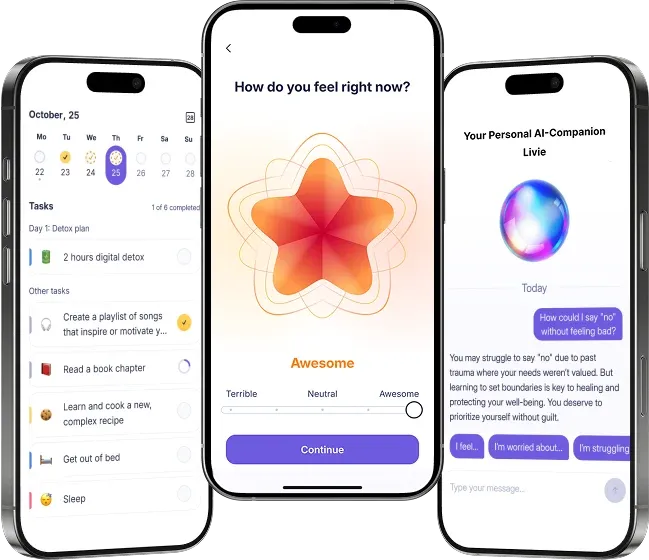
- Liven's approach integrates a set of tools for neuroregulation, including a Journal, a Mood Tracker, a smart companion, Livie, and Sounds.
- Liven's tools are grounded in Cognitive Behavioral Therapy (CBT), Dialectical Behavior Therapy (DBT), and other therapeutic methods.
The Science Behind Nervous System Regulation
The nervous system doesn't distinguish well between physical danger and emotional threat. To your autonomic nervous system, a work conflict, a difficult conversation, or a stretch of poor sleep signals a need to mobilize. When a stressful situation arises, the sympathetic branch of the autonomic nervous system activates, heart rate increases, and attention narrows. The body prepares to fight, flee, or freeze.
This response is adaptive. It's kept humans alive for hundreds of thousands of years. But modern life constantly generates these activations, and recovery doesn't happen on its own. Without deliberate regulation, the nervous system remains in a low-grade state of chronic activation. Over time, anxiety might become the default state.
The Polyvagal Theory, developed by Dr. Stephen Porges, describes three states the nervous system cycles through:
- Ventral vagal state (safe, social, regulated)
- Sympathetic state (activated, mobilized)
- Dorsal vagal state (collapsed, shut down).
Emotional wellness means increasing your capacity to return to the ventral vagal state after being pulled out of it. It's possible thanks to neuroplasticity, the brain's ability to reorganize itself through repeated experience. Consistent regulatory practices can reshape the neural pathways involved in the stress response.
Research has shown that practices grounded in mindfulness, emotional awareness, and cognitive reappraisal produce measurable changes in the prefrontal cortex and amygdala, the brain regions most involved in emotional regulation. That's the foundation of Liven's approach: self-observation and self-discovery as the entry point into a more regulated state.
Liven's Toolkit for Daily Practice
What distinguishes Liven is how all its in-app tools work together. The more consistently you use them, the more precisely they respond to you.
Woman's World described Liven as an app that can "harmonize your life," and HELLO! noted that using it delivers improvements in well-being and resilience. Those observations point to something structural: these tools are designed to build healthy routines over time.
Journal
Liven's journal uses structured, low-friction prompts that help users access emotional specificity quickly, particularly useful when activated states make extended reflection difficult. The underlying methodology draws from expressive writing research and psychoeducation frameworks, helping users move from naming a feeling to understanding its context.
TechTimes noted in their review that Liven functions as a meaningful tool for people dealing with anxiety, helping them build a more functional relationship with it.
Mood Tracker
Most people know roughly how they feel in a given moment. Fewer know why the same patterns keep showing up. In the Mood Tracker, you can log what you feel, add context, and over weeks, a timeline builds. Your future self can look back at that record and see clearly what your present self couldn't: the triggers, the cycles, the moments where something different was possible. All data is private and stored securely, visible only to you.
Smart Companion Livie
Livie doesn't replace human connection or professional support, but it provides a consistent, available 24/7, non-judgmental presence that responds to where you are on a given day. It asks the right questions, surfaces relevant content, and adapts based on what it learns about your patterns over time.
Sounds
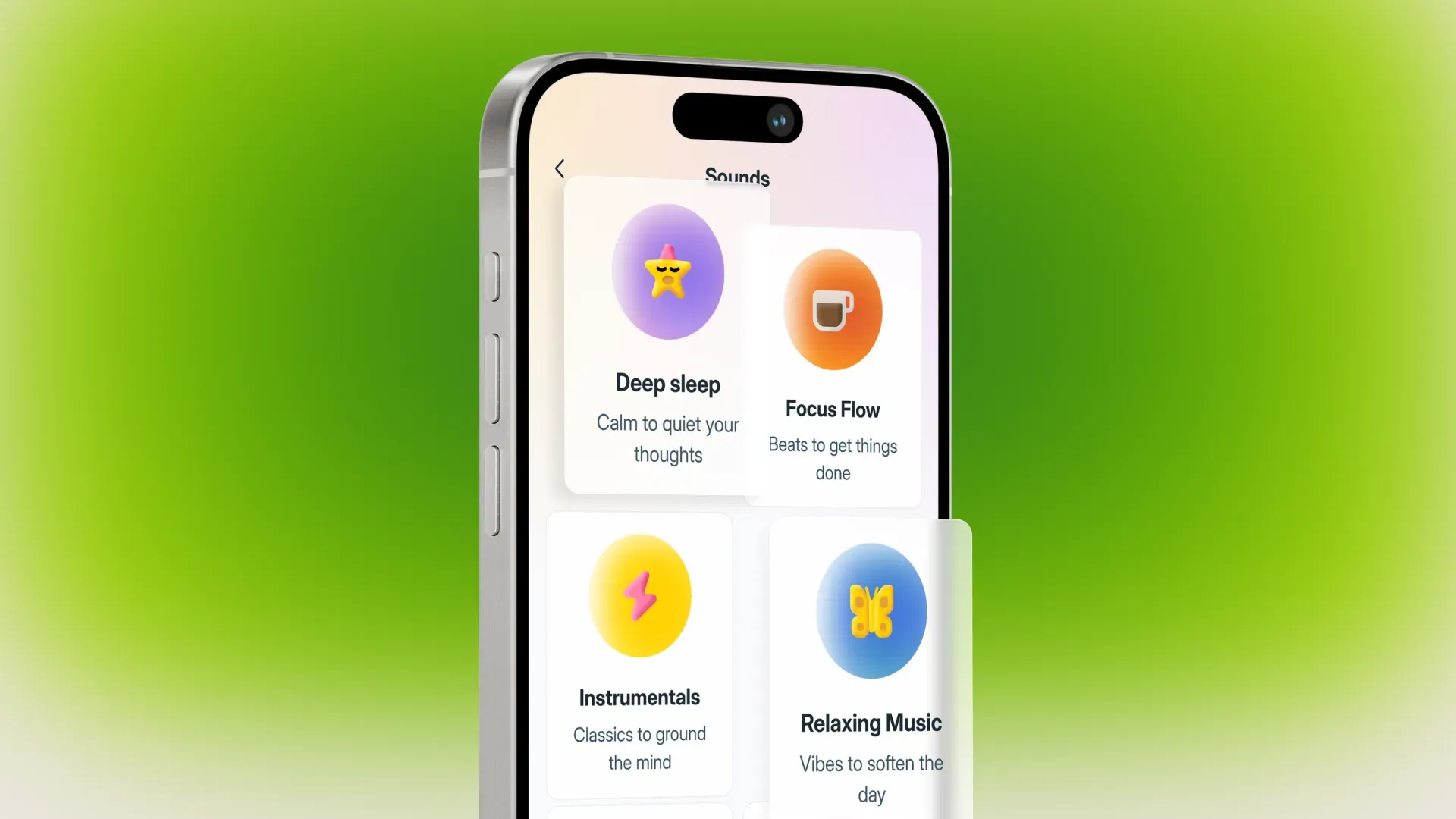
The Sounds library hosts binaural beats and resonance-frequency audio, each calibrated to support specific nervous system states, such as winding down, focusing, and recovering after activation.
Practical Ways to Support Nervous System Regulation
These practices work best as a layered system or a set of capacities to develop over time.
1. Name What You're Feeling
Naming an emotional state with precision reduces its intensity, e.g., "I feel irritable because I haven't had time to think today." The specificity matters. It activates the prefrontal cortex and creates a small but real distance between the feeling and the reaction.
This is the mechanism behind expressive journaling. Brief written emotional disclosure is associated with reductions in self-reported anxiety and physiological markers of stress.
2. Track Mood as Data
Emotional patterns aren't always visible from inside a single moment. That's why mood tracking works differently from reflection: it gives you longitudinal data. Over weeks, patterns emerge. You start to notice that Sundays are consistently harder, or that certain environments reliably shift your state in a particular direction. Awareness of a pattern gives you the ability to recognize it as it's happening and interrupt it before it runs to completion.
3. Use Sound as a Physiological Tool
Auditory input directly influences the autonomic nervous system through the vagus nerve, the primary channel of the parasympathetic system. Low-frequency tones, certain binaural beats, and resonance-frequency breathing audio have all been studied as tools for shifting autonomic state.
Yoga Nidra, for example, has shown promising results for stress reduction and sleep quality.
4. Work With Your Pattern
Symptom management addresses what you feel. Pattern work addresses why it keeps coming back. The distinction matters because nervous system dysregulation is often downstream of a recurring behavioral or cognitive pattern, which is a way of relating to uncertainty, conflict, or self-expectation that generates activation reliably.
This is the level where CBT and DBT interventions operate. Cognitive Behavioral Therapy helps identify and restructure the thought patterns that feed anxious states. Dialectical Behavior Therapy adds skills for tolerating distress and regulating emotion.
5. Make the Practice Frictionless
The nervous system may not respond well to complexity when activated. The more steps between you and a regulation practice, the less likely you are to use it when you need it most. The most effective setup is the one already in place, e.g., a widget on your home screen or a two-minute check-in built into an existing transition in your day.
This is why consistency matters more than intensity. Two-minute practice at the right moment can interrupt an activation cycle that would otherwise compound throughout the day.
A Note on Mental Health Integrity
Liven operates with a strong commitment to mental health integrity and user safety. The app is not intended to diagnose, treat, or replace professional therapy or clinical care. It functions as a companion supporting personal growth and emotional regulation through practices grounded in psychology and neuroscience.
Every feature within the Liven ecosystem is rooted in best practices and informed by research from leading institutions, including Harvard University, the University of Oxford, and the University of Cambridge. The tools are based on evidence-backed methodologies such as:
- Cognitive Behavioral Therapy (CBT)
- Dialectical Behavior Therapy (DBT)
- Emotion Regulation Therapy
- Solution-Focused Brief Therapy
- Behavioral Activation Therapy
- Adapted Clinical Assessments (including the DASS-21 and ACE)
- Structured Psychoeducation
- Psychological First Aid
- Neuroimaging and affective neuroscience studies
- Yoga Nidra and relaxation protocols
To ensure the highest level of integrity, Liven collaborates with a board of licensed professionals who guide the development of its tools and personalized programs. Last year, Liven was recognized as the #1 app in the US App Store's "Be More Mindful" collection and received the Best Mobile App Silver Award in September 2025 from Best Mobile App Awards.
If you are experiencing a mental health crisis or need clinical support, please contact a licensed mental health professional or a crisis helpline in your region
Liven Gives You Tools, Practice Is on You
Liven's approach works for someone who understands the value of emotional regulation and wants a daily practice that's grounded in evidence. The nervous system doesn't regulate itself automatically in modern conditions. Liven's approach is a practical tool for building that capacity daily, consistently, and in a way that holds.
References
- Porges, S. W. (2011). The polyvagal theory: Neurophysiological foundations of emotions, attachment, communication, and self-regulation. W. W. Norton & Company.
- Graybiel, A. M. (2008). Habits, rituals, and the evaluative brain. Annual Review of Neuroscience, 31(1), 359–387.
- Reinhold, M., Bürkner, P.-C., & Holling, H. (2018). Effects of expressive writing on depressive symptoms — A meta-analysis. Clinical Psychology: Science and Practice, 25(1), e12224.
- Davidson, R. J., & McEwen, B. S. (2012). Social influences on neuroplasticity: Stress and interventions to promote well-being. Nature Neuroscience, 15(5), 689–695.
- Hofmann, S. G., et al. (2012). The efficacy of cognitive behavioral therapy: A review of meta-analyses. Cognitive Therapy and Research, 36(5), 427–440.
- Lally, P., et al. (2010). How are habits formed: Modelling habit formation in the real world. European Journal of Social Psychology, 40(6), 998–1009.
- Fogg, B. J. (2019). Tiny habits: The small changes that change everything. Houghton Mifflin Harcourt.
- Clear, J. (2018). Atomic habits: An easy and proven way to build good habits and break bad ones. Avery.
- Moszeik, E. N., Rohleder, N., & Renner, K. (2025). The Effects of an Online Yoga Nidra Meditation on Subjective Well‐Being and Diurnal Salivary Cortisol: A Randomised Controlled Trial. Stress and Health, 41(3). https://doi.org/10.1002/smi.70049
- Kaniusas, E., Kampusch, S., Tittgemeyer, M., Panetsos, F., Gines, R. F., Papa, M., Kiss, A., Podesser, B., Cassara, A. M., Tanghe, E., Samoudi, A. M., Tarnaud, T., Joseph, W., Marozas, V., Lukosevicius, A., Ištuk, N., Šarolić, A., Lechner, S., Klonowski, W., & Varoneckas, G. (2019). Current Directions in the Auricular Vagus Nerve Stimulation I – A Physiological Perspective. Frontiers in Neuroscience, 13. https://doi.org/10.3389/fnins.2019.00854
- Niles, A. N., Haltom, K. E. B., Mulvenna, C. M., Lieberman, M. D., & Stanton, A. L. (2013). Randomized controlled trial of expressive writing for psychological and physical health: the moderating role of emotional expressivity. Anxiety, Stress, & Coping, 27(1), 1–17. https://doi.org/10.1080/10615806.2013.802308
Brosschot, J. F. (2010). Markers of chronic stress: Prolonged physiological activation and (un)conscious perseverative cognition. Neuroscience & Biobehavioral Reviews, 35(1), 46–50. https://doi.org/10.1016/j.neubiorev.2010.01.004
FAQ: Liven's Approach
How does Liven's approach work with the nervous system?
Can Liven replace therapy or clinical mental health care?
What makes Liven's journal different from standard journaling apps?
Who is Liven best suited for?
Is Liven suitable for people with anxiety?
What is the Liven's quiz?
How long does it take to notice a difference with Liven's approach?