

You know you're dysregulated. You might feel the tightness in your chest, the short fuse, the way small things land harder than they should. What you don't always have is something specific to do about it at that moment.
Stress doesn't resolve itself. The body mobilizes to meet a threat, and without a way to complete that cycle, it stays braced sometimes for hours, sometimes for days. What looks like anxiety or irritability is often an incomplete stress response looking for an exit.
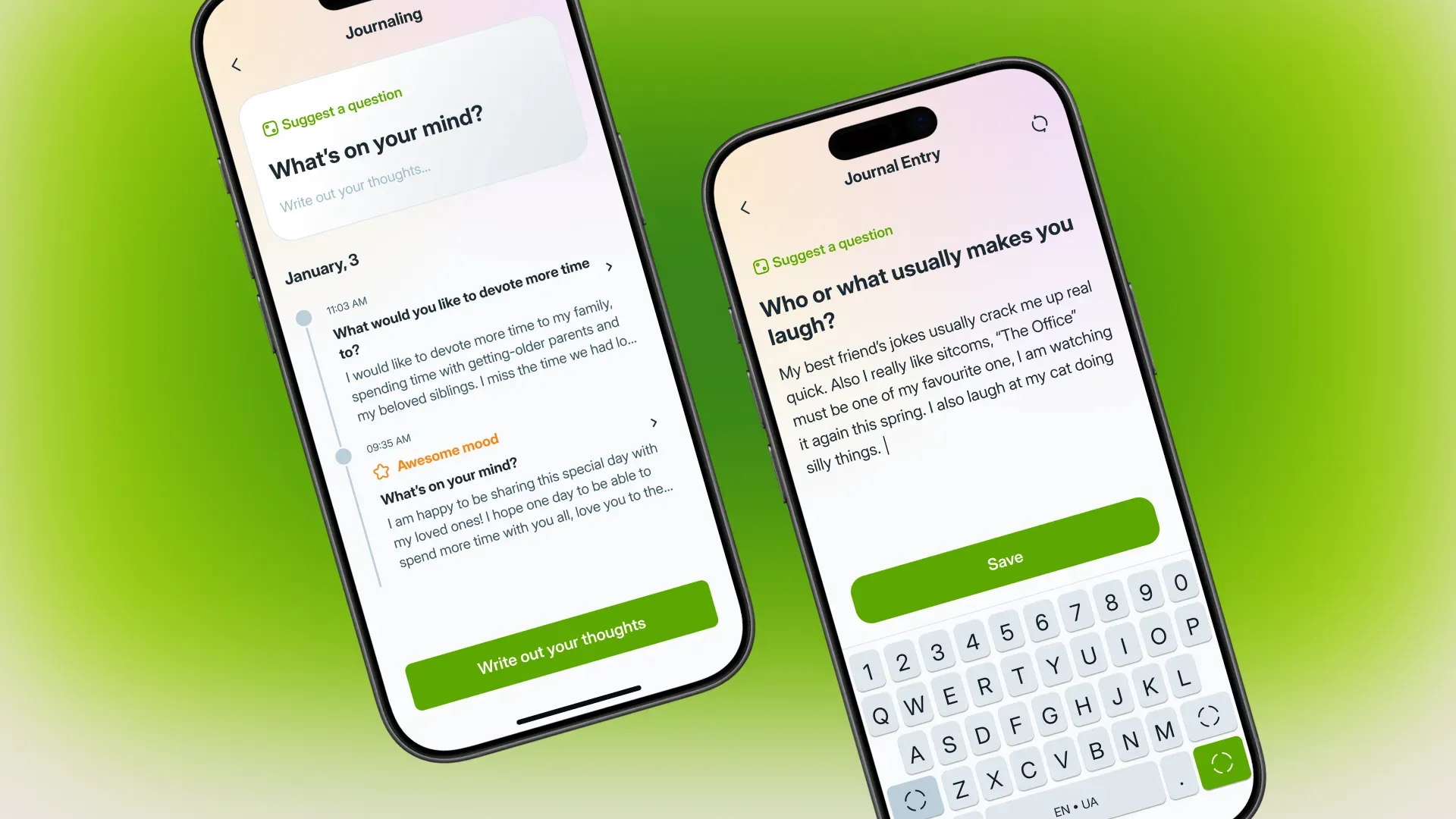
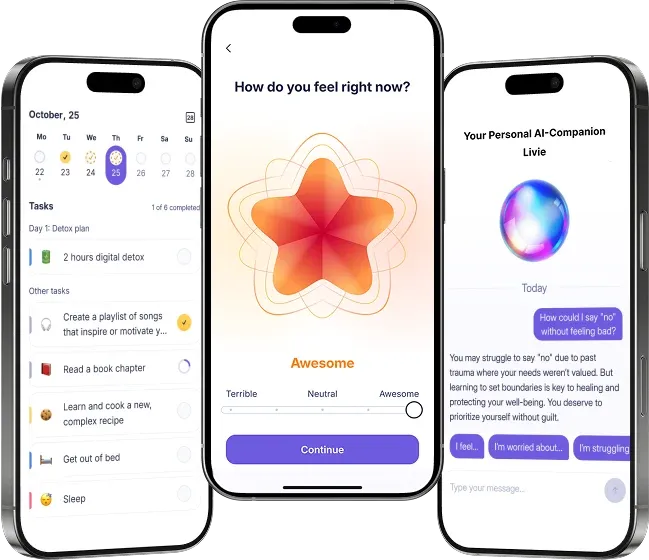
The Liven app offers you a 360 toolkit for moments like this. Its features, such as a Journal, Mood Tracker, Sounds, and the smart companion Livie, can help you let off some steam and regulate your nervous system.
Key Learning
- The nervous system doesn't automatically reset after stress and needs help completing the cycle.
- Naming emotions, writing, sound, and reflection are all evidence-based regulation tools.
- Liven puts those tools in one place, designed for daily use.
- Brief daily practice outperforms occasional deep dives.
- Liven complements professional mental health support.
Why the Nervous System Gets Stuck
The autonomic nervous system runs two primary modes: the sympathetic branch (fight, flight, freeze) and the parasympathetic branch (rest, digest, recover). Under stress, we might experience symptoms such as a rise in heart rate, narrowing of attention, etc.
The stress response is designed to move through the body. Movement, breath, and connection are how the nervous system signals completion, a return to baseline. Without them, the activation lingers. That background hum of low-grade alert is what makes ordinary tasks feel more expensive than they should.
Stephen Porges' Polyvagal Theory adds useful nuance: beneath activation and shutdown lies a third state, the ventral vagal state, associated with safety, connection, and clear thinking. Getting there requires giving the nervous system signals it recognizes as safe.
That's exactly what the right daily practices do.
How Liven Helps You Reset
1. Giving the Feeling a Name
There's a specific neuroscience behind naming what you feel. Research found that labeling an emotion reduces activity in the amygdala, the brain's threat-detection center. Saying "I feel anxious" shifts processing toward the prefrontal cortex, where considered responses become possible. The feeling doesn't disappear, but it stops running the show.
Liven's Mood Tracker makes that shift more effortless. You open the app and log how you're doing. The check-in prompts are specific enough to get past the default "I'm fine":
- What got under your skin today?
- What made you anxious or scared?
- Do you feel needy or unsettled?
- How are you holding up?
Each log is a data point. Over time, patterns emerge: the days that reliably spike, the triggers you hadn't quite named before, the emotional combinations that tend to cluster. Thanks to a Mood Tracker, you're building a map of your own nervous system to help you see a clearer picture of your emotional state.
2. Writing as Regulation
James Pennebaker and Sandra Beall's research found that writing about emotionally significant events reduced psychological distress and improved physiological markers of health. You don't need to be skilled at writing for it to work. All you need is a private space and a few uninterrupted minutes.
Liven's Journal can be that space for you. What you write stays yours. A mood log names what's running; the journal traces it further: what triggered it, what it connects to, what might help. Together, they move you from awareness to integration.
3. Sounds as a Physiological Tool
Certain sounds have measurable effects on the nervous system, specifically, binaural beats, which work by presenting slightly different frequencies to each ear and prompting the brain to produce a third frequency in the gap between them.
Research found significant reductions in anxiety using theta-wave protocols (4–8 Hz). Theta frequencies are associated with deep relaxation, the hypnagogic state before sleep, and parasympathetic activation.
Liven's Sounds library offers different lists for coming down from activation, easing into sleep, or simply creating a moment of interruption in a day that won't stop.
4. Smart Companion to Externalize the Noise
When you're dysregulated, the last thing you need is more input. What may help is a space to put the internal noise outside yourself, externalize it, hear it back, and start to see it more clearly.
Liven's smart companion, Livie, creates that space. It asks questions that move toward clarity and meets you where you are.
Over time, it learns what you're working with. The check-ins you've logged, the patterns you've named, the context you've shared. Livie gets sharper the more you show up.
"Rewiring happens through micro choices. Speaking to yourself gently. Comforting the inner child instead of silencing them. Journaling on who you would be if you believed you were wanted and safe. Choosing 1 percent less self-abandonment every day. This is how the nervous system learns to adapt to a new way of living.” — Allie Prosalova, Holistic Health Practitioner
Final Thoughts: Why Consistency Is the Point
One breathing exercise will help you right now, but it won't change your nervous system baseline. What can change the baseline is regularity. Pennebaker's research showed that five minutes daily outperforms thirty minutes monthly. Lally found that habit formation takes an average of 66 days.
Each tool in the Liven app reinforces the others: a mood log informs what you write in the journal. A pattern in the Mood Tracker surfaces in the companion's questions. A particularly tense day leads naturally to the Sounds library.
The more consistently you show up, the clearer the picture of your patterns, your triggers, and the small moments can get.
If you're looking for a one-time fix, a breathing exercise that will get you there faster, Liven isn't for that. The app is designed as a daily self-regulation tool that can also serve as a complement to professional care. With Liven, self-discovery and self-care are a consistent journey.
You can start it with a log of how you feel today.
References
- Lally, P., van Jaarsveld, C. H. M., Potts, H. W. W., & Wardle, J. (2010). How are habits formed: Modelling habit formation in the real world. European Journal of Social Psychology, 40(6), 998–1009.
- Lieberman, M. D., Eisenberger, N. I., Crockett, M. J., Tom, S. M., Pfeifer, J. H., & Way, B. M. (2007). Putting feelings into words. Psychological Science, 18(5), 421–428.
- Pennebaker, J. W., & Beall, S. K. (1986). Confronting a traumatic event: Toward an understanding of inhibition and disease. Journal of Abnormal Psychology, 95(3), 274–281.
- Porges, S. W. (2025). Polyvagal Theory: Current Status, Clinical Applications, and Future Directions. PubMed, 22(3), 169–184. https://doi.org/10.36131/cnfioritieditore20250301
- Wahbeh, H., Calabrese, C., & Zwickey, H. (2007). Binaural beat technology in humans: A pilot study to assess psychologic and physiologic effects. Journal of Alternative and Complementary Medicine, 13(1), 25–32.
- Saskovets, M., Saponkova, I., & Liang, Z. (2024). Effects of Sound Interventions on the Mental Stress Response in Adults: A Scoping Review (Preprint). JMIR Mental Health, 12. https://doi.org/10.2196/69120
FAQ: Liven Nervous System Reset
What does a nervous system reset mean?
Can an app help with nervous system regulation?
How does Liven's Mood Tracker help regulate the nervous system?
How do Liven's Sounds work for nervous system regulation?
What does Liven's smart companion do that's different from a chatbot?
How often should I use Liven for it to actually work?
Is Liven a replacement for therapy?