How to Understand My Feelings?



You go through your day doing ordinary things like making coffee, answering emails, and talking to your partner. But here and there, you notice a slight prick of anger, shame, or guilt. Somehow, these feelings don’t make sense to you and leave you confused.
This article gives an answer to the “how to understand my feelings?” question, so you can decode your emotions, identify triggers, and understand what your feelings are signaling about the situation.
Key Learnings
- Feelings show up in the body and brain before we can explain them.
- Knowing what triggers your emotional states makes it easier to respond in ways that feel healthier for you and the people around you.
- Self-compassion and thoughtful responses help turn emotional understanding into real change.
Core Steps to Understand Your Feelings
Before you can respond effectively to your emotions, it helps to recognize, name, and explore them. The following steps teach you how to notice your feelings, identify triggers, assess intensity, and choose thoughtful responses.
Note: For anyone living with trauma, anxiety, or panic, diving straight into triggers or intense physical sensations can feel overwhelming. It’s important to be gentle with yourself and move at a pace that feels safe and controlled.
Step 1. Notice What You’re Feeling
If you wonder how to better understand your feelings, start by learning to notice them.
Imagine this: you’re sipping your morning coffee when suddenly a comment from your partner makes your chest tighten. For a moment, you don’t even know why. That’s your body giving you a heads-up about your emotions before your thinking brain center can catch up.
You might notice physical sensations like:
- A tight chest when you feel scared
- Heaviness when you feel sad
- Restlessness when you’re feeling anxious
- A sharp edge of anger that seems to come out of nowhere.
”Having the eyes open with a soft focus, and listening to sound, can be a safe entry point for someone who is overstimulated. This practice is about bringing attention to “the soundtrack of the present moment.” The intention is to notice what is already here with an open, nonjudgmental awareness.” — Gerald Avery, Mindfulness Facilitator
Step 2. Name the Feeling to Calm the Brain
Sometimes, you experience strong emotions that are easy to feel but hard to explain. In those moments, it’s natural to wonder, "How can I get my husband to understand my feelings?"
Many people have a limited emotional vocabulary, unless you've already practiced self-awareness. We default to “fine,” “stressed, “bad,“ etc.
Plus, most difficult feelings are complex and layered:
- Anger often covers fear
- Shame gets mixed with sadness
- Guilt sits on top of resentment
An emotion wheel chart can help you move from vague to specific. Instead of “I’m upset,” you might realize “I feel vulnerable,” “I feel guilty,” “I’m afraid of disappointing someone.” And that’s a straight road to understanding what triggered that specific feeling.
“The first step is awareness. Notice the moments you feel small, guilty, or “too much.” Ask: “If this feeling had words, what would it say?” And then gently flip it: “What would I do right now if I believed I was worthy, welcome, and not a burden?”— Allie Prosalova, Holistic Health Practitioner
Step 3. Identify the Trigger
According to the appraisal theory developed by Susan Folkman and Richard Lazarus, emotions aren’t a direct result of the event itself but of how your brain interprets the event.
What might be a trigger for one person won’t be for the other because each life story is unique. No wonder that you sometimes ask yourself, “How to understand my boyfriend's feelings?” when the reactions of you two differ so much in regard to the same situation.
Journaling might be a great tool to help you identify the trigger. As a mindful practice, it also calms the nervous system and can be a part of your personalized dopamine management plan.
A possible journaling prompt might be:
- What just happened?
- What did this remind me of?
- What did the situation threaten? (safety, connection, control, etc.)
- What can I do to support myself right now?
Step 4. Understanding Intensity of the Emotion
Let’s say you’ve got a partner. You might think, “How to make him understand my feelings?” when strong feelings show up, and you’re not sure whether to talk, pause, or walk away.
Rating intensity (low, medium, high) helps you decide how much care the moment actually needs.
One simple way to work with emotional intensity is to pause and rate the feeling on a scale from 1 to 10. A “3” might mean mild irritation you can carry on with, while an “8” signals that your nervous system needs immediate care before problem-solving.
Step 5: Approach the Situation with Self-Compassion
Phrases like “I shouldn’t feel this” or “This emotion is too intense” often create shame on top of pain. That’s why it’s so important that you give yourself space to feel and recognize that learning to understand your emotions takes time, and that’s totally okay.
Self-acceptance is important because:
- You don’t hate yourself for mistakes
- Your self-worth doesn’t depend on winning, grades, likes, or praise
- You think: “I’m okay as a person, even when things go wrong.”
“On a nervous system level, safety means this: I no longer attack myself when I am messy. I no longer abandon myself when I am overwhelmed. I let emotions move through my body so they can complete instead of getting stuck.” — Allie Prosalova, Holistic Health Practitioner.
Step 6: Choose a Response That Fits the Feeling
Once you understand the feeling, the question is: what now? Now you have to choose a response that fits the emotion, the intensity, and the moment you’re in. Because when we don’t pause to choose how we respond, we default to old patterns, which might be snapping, withdrawing, overexplaining, or trying to regain control in ways that don’t actually help us feel better. Shifting those patterns requires practice and time, rather than immediate mastery.
Examples of Responses
| What you’re feeling | What it might mean | A possible helpful response |
| Anger or irritation | Someone has crossed your boundary | Calmly talk or set a limit |
| Fear or anxiety | Safety feels uncertain | Slow breathing, grounding, journaling |
| Sadness | Loss, disappointment, or disconnection | Reach out to trustworthy friends; rest; schedule a therapy session |
| Shame | Fear of rejection or judgment | Practice self-compassion, name the feeling |
| Guilt | You’re afraid you might’ve hurt someone | Reflect, repair if needed, then let go |
When Feelings Start to Feel Like Too Much
Additional mental health support, like therapy, coaching, or CBT-based programs, is a good idea if you notice ongoing anxiety, persistent shame or guilt, difficulty managing anger, feeling disconnected from good feelings, or strain in relationships.
A good mental healthcare professional can teach you how to regulate difficult feelings, recognize unhelpful patterns, and develop healthier ways to respond when you suddenly feel overwhelmed.
Final Thoughts: Understanding Your Feelings Takes Time
Learning how to understand your feelings isn’t about mastering emotions or displaying only positive emotions. It’s about building a relationship with yourself that’s curious, compassionate, and honest.
It all takes time, but with the right support and approach, you’ll learn to make sense of your emotions without rushing or being harsh to yourself.
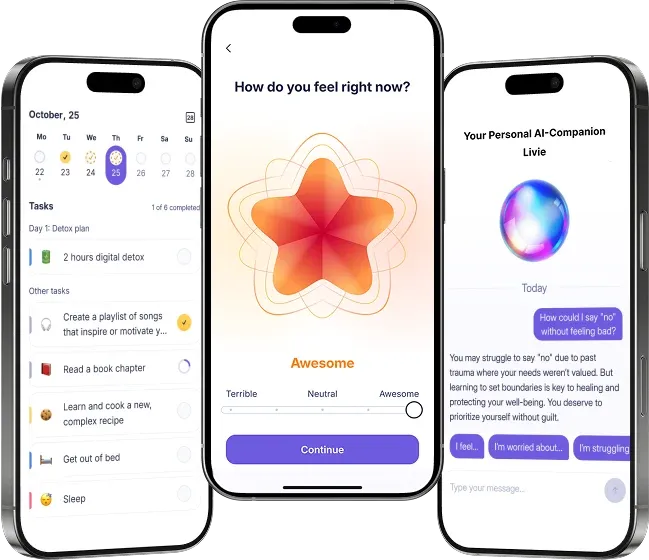
If you’d like support along the way, you can continue your self-discovery journey with Liven: try the Liven app (Google Play or App Store), explore more insights on the Liven blog, or learn more about your current mental health state with Liven’s free wellness tests.
References
- Cordaro et al. (2024). Contentment and self-acceptance: Wellbeing beyond happiness. J Happiness Stud, 25, 15. https://doi.org/10.1007/s10902-024-00729-8
- Desai et al. (2024). Holistic well-being and dopamine fasting: An integrated approach. Cureus, 16(6), e61643. https://doi.org/10.7759/cureus.61643
- Simplified in Short. (2025). Cognitive appraisal theory explained [YouTube]. https://www.youtube.com/watch?v=w7gkLbtC7SQ
- The Grateful Therapist. (2022). Body-mapping for anxiety [YouTube]. https://www.youtube.com/watch?v=V1XADChMNak
- Therapy in a Nutshell. (2024). How to stop beating yourself up [YouTube]. https://www.youtube.com/watch?v=fb8QJa7VHmE
FAQ: How to Understand My Feelings
Why do my emotional reactions feel so strong sometimes?
How can emotional awareness improve my relationships and mental health?
What are healthy ways to manage difficult emotions in everyday life?