Emotional Regulation Exercises to Use When Everything Feels Too Much



Reviewed by
Tara Passaretti, M.S., LMHC


Have you ever felt like a pot about to boil over? One more comment from your uncle at Christmas Eve dinner, one more passive-aggressive remark while decorating the tree, one more heavy sigh during gift shopping, and suddenly it feels like too much. You’re not alone in feeling this way.
According to Gallup’s latest report on global emotional health, more people now say they spent much of the previous day worrying, and over a third reported feeling stressed. We all experience intense emotions at times. Emotional regulation helps us communicate our needs more accurately and respond with intention rather than impulse.
Now, we’ll take a look at practices to build your emotion regulation skills and explain how to improve your emotional well-being over time.
Key Learnings
- Emotional regulation skills help reduce emotional overwhelm by calming the nervous system and creating a space between feelings and actions.
- Breathing exercises, grounding, and body scans reconnect you with your body and shift your physiological state.
- Cognitive behavioral techniques such as reframing and the S.T.O.P. method help you evaluate situations more realistically and prevent reactive behavior.
- Building emotional regulation is a gradual process supported by daily habits.
The Best Emotional Regulation Practices
“People have different comfort levels with various types of activities. Some find slower practices frustrating, while others feel overstimulated by fast-paced approaches. Learning new skills can take time, especially when we’re used to living in a culture that prioritizes constant productivity and staying busy.” — Tara Passaretti, M.S., LMHC.
However, if you find that certain emotional regulation practices continue to feel uncomfortable even after giving them a few tries, give yourself permission to set them aside and explore other strategies that feel like a better fit for you.
Breathing Exercises to Address Emotional Dysregulation
Breathing is one of the most effective emotion regulation skills that can bring immediate relief and promote our well-being in the long term.
- Sit comfortably and let your shoulders drop.
- Use the 4-7-8 breathing method. Inhale gently through your nose for 4 seconds. Hold your breath for 7 seconds. Exhale slowly through your mouth for 8 seconds. Think of the long exhale as telling your nervous system, “You’re allowed to relax now.” You can adjust or pick the mental phrase that suits your personality more.
- Pay attention to your emotions and where you feel tension release in your body. Repeat this for a few minutes.
- If the emotional response remains overwhelming, place your right hand on your heart and your left on your belly, and take a belly breath. This way, you send calming signals to your brain. It’s a small gesture that often reminds your brain you’re not alone.
- If a thought interrupts you, acknowledge it and return to your breath without judgment.
Grounding with the 5-4-3-2-1 Method
Emotions don’t exist in our minds apart from our bodies. They make up a complex system that works in unison. Grounding helps you come back to the present moment and reduce stress. View it as waking up from an overwhelming dream: you nudge yourself back to reality, not dwelling on the feelings. This emotion regulation strategy is commonly employed in Dialectical Behavior Therapy (DBT) to help the nervous system return to a state of calm.
Softly guide yourself through:
- 5 things you can see
- 4 things you can touch
- 3 things you can hear
- 2 things you can smell
- 1 thing you can taste.
Occasionally, people may find it grounding to direct attention toward lighthearted or positive stimuli, such as playful animals or joyful social interactions, while others respond better to calming natural environments. Focusing on these sensory experiences engages the parasympathetic nervous system, signaling to the body and brain that the environment is safe and promoting physiological regulation.
If you require additional assistance, please refer to the instructions and a video available on the University of Rochester's website.
Body Scan for Emotional Control
Let’s imagine a situation: you have just finished arguing with someone. All is good, and you think you’ve felt no emotions at all. Then, when you look at your hands, you notice that they are shaking. It’s one of the ways in which our body catches onto our feelings faster than we even recognize them.
When we don’t notice how our body feels, it essentially keeps the tension within. Our bodies store different emotions, including even the most positive ones. A simple body scan invites each part of you to release tension. This emotional regulation practice can be one of the most effective coping mechanisms for managing our emotional responses, soothing the nervous system, and promoting sleep and restfulness.
- Sit or lie comfortably.
- Take a few slow, deep breaths and begin to notice where you are holding tension in your body.
- Focus on each body part, from head to toe (or vice versa), and notice sensations without trying to change them.
- Finish with a few breaths, observing how your body feels overall.
Want to try more? We've gathered a few guided practices for managing emotions:
- 7-minute body scan meditation from Dr. Adam Rosen
- 9-minute body scan practice from Therapy in a Nutshell
- 30-minute body scan exercise from Ally Boothroyd.
Cognitive Reappraisal
One of the most powerful emotion regulation strategies in Cognitive-Behavioral Therapy (CBT) is cognitive reappraisal. It involves changing the way you perceive a situation to alter its emotional impact. Cognitive reappraisal helps you view a situation from a different perspective and see yourself within it more clearly.
By doing this, your brain can calm emotional reactions, helping you feel more in control and respond to stress in a balanced way. Example: Instead of thinking, “I messed up, I’m a failure,” you might reframe as “I didn’t get it right this time, but I can learn and improve.”
- Notice the thought that is increasing your current distress. Ask yourself, “Is this thought a fact or a feeling?” Listen to what your inner voice says. Evaluate what is happening in the moment and compare it with how you initially reacted.
- Offer a more balanced perspective. For instance, instead of “I can’t handle this,” try “This is hard, and I’m doing my best.”
- Repeat this new thought and listen to how it feels. Sometimes, a comment or situation that initially felt unpleasant can take on a more positive meaning over time. If the interpretation doesn’t feel quite right, you can adjust it to reflect your experience better.
Here are a few useful worksheets from Positive Psychology that you can print out and use whenever you feel overwhelmed:
The S.T.O.P. Method
Sometimes, all you can do is react fast before the situation escalates. This can be especially crucial if you are experiencing anger in the workplace or in a close family circle. One of the commonly used skills in DBT and CBT for mental health improvement, this emotional regulation method helps individuals check in with different emotions and act objectively.
- S – Stop. Pause for a moment, both your body and your thoughts. You can say “Stop” aloud or in your mind to make sure you don’t proceed.
- T – Take a breath. It’s just a small breath, but it is like taking the first step to a calmer state. It expands your lungs and feeds your brain with oxygen.
- O – Observe. Pay attention to what is happening in your body. What emotion do you feel? What thoughts emerge right now? This is mostly to check in with yourself, but it often coincides with external events.
- P – Proceed mindfully. Now that you’ve paused before reacting, you can think about an appropriate way to handle the situation. How do you want to respond now when the initial reaction has dulled?
Journaling to Express Yourself and Gain Clarity
Having the freedom to express ourselves on paper without anyone else noticing is a great opportunity to develop a safe space that belongs only to you. Journaling is a healthy emotional regulation strategy that enables you to process both unpleasant and positive emotions.
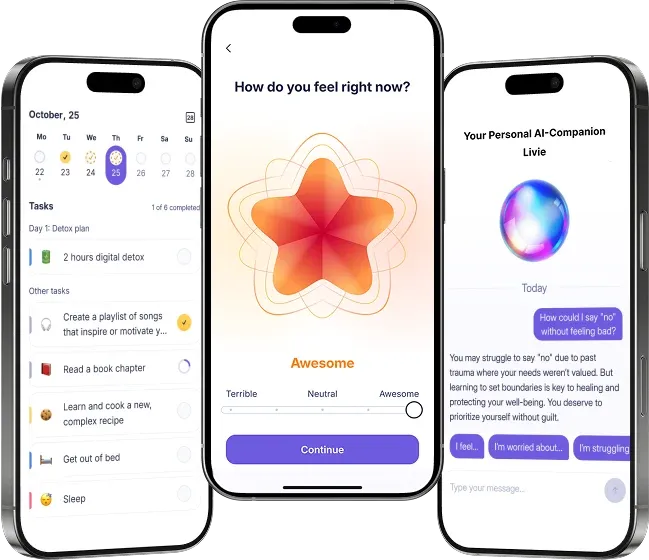
If you need to release strong emotions while maintaining healthy relationships, this practice can help you express yourself safely and constructively. Simply opening the journal function in the Liven app can give you immediate access to emotional self-regulation.
There’s no right or wrong way to journal about your feelings. You can approach expressive writing or journaling in different ways. Some people start by noting the events and the physical or emotional sensations that were triggered. Others begin with the feeling itself, letting it flow freely before reflecting on it later. Some may write passionately without revisiting the words, while others prefer to explore and reflect on the details of the situation thoughtfully.
Physical Expression of "Difficult" Emotions
Regulation activities take many forms, and this one involves expressing strong emotions physically. Feelings like anxiety directly affect our bodies. Most of these are for when no one is around, so you can let your body really feel it all and pour it out without a filter.
- Find a private, safe space. A bedroom, a car, a forest, the bathroom — anything that will give you a feeling of "privacy".
- Pick one of these or come up with what you feel is suitable for you:
- Punching a pillow
- Screaming into a pillow or blanket pile
- Shaking your arms or legs
- Tearing paper
- Crumpling a piece of paper with all your strength
- Pushing against the wall with both hands.
- Tell yourself: “I’m allowed to release this feeling safely.”
- Let the action be as messy and imperfect as possible. If you’re not comfortable expressing your emotions in this way, closing your eyes and focusing on the sensations in your body may be helpful.
- Stop when the feeling has finally settled. Take a deep breath and say: “The feeling has moved. I’m here now.”
Somatic exercises are immensely helpful for people who associate emotional regulation solely with cognitive change. Physical movement helps us handle our emotions effectively.
📚 If you're ready to explore more practical tips for expressing and regulating your emotions, check out this platform.
Emotional Wave Technique
Music is an underrepresented yet powerful way to regulate emotions, and it can be one of the most exciting strategies, appealing to both our senses and minds. Research repeatedly demonstrates that music is highly beneficial for emotional management and expression.
Choose one of two paths:
a. Ride the emotion (play music that matches what you feel)
b. Shift the emotion (start with matching music, then slowly transition to calmer tracks).
- Find a comfortable position. It can be sitting, lying down, or standing. You can always change the pose.
- Play the first song. Start with something familiar; we have a stronger emotional connection with songs we already know.
- Follow your body’s cues. It can be something simple, such as tapping, swaying, or humming in sync with the song. Some people start crying because the song they are listening to resonates with their emotions so deeply. Hug yourself or put a hand on your chest if you feel like it.
- If you want to shift your emotions toward something calmer, gradually adjust the music. For example, if you were angry and listened to a heavy metal track, you might shift to classic rock or rap to maintain the high rhythm while still giving you that adrenaline rush. Notice how your body reacts over time.
- After your emotions settle, sit in silence for a few minutes.
Here are a few playlists that you can try:
- It’s okay, calm down. This ambience is for days when you feel tired and lonely.
- Pov: your mental health is draining. This playlist acknowledges when we feel like we cannot move further.
- You’re starting to hate them. This compilation allows you to release all your anger by listening to these weirdly comforting beats.
- You have to find hope. Just as the title suggests, this one’s to rebuild your faith in the world.
- Summertime/Good mood playlist. It’s happy and will bring good vibes into your day.
Building Up Your Emotion Regulation Skills Over Time
It’s probably not surprising that the more stable our daily emotions are, the easier managing emotions becomes when something goes wrong. We can slowly build up our sense of safety by adopting a few emotional regulation techniques.
Mood and Trigger Tracking
People who track their emotions become more in tune with their feelings and manage them more effectively on a daily basis. It builds emotional awareness and a more informed self-perception.
Here’s what you can track for a deeper self-awareness:
- Each day’s general mood
- Any spikes or dips
- What happened before the shift (possible triggers)
- How you responded
- What helped afterward.
Patterns become clearer when you write them down. You may start noticing that certain environments, people, or events consistently affect you. Seeing the pattern helps us change the response.
Building Your Distress Tolerance
Distress tolerance refers to the ability to endure and survive emotional discomfort without exacerbating it, focusing on coping strategies and behavioral skills to manage emotional pain. Daily grounding and mindfulness exercises improve your distress tolerance over time. Check out these mindfulness practices from UHN.
Another step toward developing distress tolerance is to take on small, manageable challenges, such as sending a message you’ve been avoiding or starting a task for just 2 minutes. Speak softly to yourself when emotions rise: “This is my nervous system doing its best to protect me.”
A simple tool proposed by Dialectical Behavior Therapy (DBT), the Subjective Units of Distress Scale, helps individuals learn to recognize their ability to tolerate stress. You can explore how it works and get a worksheet here.
Are you unsure why you often feel overwhelmed and struggle to relax? This free test will help you create a personalized dopamine management plan and learn new regulation activities.
Creating Your Emotional Support Toolkit
Think of this as your own first-aid kit for your mind, body, and heart. It’s a collection of items, reminders, and sensory comforts that help you feel safe when you really need a recharge.
Find a box or container that can house all the items you’d like to include. It can be:
- A soft blanket or sweater
- A favorite book or poem
- A calming scent or essential oil
- Soul-warming photos
- Snacks or tea that bring you comfort.
For more ideas and inspiration, you can watch this creator’s video, which provides detailed explanations of each item. Keep this toolkit in one place. When something goes wrong, create a comfortable space using these tools.
With Calmer Mind, Stronger Heart
Changing the way you regulate your emotions isn’t always easy. Similar to learning a new language, it takes practice and self-compassion. What can help? Reminding yourself that success isn’t “I never feel stressed” but “I feel less stressed from day to day.” It’s celebrating every calm day and smiling just a bit more. It’s about trying one exercise and taking pride in having done it.
References
- de Bruin, E. J., Meijer, A., & Bögels, S. M. (2020). The contribution of a body scan mindfulness meditation to effectiveness of internet-delivered CBT for insomnia in adolescents. Mindfulness, 11(4), 872–882. https://doi.org/10.1007/s12671-019-01290-9
- Coker, S. D. (2023). What adult educators can do to assist traumatized adults learn. New Horizons in Adult Education and Human Resource Development, 35(4), 183–185. https://doi.org/10.1177/19394225231213143
- Corrigan, F., Fisher, J., & Nutt, D. (2010). Autonomic dysregulation and the window of tolerance model of the effects of complex emotional trauma. Journal of Psychopharmacology, 25(1), 17–25. https://doi.org/10.1177/0269881109354930
- Khng, K. H. (2023). Deep breathing and mindfulness: Simple techniques to promote students’ self-regulation and well-being from the inside out. Positive Education, 311–325. https://doi.org/10.1007/978-981-99-5571-8_17
- Malhi, G. S., Hamilton, A., Morris, G., Mannie, Z., Das, P., & Outhred, T. (2017). The promise of digital mood tracking technologies: Are we heading on the right track? Evidence Based Mental Health, 20(4), 102–107. https://doi.org/10.1136/eb-2017-102757
- Moore, K. S. (2013). A systematic review on the neural effects of music on Emotion Regulation: Implications for Music Therapy Practice. Journal of Music Therapy, 50(3), 198–242. https://doi.org/10.1093/jmt/50.3.198
- Phang, K. C., Keng, L. S., & Chiang, C. K. (2014). Mindful-S.T.O.P.: Mindfulness made easy for stress reduction in medical students. Education in Medicine Journal, 6(2). https://doi.org/10.5959/eimj.v6i2.230
- Picó-Pérez, M., Radua, J., Steward, T., Menchón, J. M., & Soriano-Mas, C. (2017). Emotion regulation in mood and anxiety disorders: A meta-analysis of fMRI cognitive reappraisal studies. Progress in Neuro-Psychopharmacology and Biological Psychiatry, 79, 96–104. https://doi.org/10.1016/j.pnpbp.2017.06.001
- Samokhval, V. (2025a, May 22). The physical symptoms of anxiety: Understanding the body’s response. The Liven. https://theliven.com/blog/wellbeing/anxiety/how-anxiety-affects-the-body-the-physical-symptoms
- Samokhval, V. (2025b, July 29). Anger in the workplace: Strategies to stay calm and professional. The Liven. https://theliven.com/blog/wellbeing/anger-management/anger-in-the-workplace-professional-strategies-to-stay-calm
- State of the World’s Emotional Health 2025. Gallup. (2025). https://www.gallup.com/analytics/349280/state-of-worlds-emotional-health.aspx
- Thoma, M. V., Ryf, S., Mohiyeddini, C., Ehlert, U., & Nater, U. M. (2011). Emotion regulation through listening to music in everyday situations. Cognition and Emotion, 26(3), 550–560. https://doi.org/10.1080/02699931.2011.595390
- Willard, C. (2024, December 16). A quick, calming body scan to check in with yourself. Mindful. https://www.mindful.org/a-quick-calming-body-scan-to-check-in-with-yourself/
- Wilson, E. (2025, April 2). Using DBT techniques for effective stress management. Elizabeth & Associates, LLC. https://elizabethassociates.org/using-dbt-techniques-for-effective-stress-management/
FAQ: Emotional Regulation Exercises
What are emotional regulation skills, and why are they important?
How do I start improving my emotional regulation in daily life?
What causes emotional dysregulation or poor emotion regulation?
What are some effective emotion regulation strategies I can use when emotions feel overwhelming?
How can emotional regulation help my relationships?
Can improving emotional intelligence actually improve emotion regulation?
What should I do if my emotions regularly feel too intense or unmanageable?