Emotional Awareness Exercises: A Simple Guide to Understanding Yourself


How often has it happened that you felt something but couldn’t find the right words to describe the feeling? Or how often did you ignore your emotions and not manage to recognize your needs in time, only to end up angry, frustrated, and exhausted?
The skill that helps you prevent those moments is called emotional awareness, which is the ability to notice what you feel, understand why you think it, and recognize what you need.
Below, you’ll find simple emotional awareness exercises that teach you how to notice physical sensations, identify your feelings, and reflect more deeply on your emotional experiences.
Key Learnings
- Emotional awareness is a skill that grows with daily practice.
- Reflection exercises provide valuable insights into triggers and needs.
- Utilizing technology tools like apps can support the development of emotional awareness in daily life.
🧘🏽♀️ Mindfulness Exercises for Emotional Awareness
These exercises help you recognize how both positive and negative emotions reside within your body and develop emotional awareness through the mind-body connection.
Body Sensation Scan
Best works for/when: You feel disconnected from your body
This Mindfulness-Based Stress Reduction (MBSR) technique is based on the idea that one can cultivate self-awareness by learning to stay present in the moment and observe physical sensations.
It’s a simple practice where one moves their attention slowly through the body, all while noticing sensations such as warmth, tension, tingling, and heaviness.
When you understand how emotions manifest in your body, you can recognize the early signs (such as a tight jaw or clenched stomach) and express them healthily.
How to Implement as a Beginner
- Lie down comfortably and close your eyes.
- Take a few slow, deep breaths to calm down.
- Start at your feet and move upward very slowly.
- For each body area, pay attention to the sensations.
- If your mind wanders, gently redirect your attention with compassion.
- Notice your overall emotional state in the end.
Emotion-to-Body Mapping
Best works for/when: You want to see where emotions reside in your body or notice patterns related to chronic pain, tension, or stress
This exercise helps you learn which body areas you associate with different emotions. For instance, you might feel anxiety in the stomach or shame in the throat.
How to Implement as a Beginner
- Print or draw a simple outline of a body.
- Choose an emotion (you can start with the basic ones: anger, fear, sadness, joy, disgust, and surprise).
- Close your eyes and recall a time you felt it. Where did it show up in your body?
- Choose a color you associate with this emotion and color/mark those areas on the body map.
Every time you find it difficult to name the emotion you’re experiencing in the moment, you can grab the map, focus on where the sensation is strongest, and use that body cue to find the closest emotional match.
Micro-Sensation Check
Best works for/when: You want tiny, doable emotional awareness exercises on busy days
A Micro-Sensation Check is a short pause where you notice micro-level physical sensations for 5–10 seconds. It helps you reconnect with your body, ground yourself, and identify your needs. For example, in the moment, you might experience hunger but suppress the signal because you’ve got a lot of work on your plate (pun intended).
How to Implement as a Beginner
Do the exercise a few times per day. You can even set a phone or a sticky-note reminder for that.
- Pause for 5–10 seconds.
- During that time, close your eyes, take a few deep breaths, and focus on the following 3 sensations: heartbeat, breath, and muscle tone.
- Label the sensations and ask yourself what your needs might be. For instance, a fast or pounding heartbeat may indicate that you are overworking yourself, while stiff muscles can signal tension, stress, or the need for a short break.
- Continue with your day.
📚 Extra Resources for Your Journey
- Apps like Headspace and Calm can be beneficial for beginners who need guidance. An app like Aura is also a good tool if you’re looking for extra-short micro-meditations on busy days.
- Body mapping tutorials on YouTube.
- The Body Keeps the Score by Bessel van der Kolk. The book explains how trauma and stress live in your body and why body-based techniques are essential for healing.
🌱 Emotion Identification Exercises
These exercises help you identify the underlying emotion driving your reaction, even when it seems subtle or unclear.
The “Name It to Tame It” Exercise
Best works for/when: Your emotions are overwhelming or confusing in the moment
Perhaps it's one of the most popular exercises in psychology, originating with psychiatrist Dr. Dan Siegel. According to this leading expert in interpersonal neurobiology, when we label emotions, our amygdala (the area in the brain responsible for emotional intensity and threat response) becomes less activated, while the prefrontal cortex (your reasoning center) steps in and helps you think more clearly.
How to Implement as a Beginner
- Pause when you notice physical sensations or changes in mood.
- Ask yourself: “What am I feeling right now?”
- Choose the most accurate emotion label you can, such as “I feel anxious,” “I feel frustrated,” “I feel relieved,” etc.
- Say it out loud or write it down.
The “3 Whys” Exercise
Best for: You want to identify the trigger for the emotion you’re feeling
This exercise is used in modern emotional awareness training to help one uncover their hidden beliefs, personal sensitivities, and unspoken needs.
How to Implement as a Beginner
Once you feel your reaction is “too big for the situation” and you want to gain some self-control, pause and ask yourself, “Why am I reacting to this?” Ask yourself 2 more times.
For example, you feel disproportionately upset when your partner leaves dishes in the sink:
- Why? → “Because I feel disrespected.”
- Why? → “Because I already feel overwhelmed today.”
- Why? → “Because I’ve been neglecting rest and feel at my limit.”
The Emotion Wheel
Best works for/when: You want to expand your emotional vocabulary and become more mindful of your emotional state
This exercise is based on the idea that there are basic emotions, each accompanied by more nuanced sub-emotions.
How to Implement as a Beginner
- Print or open a digital Emotion Wheel.
- Notice how you feel in the moment.
- Scan the wheel for words that resonate.
- Pick the closest match.
- Optional: Combine with the “3 Whys” exercise and track it in your journal.
📚 Additional Resources for Your Journey
- Another Emotion Wheel, which explains how you might feel the emotion and the best ways to manage it.
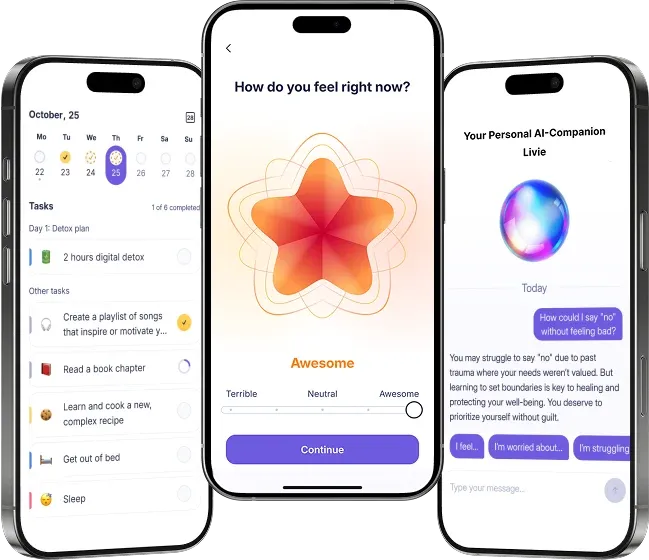
- Mental health apps like Liven that help you track your emotions throughout the day and spot patterns in triggers and behaviors.
- Permission to Feel by Marc Brackett. The book teaches you how to recognize and process emotions.
💭 Reflection & Insight Exercises
Reflection exercises help you slow down, understand why you feel the way you feel, and dive even deeper into emotion & trigger analysis.
Journaling Prompts for a Specific Purpose
Best works for/when: You want a structured way to explore your emotions
Today, many therapeutic approaches, such as cognitive-behavioral therapy (CBT), dialectical behavior therapy (DBT), and acceptance and commitment therapy (ACT), incorporate journaling as a tool for insight and emotional processing.
Journaling is also a great way to reduce anxiety (especially gratitude journaling) and notice patterns in your emotional experiences.
Meanwhile, structured journaling prompts, such as those below, help avoid “blank page paralysis” and gently lead you into a reflection on a specific topic.
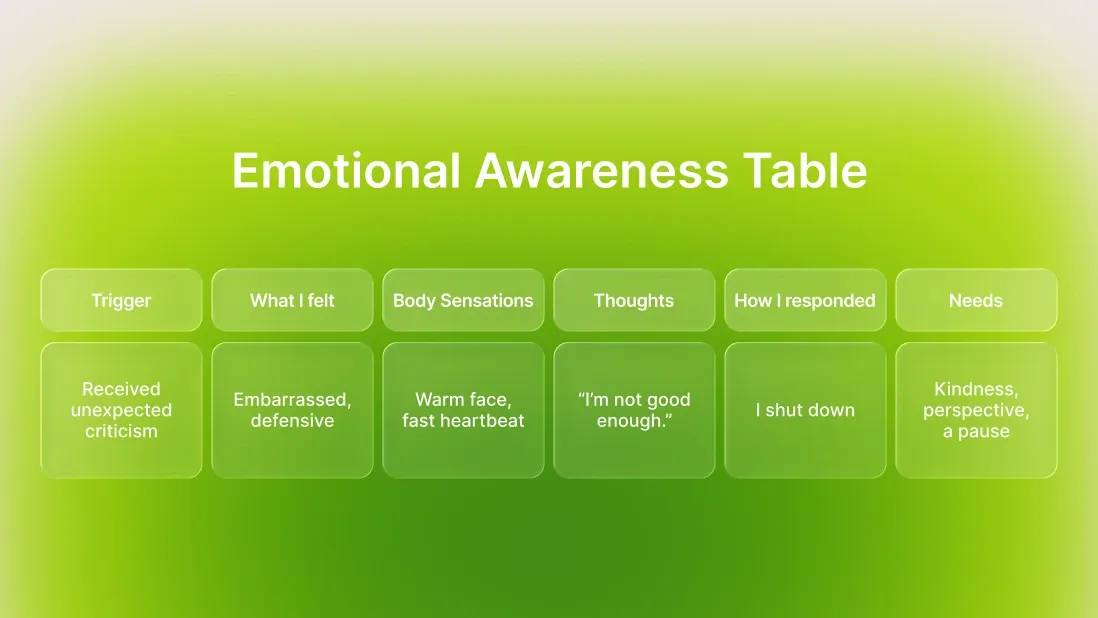
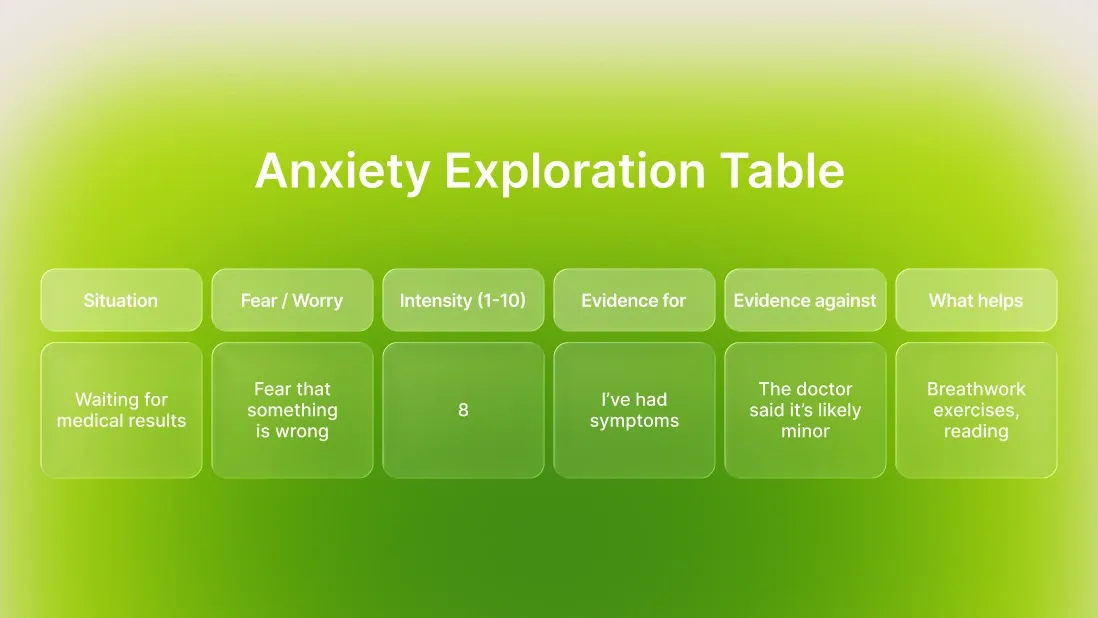
For example, here are a few examples of table prompts that you can use:
Emotional Awareness Table
Anxiety Exploration Table
Low Mood Prompt
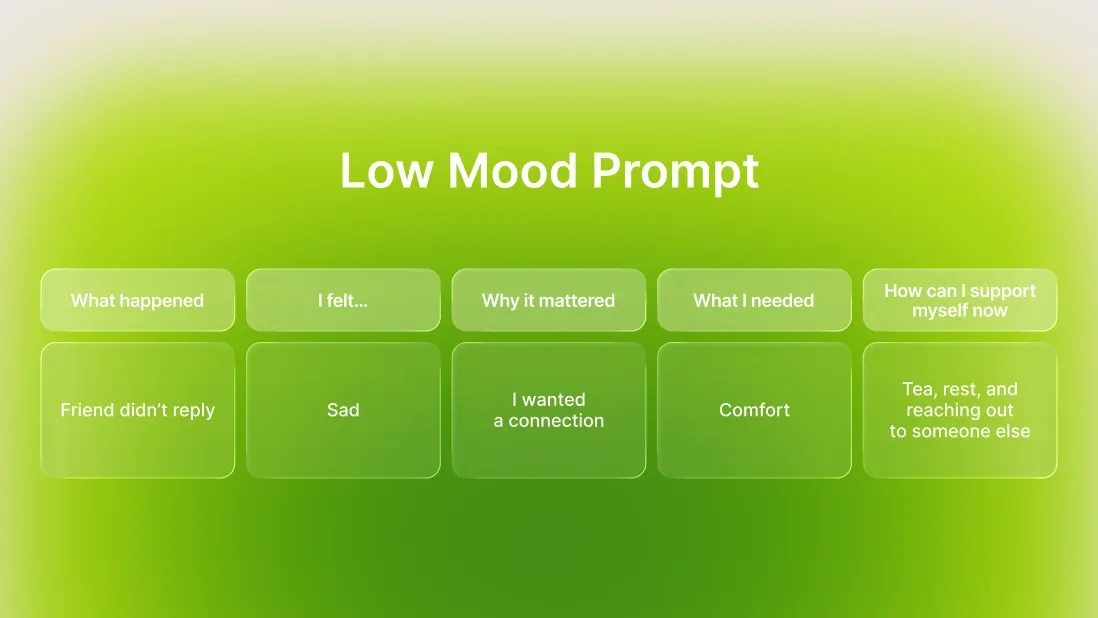
How to Implement as a Beginner
- Pick one purpose (anxiety, anger, relationship management, confidence, etc.)
- Choose 1–2 prompts only.
- Set a 10-minute timer.
- Write without editing. Let the thoughts flow naturally.
The “Unsent Letter” Exercise
Best for/when: You need to process strong emotions such as anger, grief, or resentment when directly communicating them is risky, overwhelming, or impossible
Widely used in Gestalt therapy, narrative therapy, and grief counseling, this “letter” exercise creates a safe container for one’s complex emotions.
How to Implement as a Beginner
- Address the letter to the person (or part of yourself).
- Write freely for as long as you need.
- Don’t hold back — this letter is private.
- End with: “What I needed was…”
- Optional: burn the letter, save, or ritualize the closing.
HALT Exercise
Best works for/when: During stressful situations or impulsive reactions
HALT (Hungry, Angry, Lonely, Tired) originated as an exercise in addiction recovery programs. Today, it’s a popular short exercise widely used in psychology that can help you check whether physical or basic emotional needs are driving your state.
How to Implement as a Beginner
- Pause. Take deep breaths.
- Ask yourself: “Am I Hungry? Angry? Lonely? Tired?”
- Address the need.
- Re-evaluate your emotional state afterward.
📚 Additional Resources for Your Journey
- Add some narrative writing exercises and learn more about the concept of “narrative identity,” aka “the story you tell yourself.”
- Listen to the soothing podcast “The Wise Heart of Radical Acceptance” by Tara Brach.
- Try mental health tools like Liven for self-care and support. You can create your personalized dopamine management plan, schedule regular self-care activities, build your own "dopamine menu", set up a healthy morning routine, and get guidance on how to support yourself on tough days — all in one app.
Emotional Self-Awareness Exercises: Which One Do You Need?
| Exercise | Ease | When / Context | Type of Benefit |
| Body Sensation Scan | Easy | Feeling disconnected or tense | Grounding + awareness |
| Emotion-to-Body Mapping | Moderate | You want to find patterns in emotions | Improved mind-and-body connection |
| Micro-Sensation Check | Very easy | Busy, stressed moments | Fast grounding |
| Name It to Tame It | Very easy | Overwhelmed or confused | Emotional regulation |
| 3 Whys | Easy | Reaction feels “too big” | Insight + clarity on your needs |
| Emotion Wheel | Easy | You don’t know what you feel | Improved self-awareness |
| Journaling Prompts | Moderate | Need structured self-reflection | Insight + processing |
| Unsent Letter | Moderate | Anger, grief, resentment | Deep emotional processing |
| HALT Check | Very easy | You feel irritable, impulsive, reactive | Improved clarity on needs |
How to Build Your Own Emotional Awareness Routine
Here is how to do it easily without long sessions or complicated techniques.
1. Choose 1 or 2 exercises to focus on.
Start small. No need to do all the exercises, as there is a risk you’ll get overwhelmed and will want to quit it all.
2. Make things easier with automation.
Automation helps you build habits that last. For instance, a standard mental health app like Liven comes with:
- Mood Tracker allows you to track your mood and triggers. Later, automatically creates a detailed mood analysis;
- Journaling feature — journal your reflections with prompts in one place;
- Dopamine Routine Builder helps you choose and schedule activities for self-care time, healthy morning routines, tough days, and more. This, in turn, enables you to stay consistent with your habit building.
3. Combine exercises for more benefits.
You can pair exercises to amplify their effects. For instance:
- Micro-Sensation Check + HALT = Notice physical signs + meet your basic needs before reacting;
- Journaling Table + 3 Whys = Explore emotions and uncover triggers in one session;
- Emotion-to-Body Mapping + Name It to Tame It = Spot where the emotion shows up and label it to reduce overwhelm.
4. Bundle your emotional self-awareness exercises into existing routines.
For instance:
- Journal in the morning while drinking your cup of coffee.
- Make a body scan a part of your bedtime routine.
- Check in with the Emotion Wheel during your lunch break.
5. Track your progress.
Keep track of your practice to notice improvements — this will help you stay motivated and confident, and identify areas that might need fine-tuning. For instance, you might feel that journaling in the morning puts you in a rush and decide to move it to the evening routine, and spot emotional patterns you might otherwise miss (like recurring triggers or weekly mood cycles).
Tools that might help to track your progress include:
- Mood trackers (Liven, Daylio, Moodflow)
- Emotion journals (paper journal or digital notes)
- Body awareness logs (simple weekly check-ins on tension, pain, or fatigue)
- Progress reflection prompts (such as “What helped me stay grounded this week?”)
- Trigger logs (quick notes about what set off emotional reactions; often a part of mood trackers if you’re using apps like Liven)
- Weekly or monthly review templates
- Habit trackers (Notion, TickTick, Habitica).
A Gentle 4-Week Emotional Awareness Starter Plan
| Week | Main Focus | Daily Exercise | Optional Add-Ons |
| Week 1 | Start becoming aware of emotions + physical sensations | 2–3 daily micro check-ins: “What am I feeling? Where in my body?” | • Mood tracker (a few times per day) • 2-min body scan before bed |
| Week 2 | Dive deeper into building mind-and-body awareness | 5-10 min with the Emotion Wheel and Emotion-to Body Mapping | • Add soundscapes to your body scan sessions • Try other guided mindfulness practices for beginners (apps like Calm and Aura can help) |
| Week 3 | Collect & Understand triggers | 2-3 daily HALT checkins + “3 Whys”, especially when feeling overwhelmed | • Log your triggers throughout the day |
| Week 4 | Identify patterns | Add 10 minutes of reflective practices like journaling | Continue exploring new approaches or sticking to the ones you liked + plus learn more about the next step — emotional regulation |
When to Look for Professional Help
Sometimes, self-practice is not enough, and that’s totally okay. The key is to recognize when:
- You can’t function the way you used to because negative emotions feel too overwhelming and persistent.
- Emotional patterns lead to repeated conflicts or relationship challenges.
- You feel stuck despite consistent practice.
Please don't be ashamed to ask for help, as we all need support from others from time to time. A therapist can teach you how to manage emotions and, over time, develop emotional awareness skills that last.
Final Thoughts
These exercises help you build a more grounded sense of self and develop emotional intelligence from the inside out. The key is to stay patient, see what works for you, and what needs some fine-tuning.
If you'd like to deepen your practice, continue your self-discovery journey with Liven: explore the Liven app (Google Play or App Store), read more insights on our blog, and check in with yourself through Liven’s free wellness tests.
References
- Brach, T. (2023). The wise heart of radical acceptance [Video]. YouTube. https://www.youtube.com/watch?v=-jUAw5KnghM
- Brainwaves Video Anthology. (2019). Marc Brackett – Permission to feel [Video]. YouTube. https://www.youtube.com/watch?v=vmgp6itRTNw
- Coolout. (n.d.). Interactive emotions wheel. https://www.coolout.co/interactive-emotions-wheel
- Curtis, R. (2023). Therapeutic questions of narrative therapy [Video]. YouTube. https://www.youtube.com/watch?v=wriYwd_ncLw
- Hema, M. (2024). The role of gratitude journaling in enhancing mental well-being. Unified Visions, 131. https://www.researchgate.net/profile/Sanjay-Prasad-12/publication/386157268_UNIFIED_VISIONS/links/6746d750a7fbc259f191cb71/UNIFIED-VISIONS.pdf#page=140
- Kolk, B. van der. (2023). How the body keeps the score on trauma [Video]. Big Think+. YouTube. https://www.youtube.com/watch?v=iTefkqYQz8g
- Marks, T. (2024). The story you tell yourself: Understanding your narrative identity [Video]. YouTube. https://www.youtube.com/watch?v=jyyFfQAw9as
- McGill Counselling. (n.d.). The feelings wheel. https://mcgillcounselling.com/feelings-wheel/
FAQ:Emotional Awareness Exercises: A Simple Guide to Understanding Yourself
What are the benefits of practicing emotional awareness exercises daily?
How does emotional intelligence improve interpersonal relationships?
What does emotional intelligence refer to?
How can I develop emotional awareness if I’m starting?
Can emotional intelligence activities benefit the workplace?
How do emotional intelligence exercises support self-growth?
How do emotional intelligence skills help with decision-making?
Why is self-management important for emotional well-being?