



Cultural norms often encourage us to suppress or mask difficult emotions. For example, a recent study in the UK has found that around 64% of individuals admitted to “putting on a brave face” to avoid talking about their mental health. Surprisingly, younger generations are experiencing this more than their parents or grandparents.
Although results vary from place to place, the trends remain relatively similar: people try to avoid uncomfortable emotions, but every emotion has a purpose. Sometimes, we try to stay positive and hide complex feelings. Today, toxic positivity is on the rise: 68% of people admit to experiencing toxic positivity from someone during the recent week. We try to “power through” for the sake of a tough career period, winter holidays, or a relationship.
However, this can lead to long-term mental, emotional, and physical difficulties. When we learn to process emotions in a healthy way, we allow ourselves to experience the full scope of life, embracing its fragility.
Key Learnings
- All emotions, even including so-called negative ones (such as anger, guilt, shame, fear, and sadness), serve adaptive purposes, such as signaling threats, motivating problem-solving, or guiding social behavior; all feelings are valid.
- Healthy emotion management involves naming the feeling, validating it, listening to the message behind it, allowing the body to experience it, and reflecting on it.
- Suppressing emotions keeps the nervous system in a state of stress, whereas mindful acknowledgment promotes psychological flexibility and recovery.
How Are Emotions Created?
Before we talk about managing emotions, especially during the holiday swirl, let’s take a moment to understand how emotions are actually created in the brain. When we know what’s happening inside, it becomes much easier to work with what we feel, rather than fighting it.
Emotions originate in our brain, but they are also shaped by our senses and thoughts. You may have heard of the CBT Triad, which explains the connection between our thoughts, feelings, and behavior. Let’s imagine that you had an unpleasant conversation with one of your colleagues, and it made you think that they don’t really like you. The moment a thought forms as a response to the situation, it can influence our emotions. We become worried and angry, yet the thought precedes the emotion.
So, the first step in this process is the reaction of our limbic system to what is happening. When it detects the trigger, such as our thought, it sends signals to our nervous system. As a result, our body responds with physical cues, such as a rapid heartbeat, a tight stomach, or chest tightness (depending on the situation). After that, our mind labels these sensations based on context and past experiences.
Our experiences also shape how we view the world and the coping mechanisms we choose. For example, childhood experiences affect our anger patterns, and our past relationships can make us sad even on a randomly good day. Some treatment strategies, such as Dialectical Behavior Therapy (DBT), suggest that we need to develop new experiences to form new associations with the same triggers.
Sometimes, our unpleasant feelings can result from dopamine dysregulation. If you’re curious to understand what’s going on beneath the surface, you can take this short quiz and explore your personalized dopamine management plan.
How to Manage Your Emotions Step-by-Step
Many people are never taught how to process their emotions effectively. Instead, we're forced to regulate and told to "calm down or control ourselves," but by doing so, we skip a vital step. These suggestions often overlook the most crucial part — the one where we actually accept, experience, and understand what difficult feelings mean.
Below is a simple coping process you can return to whenever you feel emotionally overwhelmed — this emotional regulation approach will reduce your worry naturally, whether that’s after a tough conversation, a wave of sadness, or stress that hits during the holidays.
Step 1. Notice and Name the Feeling
Always begin with awareness. Quite often, we go through our lives without noticing our feelings, leaving them unexpressed in our bodies. When you name your emotions (for example, “I feel sad,” “I feel good”), you activate the prefrontal cortex, which is a part of your brain that is responsible for language and regulation.
Psychologists call this affect labeling, and studies show it lowers activity in the amygdala, the brain’s emotional alarm system. However, we’d like to pause here for a moment — there’s much that is still unknown about how naming our emotions helps us manage them.
In Narrative Therapy, naming the problem is one of the first steps. Naming the feeling/emotion is part of emotional meaning‑making: when a person articulates “I feel frustrated,” they can separate themselves from the story, see the emotion, and begin to reshape their narrative.
Sometimes we try to intellectualize our feelings. Dana Dozzyy, a Nervous System Practitioner, notes that most people who use “difficult” words to describe unpleasant emotions do so to avoid what they truly feel. She suggests using simple phrases to focus on the raw experience of your emotions. For example, say things like, “I feel hurt” and explain your physical sensations in a similarly plain way.
Step 2. Validate Intense Emotions Without Judgment
We usually jump to discarding our feelings or try to “label” them in some way. Although it gives us temporary relief, it also stops us from processing. All emotions, even the ones society names as “negative,” are valid and exist for a reason. Validating yourself doesn’t mean you have to act on your feelings or agree with them. It just means noticing and accepting them.
When you tell yourself, “It’s okay that I feel this,” you create a sense of psychological safety by giving yourself permission to feel your emotions. While we deny our feelings or try to evaluate them, we stay in the avoidance loop. The moment we let go is when we let go of the suppressed tension, fear of being judged, or repressed anger.
Here’s an example of validating your emotions during the busy holiday season:
“It makes sense, I feel drained after spending time with that family member all day. I am on edge because we have been discussing some uncomfortable topics. That doesn’t mean I don’t love them.”
Some other phrases to validate yourself:
- Understandably, I feel this way.
- I don’t need to change this feeling or do anything with it.
- This feeling provides me with insight into this situation.
Step 3. Listen to the Message Behind Difficult Emotions
Our emotions are our reactions to things that we care about. In her TED Talk about emotional courage, Susan David explains that emotions present our core beliefs:
“Our emotions contain flashing lights to things that we care about. We tend not to feel strong emotion to stuff that doesn’t mean anything in our worlds. If you feel rage when you read the news, that rage is a signpost, perhaps, that you value equity and fairness — and an opportunity to take active steps to shape your life in that direction.”
So, for this step, ask yourself, “What is this emotion trying to tell me?” It doesn’t mean you will always have the answer immediately; sometimes it can take days to figure out what’s affecting you. Simply grow and nourish curiosity inside.
Step 4. Let the Body Feel
We experience our emotions physically. Have you ever felt like the days when you had to mask your feelings, body aches, and pains? That’s your body’s way of telling you it has stored your negative/unhelpful emotions.
Find a safe, restorative way to let your feelings move through your body. When you add physical movement to the situation, you complete what’s known as the stress response cycle, which discharges excess adrenaline and cortisol. Studies repeatedly show that physical activity helps people better regulate their emotions.
Important note: don’t overdo it, as too strenuous activity can instead increase your stress levels.
Try this: After feeling emotionally charged, do something grounding, such as deep breathing, body scanning, taking a slow walk in cold air, practicing a breathing exercise, or holding something warm in your hands.
Step 5. Reflect
While we often prefer to move on, taking time to pause and reflect helps us manage our emotions for longer. Take a moment to pause, notice your thoughts and feelings, and give your emotions a name. Observe them without trying to fix or suppress them.
Why “Negative” Emotions Surface More During Winter Holidays
Despite what we might expect, winter holidays are among the most stressful periods of the year, according to at least 28% of Americans and more than 30% of Brits. It’s not surprising — despite often being called “the best time of the year” in countless songs and movies, these periods are also the most demanding. We try to deal with job demands, control our spending, and make most people in our lives happy. Here are a few reasons why that happens, in more detail.
The Weight of Reflections for Mental Health
Let’s be honest: winter time is also a time for New Year’s resolutions and reflection. We start contemplating what worked this year and what didn't. We revisit our regrets and memories. When combined with more days of solitude, this can lead to distorted thinking.
The Harmful Ways of Forced Joy
From Home Alone, the world classic, to songs about Santas and reindeer in the night sky, Christmas has become not just one of the most monetized holidays but also “the happiest.” Everyone is supposed to be smiling and buying each other gifts, and being anything but seems wrong. It’s one of those times when our pseudo-positive coping backfires.
If we don’t feel the same joy as others, we experience emotional dissonance. It’s when the feelings we have don’t quite match the ones we are “supposed” to have. A writer Brittany Ann beautifully and melancholically recounts her thoughts:
“While I love to give gifts to loved ones, the thought of not picking out the perfect one makes me want to burst into tears. So, I always go overboard. And when I log on to my social media handles and see couples going on holiday outings, I realize how alone I actually feel.”
People Deal With Old Memories
We carry our memories with us. And although they tend to sometimes vanish into the background, they can reemerge when we meet family, an old friend, or ex-partners. Even positive meetings can stir complicated feelings. That’s why we can feel “too much” around the holidays: we react not to the specific day in the present but a combination of things that have happened to us before.
It’s Environment and Biology
People often become more depressed during the colder seasons due to shorter days and reduced sunlight. Whether we are experiencing common winter sluggishness or seasonal affective disorder, the lack of sunlight is the primary reason for both. This affects our serotonin levels and circadian rhythm.
Tools for Emotional Regulation
It’s easier to process your emotions when you have various tools at your fingertips already. This way, you won’t need to look for them later on when you face the emotion itself.
Apps and Online Tools
Technology can support you by offering near-immediate answers, which can be decisive in some cases.
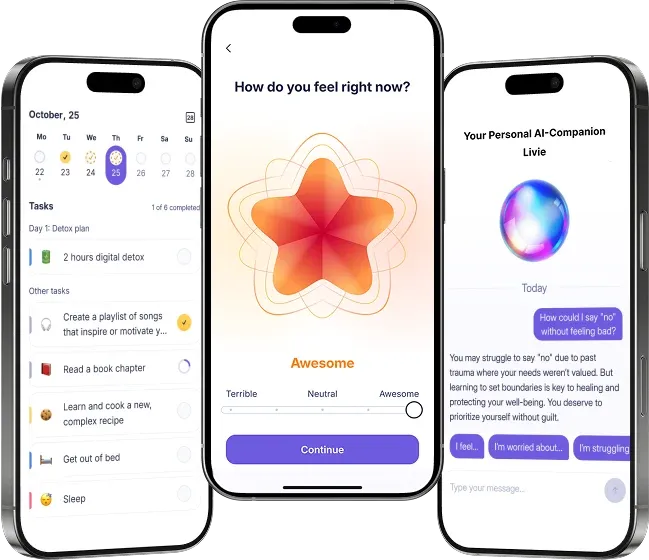
- Liven’s Mood Tracker. Liven has a feature called Mood Tracker that allows users to keep unlimited daily mood logs, listing their mood and adding details about the surrounding circumstances. Does your worry get more intense when you meet a particular person? Perhaps it is time to investigate the matter.
- How We Feel. This app is designed to help people understand their feelings in a simple yet relaxing way.
- Moody. It is an intuitive mood tracking and journaling app. Includes statistics with insights, too.
Emotional Awareness Tools
These tools help you identify emotions and practice awareness.
- Emotion Wheel. A classic and powerful starting point, the Emotion Wheel has many versions. It usually maps out various emotions and helps you get a more nuanced result. Here’s Plutchik’s Wheel, featuring interactive elements and instructions for its use.
- Emotional check-in cards. Having regular emotional check-ins is valuable. Canva’s templates allow individuals to better visualize and express their emotions — while mostly tailored to children, they can be edited and are also helpful for adults.
- Emotional journal. Journaling benefits our emotional awareness. Here’s an example of a paper journal specifically designed to help build this skill.
- Emotion log. Here’s a template for describing the situation that triggered your emotions. Please refrain from using it while you are still in the active feeling stage if your goal is to learn how to express your emotions without immediately overanalyzing them.
Playlists for Emotional Processing
We underestimate the value of music for emotional processing, says Ethan Kross, a psychologist and an expert on emotions. Listening to music is immensely helpful when we need to express our feelings rather than suppress them. While each taste is different, we’ve prepared playlists for different emotions in case you need them:
Problem Solving Starts From Acceptance
Emotions aren’t something that we need to struggle with. They are our guiding lights in the world, where things can sometimes get messy and overwhelming. Although it takes time to learn how our minds and bodies express feelings, it also gives us the power and knowledge to respond to situations in ways that feel right.
References
- Ann, B. (2022, November 23). Holiday depression: My story and tips to cope. Bezzy Depression. https://www.bezzydepression.com/discover/dep-living-well/health-this-is-how-i-keep-my-depression-in-check-during-the-holidays/
- Colella-Graham, C. (2024, August 12). The rise of toxic positivity, and what you can do about it. Forbes. https://www.forbes.com/councils/forbeshumanresourcescouncil/2022/08/10/the-rise-of-toxic-positivity-and-what-you-can-do-about-it/
- Geddes, L. (2025, November 2). How scientists are shining light on the biology behind seasonal affective disorder. The Guardian. https://www.theguardian.com/society/2025/nov/02/how-to-beat-the-winter-blues-seasonal-affective-disorder
- Golshani, S., Najafpour, A., Hashemian, S. S., Goudarzi, N., Shahmari, F., Golshani, S., Babaei, M., Firoozabadi, K., Dürsteler, K. M., Brühl, A. B., Shakeri, J., Brand, S., & Sadeghi-Bahmani, D. (2021). When much is too much—compared to light exercisers, heavy exercisers report more mental health issues and stress, but less sleep complaints. Healthcare, 9(10), 1289. https://doi.org/10.3390/healthcare9101289
- Hall, A., Gregg, L., O’Ceallaigh, B., & Wittkowski, A. (2025). Transdiagnostic patient experiences of dialectical behavioural therapy: A systematic review and metasynthesis. Frontiers in Psychiatry, 16. https://doi.org/10.3389/fpsyt.2025.1640341
- UK hiding behind a “brave face” to avoid speaking about mental health. Mind. (2024). https://www.mind.org.uk/news-campaigns/news/uk-hiding-behind-a-brave-face-to-avoid-speaking-about-mental-health/
- Levy-Gigi, E., & Shamay-Tsoory, S. (2022). Affect labeling: The role of timing and intensity. PLOS ONE, 17(12). https://doi.org/10.1371/journal.pone.0279303
- Nook, E. C., Satpute, A. B., & Ochsner, K. N. (2021). Emotion naming impedes both cognitive reappraisal and mindful acceptance strategies of Emotion Regulation. Affective Science, 2(2), 187–198. https://doi.org/10.1007/s42761-021-00036-y
- Normand-Widmer, C. (2025). The power of authentic emotional expression: A therapist’s perspective. Compassionate Inquiry. https://compassionateinquiry.com/2025/01/the-power-of-authentic/
- One quarter of Americans say they are more stressed this holiday season than in 2023, citing Financi. American Psychiatric Association. (2024, November 25). https://www.psychiatry.org/news-room/news-releases/one-quarter-of-americans-say-they-are-more-stresse
- Orpwood, G. (2023, January 30). ’Tis the season: 3 in 10 Brits say their mental health nosedives over Christmas. Mental Health UK. https://mentalhealth-uk.org/blog/tis-the-season-3-in-10-brits-say-their-mental-health-nosedives-over-christmas/
- Ortuño-Ibarra, A., & Rodríguez-Jiménez, R.-M. (2022). A proposal for emotional intelligence development through dance movement therapy. Body, Movement and Dance in Psychotherapy, 18(2), 93–109. https://doi.org/10.1080/17432979.2022.2081256
- Samokhval, V. (2025a, August 13). How childhood experiences shape anger patterns: Understanding the root causes. Liven App. https://theliven.com/blog/wellbeing/anger-management/how-childhood-experiences-shape-anger-patterns
- Samokhval, V. (2025b, September 12). The role of emotional regulation in stress management. Liven App. https://theliven.com/blog/practices/calm/effective-stress-management-practical-strategies
- Robson, D. (2023, April 13). An ancient trick to think more wisely. BBC News. https://www.bbc.com/worklife/article/20230411-illeism-the-ancient-trick-to-help-you-think-more-wisely
- Robson, D. (2025, February 27). The expert guide to taking control of your emotions. BBC News. https://www.bbc.com/future/article/20250226-the-expert-guide-to-taking-control-of-your-emotions
- The gift and power of emotional courage. (2017). TED. Retrieved from https://www.ted.com/talks/susan_david_the_gift_and_power_of_emotional_courage/transcript.
- Zhang, X., Zhang, Y.-S., Han, S., Kuan, G., Lou, H., Mu, F., Zhu, W., Ye, Y., Li, Y., Meng, S., Feng, S., Li, H., Cui, Z., Zhang, Y., Zhang, Q., Wang, G., Zhao, L., Zhou, B., Wei, Y., & Li, B. (2025). The impact of physical activity on self-emotion management among university students in Western China: The mediating roles of self-rated health and life satisfaction. Frontiers in Psychology, 16. https://doi.org/10.3389/fpsyg.2025.1567576
FAQ: How to Process Emotions
What are emotions?
What does it actually mean to process your emotions?
How to process emotions healthily?
How to process emotions healthily vs. avoiding them — what’s the difference?
How to properly process emotions when they feel overwhelming?
How long does it take to process emotions?
I don’t know how to process my emotions. Where do I start?
How to process your emotions at work without breaking down?
How to journal to process emotions effectively?