Emotional Check-In: How to Build a Routine That Supports Your Well-Being



Reviewed by
Tara Passaretti, M.S., LMHC
Some days you wake up with a quiet sense of ease. Other days, there’s a heaviness you can’t quite name, so you push past it and keep moving. We’ve all been there. In the rush of daily life, checking in with your emotional state often gets pushed aside.
An emotional check-in is a simple pause to recognize your feelings, understand their message, and choose what you need next.
We’ll examine how individuals across different developmental stages — children, adolescents, and adults — can engage in emotional check-ins to enhance emotion regulation and resilience, as well as examples of what that may look like.
Key Learnings
- Children, students, and adults can benefit from age-appropriate check-in exercises.
- Check-ins support emotional regulation by increasing awareness, promoting reflective responding, and guiding the use of appropriate coping strategies.
- Journaling, mindful moments, and creative exercises are practical tools for emotional awareness.
What Is an Emotional Check-In and Its Benefits
An emotional check-in can be a game-changer for your mental well-being, offering numerous benefits that help you stay connected to your feelings and improve emotional resilience. To better understand its impact, let’s begin by exploring the clinical components of a check-in:
#1: Strengthens Emotional Regulation
The feelings check-in pause prevents you from acting on the feeling. For instance, you might start feeling angry, but strong emotional regulation skills help you pause briefly to avoid yelling at your partner and respond intentionally, rather than reacting automatically.
#2: Builds Coping Skills
Once you recognize your emotional triggers or notice an increase in emotional intensity, you can learn to engage in healthy coping strategies, such as paced breathing, reflective journaling, grounding exercises like the 5-4-3-2-1 technique, or spending time in restorative environments, like nature.
These practices often take only a few minutes, improve mood regulation, and can support your personalized dopamine management plan by helping you notice what genuinely boosts or drains your mood.
#3: Cultivates Daily Feelings Awareness
Daily check-ins help one expand their emotional vocabulary because "bad" and "fine" aren’t enough to describe complex feelings.
Additionally, one can finally stop avoiding "feeling" their emotions if they’re accustomed to suppressing feelings all the time.
#4: Encourages Connection and Social Emotional Learning
In a classroom setting or home environment, emotional check-ins support social-emotional learning(that’s why it’s often called "social-emotional check-in"), which helps kids and students build empathy and communication skills.
#5: Supports Long-Term Mental Health and Well-Being
It’s easier to gain a deeper understanding of your needs and boundaries when you consistently track and analyze your emotional experiences. For instance, recognizing unhelpful emotions early allows you to take timely measures to prevent burnout.
What Does an Emotional Check-In Look Like?
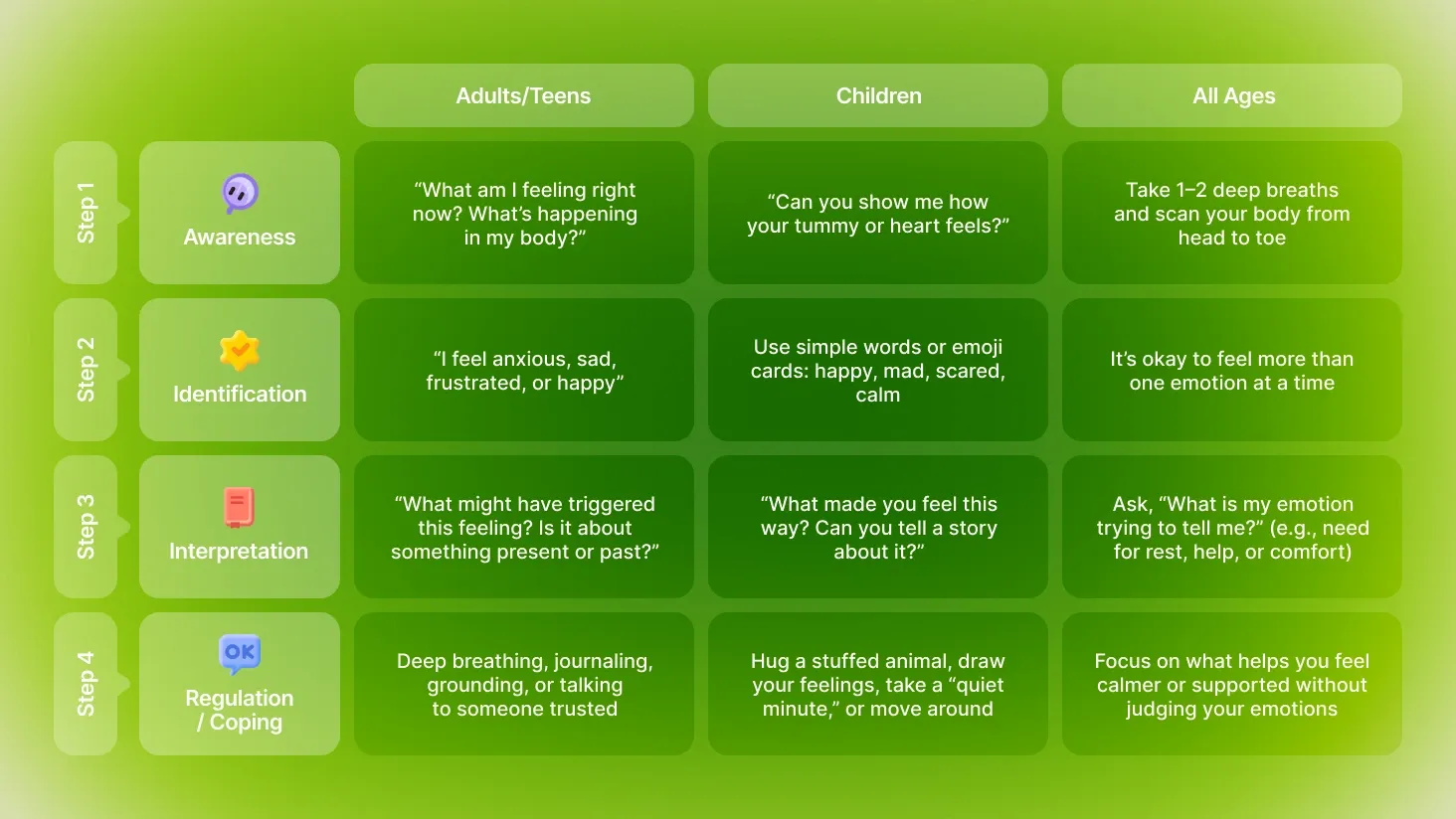
Let’s visualize what an emotional check-in might look like for different groups:
Step 1: Pause and Notice (Awareness)
- Adults/Teens: “What am I feeling right now? What’s happening in my body?”
- Children: “Can you show me how your tummy or heart feels?”
- All Ages: Take 1–2 deep breaths and scan your body from head to toe. Notice physical sensations (racing heart, tight shoulders, warm face), thoughts, and mood.
Step 2: Name Your Emotion (Identification)
- Adults/Teens: “I feel anxious, sad, frustrated, or happy.”
- Children: Use simple words or emoji cards: happy, mad, scared, calm.
- All Ages: It’s okay to feel more than one emotion at a time.
Step 3: Understand Your Emotion (Interpretation)
- Adults/Teens: “What might have triggered this feeling? Is it about something present or past?”
- Children: “What made you feel this way? Can you tell a story about it?”
- All Ages: Ask, “What is my emotion trying to tell me?” (e.g., need for rest, help, or comfort)
Step 4: Choose a Response (Regulation / Coping)
- Adults/Teens: Deep breathing, journaling, grounding, or talking to someone trusted, a short walk, stretching, or listening to music.
- Children: Hug a stuffed animal, draw your feelings, take a “quiet minute,” or move around
- All Ages: Focus on what helps you feel calmer or supported without judging your emotions
Daily Emotional Check-In for Kids
Children may feel overwhelmed by big emotions since they haven’t yet learned how to identify or regulate them, making healthy expression difficult.
The exercises below are fun and visual, helping children connect awareness, reflection, and expression.
#1: Weather Feelings Chart
When: At breakfast, before school, or during a classroom morning meeting
How: Invite the kid to answer the question, “What is the weather inside today?” Just like one checks the sky before heading outside, they can learn to recognize what’s happening in their inner world. You can also use an emotional check-in chart with "weather" characters that show different emotions, so a kid can choose one that describes their feelings the best.
Why: This exercise tells the kid that “Our feelings change every day just like the weather, and it’s okay.”
Result: Children learn to recognize and manage their emotions more effectively, which helps them develop foundational skills in emotional regulation.
#2: Feelings Faces Cards
When: During playtime or storytime
How: Lay out cards which show different emotions: happy, sad, angry, surprised, scared, calm. Ask the child to choose the card that best describes how they’re feeling at the moment.
Why: Research studies have demonstrated empirical support that observing facial expressions in others engages a mirror‑neuron-like system (in both children and adults), which could help them simulate or internally “feel” what they see. By activating these circuits, children can build neural associations between what they see (such as a frown) and their internal state (anger, sadness, etc.)
Results: The study shows that empathy begins to emerge in the second and third years of life (around age 1–3).
#3: Color Your Feelings
When: After school or before bedtime
How: Give your child crayons, markers, pencils, and a blank page. Ask them to paint the mood they’ve had during the day. They might color red for excitement, blue for calm, or gray for worry. For older children, you can ask them to paint a "feelings rainbow", which will consist of multiple colors and help them see how their mood changed throughout the day. For instance, they might have been sad in the morning, angry at school, and excited in the afternoon.
Why: Using colors makes it easier for kids to express and process complex emotions.
Result: Kids learn that emotions can shift within a single day. They also get more comfortable at exploring both what’s traditionally considered "positive" and "negative" emotions.
#4: Feelings Thermometer
When: Before bedtime or after an emotionally charged moment during the day
How: Use a picture of a vertical thermometer with a scale from 1 to 10. Ask the kid to rate their feelings. For instance, if a child marks “8” on their thermometer after a playground disagreement, a parent or teacher can use that as a cue to talk about what happened.
Why: A visual scale helps kids externalize emotional intensity.
Result: The insula is a brain region involved in interoception (sensing internal bodily states) and linking those sensations to emotional awareness. You engage the insula in situations that include noticing or reflecting on internal body signals.
Daily Emotional Check-In for Students
Adolescence and young adulthood are times when emotions can feel especially intense. Yet, somehow, we expect students to cope with their overwhelming feelings on their own.
Here are a few exercises that can help students recognize their emotions, build self-awareness, and use healthy coping strategies that support their mental health and learning focus.
#1: One-Word Feelings Check-Ins
When: At the start or end of the school day
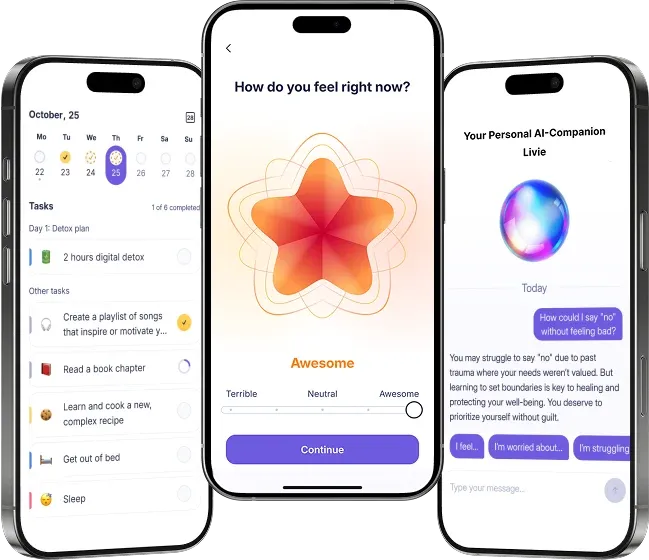
How: Teachers can ask, “What’s one word for how you’re feeling today?” If students don’t want to share, they can also do it privately in a paper journal or track their mood with a digital mental health app like Liven that offers both a journaling feature and a mood tracker.
Teachers can also offer a quick, printable emotional check-in worksheet for students who prefer writing over sharing verbally.
Some teachers even use a quick social-emotional check-in meme to make check-ins feel fun and relatable to teens.
Why: Naming emotions activates one’s prefrontal cortex, the brain’s reasoning center, and reduces the activity of the amygdala, the brain’s fear center.
Result: Teens regain control of their attention and behavior when they label and acknowledge their feelings. Plus, they feel that teachers see and support them for who they are.
#2: Mindful Moment Breaks
When: After intense lessons, exams, or emotional conversations
How: Teachers can guide students through a 3-minute mindful check-in, which includes observing breath, bodily sensations, and thoughts without judgment.
Why: These micro-pauses reduce cortisol, the stress hormone, and strengthen the brain’s self-regulation networks. Over time, mindfulness improves concentration, resilience, and emotional control.
Result: Students return to class calmer, grounded, and more emotionally balanced.
#3: Journal Check-In
When: At the end of class, during advisory time, or as a quick transition between subjects when students need a moment to reset
How: Teachers can encourage students to write for five minutes about their day in a notebook or in Liven's Journal. During the process, students should focus on their feelings and emotions rather than their actions.
Why: A short reflective writing practice activates the brain’s areas that help regulate emotions and make sense of experiences.
Result: The 5-minute journaling becomes a safe space where students can process their experiences instead of suppressing them. This leads to better self-awareness and emotional clarity.
#4: Feelings Soundtrack
When: Breaks, self-reflection practices
How: Teachers can encourage students to create playlists that match emotional themes, such as “Calm,” “Motivation,” or “Anger,” which they can listen to during study breaks or journaling sessions.
Why: Music stimulates the brain’s limbic system, the memory responsible for mood, memory, and survival. Once you pair it with emotion labeling, you actually reinforce healthy coping mechanisms.
Result: Students learn to manage emotions healthily and reduce anxiety through creative expression instead of avoiding their emotions or choosing distractions like excessive screen time as coping mechanisms.
#5: Peer Check-In Circles
When: Once a week
How: Teachers can dedicate class or advisory time for a social-emotional check-in, during which students may share one emotion word or a reflection about their week, with others listening respectfully.
Why: Group sharing activates oxytocin, the bonding hormone, which strengthens empathy and belonging.
Result: Such openness enhances peer relationships and academic engagement, as it transforms classrooms into emotionally safe spaces that foster social-emotional learning.
Daily Emotional Check-In for Adults
It’s easy to forget about emotional self-care as an adult. Work, family, and screens all distract us from our needs and true feelings. That’s why emotional check-ins, combined with micro-meditations and journal entries, are such important tools that help you stay grounded and self-aware.
#1: Work Meeting Check-In
When: At the beginning of team meetings
How: The practice encourages everyone on the team to share how they’re feeling, for instance, “focused,” “anxious,” “tired,” or “energized” — should be done intentionally (up to 30-40 seconds per person). If someone prefers not to speak, allow them to send an emoji.
Why: When a group shares and reflects on emotions, brain systems that support empathy are engaged, and stress-related responses may be reduced.
Result: Everyone on the team feels seen and supported, which, in turn, enhances collaboration and turns meetings into a space for meaningful conversations and trust-building, not just task management.
#2: Partner Check-In
When: Set aside one intentional moment each week. This might be a walk, dinner, or quiet evening, etc.
How: Take turns answering “What was the most frequent emotion for you this week and why?” After a partner answers, you can also add questions like “What can I do to make your next week easier so this emotion doesn’t feel so intense?” or “Would you like to talk more about that or have some space?”
Why: The practice encourages a consistent, open dialogue where a couple cultivates trust, empathy, and understanding before problem-solving, all the key building blocks for healthy adult relationships.
Result: The practice improves conflict resolution skills and overall relationship satisfaction.
#3: Evening Journal
When: Before bedtime
How: Keep a traditional pen-and-paper journal on your nightstand or opt for digital journaling with a mental health app like Liven, which you’ll use to name emotions, note triggers, and reflect on your coping strategies.
Here are simple emotional check-in questions for adults you can use for journaling:
- What was the strongest emotion I felt today, and what triggered it?
- When did I feel most like myself during the day? Least like myself?
- Which moment today brought me stress, and how did my body respond?
- What helped me regulate my emotions today? What didn’t?
- What do I need to feel more grounded and supported tomorrow?
Why: Expressive writing lowers anxiety and emotional distress. Plus, when consistent, journaling helps you see patterns in your triggers or coping mechanisms.
Result: You start to notice emotional patterns and triggers more clearly. Over time, journaling becomes a private space for self-awareness and self-care, and also helps strengthen your emotional resilience.
#4: One-Minute Gratitude Pause
When: In the morning after waking up, while drinking coffee at a slow pace, or tending the garden — you choose!
How: Pause for one minute to name three things you’re grateful for, whether big or small. They can be as simple as a cup of your favorite coffee, fresh flowers on the table, or a good night’s sleep.
Why: Multiple studies show that people who feel grateful have a more positive mood, less anxiety and depression symptoms, better sleep, and higher life satisfaction.
Result: A single minute of gratitude sets the emotional tone for your day, shifting focus from lack to abundance and improving mental health over time.
By the way, here is proof that self-reflection is helpful, as long as it’s guided toward positive thinking, such as gratitude, rather than rumination.
#5: Nature Check-In
When: During walks in the park, a quick loop around the block, or simply while standing near the window and admiring the view
How: Use a sensory grounding technique: notice five things you can see, four things you can touch or feel, three things you can hear, two things you can smell, and one breath-deepening movement. For instance, during a stressful afternoon, you step into a park. As you listen to birds and feel the air, your shoulders drop, and your racing thoughts slow.
Why: Nature exposure mixed with sensory grounding reduces anxiety and depression scores.
Result: You return with renewed calm, emotional clarity, and lower risks for developing depression, anxiety, or burnout.
Emotional Check‑In Routine: Kids vs. Students vs. Adults
| Age Group | Examples of Check-Ins | Main Focus | Benefits |
| Kids |
|
|
|
| Students |
|
|
|
| Adults |
|
|
|
Final Thoughts
An emotional check-in is a minute when you honor your emotions, uncover your needs, and create space for thoughtful action. Over time, this simple practice helps you build resilience, emotional intelligence, and mental well-being.
Meanwhile, continue your self-discovery journey with Liven: download the Liven app to start your emotional check-in routine (available on Google Play and the App Store), take our free wellness tests, and explore more about emotions through our blog articles and resources.
References
- Bowling, D. L. (2023). Biological principles for music and mental health. Translational Psychiatry, 13, 374. https://doi.org/10.1038/s41398-023-02671-4
- Chen, Y., et al. (2024). Gratitude and mortality among older US female nurses. JAMA Psychiatry, 81(10), 1030–1038. https://doi.org/10.1001/jamapsychiatry.2024.1687
- Diniz, G., et al. (2023). The effects of gratitude interventions: A systematic review and meta-analysis. Einstein (São Paulo), 21, eRW0371. https://doi.org/10.31744/einstein_journal/2023RW0371
- Kaur, S., et al. (2025). From struggle to strength: The therapeutic potential of gratitude journaling for student mental health. Journal of Poetry Therapy, 1–16. https://doi.org/10.1080/08893675.2025.2457621
- Makram, O. M., et al. (2024). Nature and mental health in urban Texas: A NatureScore-based study. International Journal of Environmental Research and Public Health, 21(2), 168. https://doi.org/10.3390/ijerph21020168
- Lawson, G. M., Zubrick, S. R., Shepherd, C. C. J., & others (2019). The Core Components of Evidence-Based Social Emotional Learning Programs. Prevention Science. https://pubmed.ncbi.nlm.nih.gov/30443846/
- Pfeifer, J. H., Iacoboni, M., Mazziotta, J. C., & Dapretto, M. (2008). Mirroring others’ emotions relates to empathy and interpersonal competence in children. NeuroImage, 39(4), 2076–2085. https://doi.org/10.1016/j.neuroimage.2007.10.032
FAQ: Emotional Check-In
What is an emotional check-in?
How to make an emotional check-in for kids fun?
What are emotional check-in questions for adults?
How often should I do a daily emotional check-in?