Symptoms of Emotional Neglect in Adults: Why You Feel Empty When Life Looks Fine



Reviewed by
Tara Passaretti, M.S., LMHC


You're sitting at your desk, looking at a life that, on paper, seems just fine. You have a job, friends, and a place to live. Yet, there's a persistent hum of something missing. A feeling of emptiness or disconnection. You might blame yourself, thinking you're ungrateful or just wired to feel this way. But what if it's an echo from a past you don't remember as traumatic?
This is often the landscape of childhood emotional neglect. And the symptoms of emotional neglect in adults are easy to miss precisely because they don't look like trauma. It’s not about what your parents did, but what they didn’t do. It can be the absence of emotional support, validation, and attunement that teaches a child their feelings don’t matter. As an adult, that lesson lingers, showing up in ways that are confusing and hard to pin down.
Key Takeaways
- Emotional neglect is what happens when a caregiver consistently fails to respond to a child's emotional needs, and that ongoing absence of attunement adds up quietly over time.
- In adulthood, the signs are easy to mistake for personality: a quiet emptiness, a harsh inner critic, or trouble naming what you feel.
- Childhood emotional neglect is linked to higher rates of anxiety and depression in adulthood.
- Healing often starts with something you may not have been taught growing up: taking your own feelings seriously.
This Is What Emotional Neglect Does to Your Brain
Emotional neglect can shape how the brain and nervous system respond, and understanding that can make a lot of things click into place.
Your stress alarm gets stuck on. The amygdala is the part of your brain that detects danger and fires off a stress response. When emotional needs go unmet in childhood, the amygdala becomes hypersensitive, essentially learning to expect threat even when none is present. That's why everyday situations can feel disproportionately overwhelming.
The brakes don't work as well. The prefrontal cortex is what helps you pause, reflect, and regulate your emotions before acting on them. Without consistent emotional support during development, this region may be less well-developed, making it genuinely harder to manage strong feelings.
Your body learned to live in survival mode. Emotional neglect keeps the body's stress response system, the HPA axis, more active than needed. This leads to dysregulated cortisol levels and a nervous system that swings between high alert and complete shutdown. You might know this as the feeling of being wired and exhausted at the same time, or going totally numb when things get hard.
Your nervous system swings between two extremes. When emotional needs aren't met early on, the nervous system may struggle to regulate or settle. You might oscillate between hyperarousal (anxiety, reactivity, difficulty sleeping) and hypoarousal (numbness, disconnection, low motivation), both of which are now linked to disrupted neural development following childhood neglect.
There is a reason you feel the way you do, and it goes deeper than mindset or willpower. Your brain adapted to its environment. And brains, thankfully, can keep adapting.
How Emotional Neglect Shows Up in Your Daily Life
Some of these might surprise you. Others might finally put a name to something you've felt for years but couldn't explain.
Why You Push People Away
Does the thought "I don't need anyone" feel like a point of pride? For many adults who experienced emotional neglect, it was a childhood survival strategy. When you learned that asking for help, comfort, or support was pointless or met with disapproval, you learned to stop asking. You became your own parent, your own cheerleader, and your own safety net.
As an adult, this hyper-independence looks like strength. But it's often armor that keeps intimacy at bay. You might struggle to delegate tasks, feel uncomfortable when people offer you help, or believe that vulnerability is a dangerous weakness. You're the reliable one everyone turns to, but you rarely let anyone in.
And it makes sense why: adults who grew up with emotional neglect are far more likely to cope by pulling inward, shutting down, and handling everything alone rather than reaching out to someone who could actually help.
When Everything Is Fine But Nothing Feels Like It
A persistent feeling of emptiness is one of the most common experiences of emotional neglect. You feel that something fundamental is missing, even when your life is filled with accomplishments and people. This isn’t the dramatic emptiness of deep grief, but a low-grade, chronic hollowness.
When your feelings were ignored as a child, you didn't just stop expressing them. You stopped trusting them. Emotions started to feel pointless, inconvenient, or just out of reach. So you learned to live on the surface: functional, capable, fine.
The result is a disconnect from your own inner world. Because nobody showed you that your feelings were worth paying attention to. That's a skill you can still learn.
The Voice That Says You're Not Enough
If you grew up without emotional validation, you likely filled the silence with your own explanations. A child’s brain will always choose guilt over abandonment. So, if you felt lonely or unseen, you concluded, “Something must be wrong with me.”
This belief crystallizes into a harsh inner critic in adulthood. It’s the voice that tells you you’re not good enough, that you’re a burden, or that you have to be perfect to be worthy of love. You might have:
- Perfectionism: A belief that if you do everything flawlessly, you can finally avoid criticism and feel secure.
- Low self-compassion: You’re quick to forgive others for their mistakes but hold yourself to an impossible standard.
- A deep sense of shame: You may carry a vague but persistent feeling that something is fundamentally wrong with you.
One of the Hardest Symptoms of Emotional Neglect in Adults: Not Knowing What You Feel
“How do you feel?”
For many, this is the hardest question to answer. If you reply with "I don't know," "Fine," or end up describing your thoughts instead of your feelings, there's a word for what you might be running into: alexithymia. It refers to difficulty identifying and describing emotions, and it's commonly associated with emotional neglect, especially when emotional attunement was limited growing up.
When your feelings weren't acknowledged by caregivers, you never developed a vocabulary for them. You learned that emotions were messy, inconvenient, or irrelevant. As a result, you might:
- Feel numb or emotionally flat.
- Experience physical symptoms (headaches, stomach issues) instead of clear emotions.
- Feel easily overwhelmed in emotionally charged situations.
- Struggle to connect with partners who want emotional intimacy.
Nobody explains childhood emotional neglect quite like the person who named it. Here's Dr. Jonice Webb in under 10 minutes:
Learning to identify your feelings is like learning a new language. It takes practice and patience.
How to Start Healing
Recognizing these patterns in yourself is a huge, courageous first step. You can't change what wasn't given to you. But you can start giving it to yourself now, one small skill at a time. It's a process of self-reparenting.
- Start with naming. You can't heal what you can't feel. Begin by simply noticing. Throughout the day, pause and ask: What am I feeling right now? Don't judge the answer. Just name it. Sadness. Annoyance. Boredom. It may sound too simple to work. But research on affect labeling suggests otherwise. When you name your emotions, activity in the amygdala (your brain's threat detector) goes down. And activity in the prefrontal cortex (the part that helps you pause and regulate) goes up.
- Practice self-compassion. Treat yourself with the same kindness you would offer a good friend. When the inner critic gets loud, gently counter it. Say, “You’re having a hard time. It’s okay to feel this way.” It's about providing the comfort you always needed.
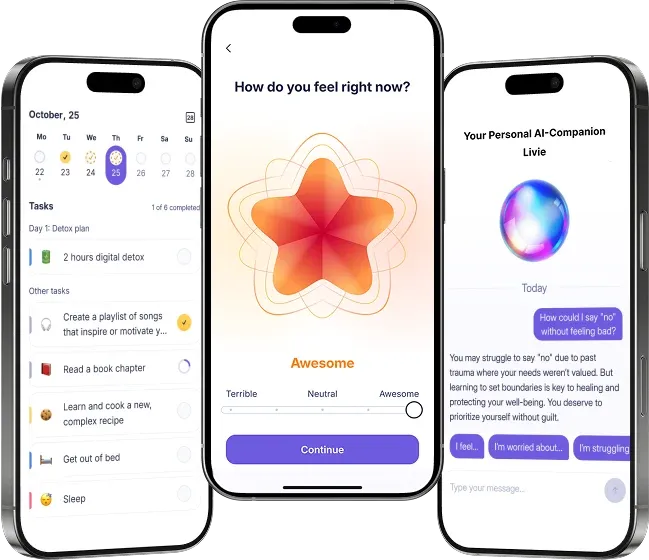
- Identify your needs. As a child, you learned to suppress your needs. As an adult, your job is to learn what they are and express them. Do you need rest? Connection? A moment of quiet? Start small. The goal is to prove to yourself that your needs are valid and worthy of being met. For many, this is the most challenging and rewarding part of the journey. If you're still figuring out what you need, Liven's personalized plan turns your honest answers into a 10-minute daily practice.
- Seek connection. Healing happens in safe relationships where you feel seen and accepted. This could be with a trusted friend, a partner, or a therapist. A therapist specializing in childhood trauma can provide a roadmap and a safe space to process these deep-seated patterns. Here's what that process can actually look like.
You're Not Broken. You Just Weren't Taught This
Living with the echoes of emotional neglect can feel isolating, but you are not alone, and you are not broken. The patterns you developed were once adaptive: they were how you coped, how you got through experiences where your emotional needs weren't consistently met. They reflect resilience, not deficiency.
You may have spent a long time adapting to environments that didn't leave much room for your emotional experience. Healing can look like slowly creating that space for yourself, imperfectly, gently, and on your own terms.
Sources
- Deitz, A. H. (2024). Self-compassion, childhood emotional neglect, and posttraumatic growth: Parental well-being during COVID-19. Journal of Affective Disorders, 350, 504–512. https://doi.org/10.1016/j.jad.2024.01.130
- Eggert, L., Kenntemich, L., von Hülsen, L., Gallinat, J., & Schäfer, I. (2024). Associations between childhood neglect and depressive symptoms: The mediating effect of avoidant coping. Depression and Anxiety. https://doi.org/10.1155/da/9959689
- Xiao, Z., Baldwin, M. M., Wong, S. C., Obsuth, I., Meinck, F., & Murray, A. L. (2023). The impact of childhood psychological maltreatment on mental health outcomes in adulthood: A systematic review and meta-analysis. Trauma, Violence, & Abuse, 24(5), 3049–3064. https://doi.org/10.1177/15248380221122816
- Yoshimura, S., Okamoto, Y., Onoda, K., Matsunaga, M., Okada, G., Kunisato, Y., & Yamawaki, S. (2022). Changes in neural activity during the combining affect labeling and reappraisal. Neuroscience Research, 185, 49–56. https://doi.org/10.1016/j.neures.2022.09.003
- Yuan, S., Wu, H., Wu, Y., Xu, H., Yu, J., Zhong, Y., Zhang, N., Li, J., Xu, Q., & Wang, C. (2022). Neural effects of cognitive behavioral therapy in psychiatric disorders: A systematic review and activation likelihood estimation meta-analysis. Frontiers in Psychology, 13, 853804. https://doi.org/10.3389/fpsyg.2022.853804
- Murphy, F., et al. (2022). Childhood trauma, the HPA axis and psychiatric illnesses: A targeted literature synthesis. Frontiers in Psychiatry, 13, 748372. https://doi.org/10.3389/fpsyt.2022.748372
- Morales-Muñoz, I., et al. (2025). Neglect and neurodevelopment: A narrative review understanding the link between child neglect and executive function deficits. PMC. https://pmc.ncbi.nlm.nih.gov/articles/PMC12292309/
- Cheng, Y., et al. (2025). Brain white matter alterations in young adults with childhood emotional neglect experience. Behavioral Sciences, 15(6), 746. https://doi.org/10.3390/bs15060746
FAQ: Symptoms of Emotional Neglect in Adults
Is emotional neglect a form of trauma?
How is emotional neglect different from emotional abuse?
Can you have symptoms of emotional neglect even with loving parents?
Why do I feel guilty for thinking I was emotionally neglected?
Can a good adult relationship heal childhood emotional neglect?