How to Stop Guilt-Tripping Yourself: Go From Self-Punishment to Self-Understanding



Reviewed by
Tara Passaretti, M.S., LMHC


Not all guilt deserves your attention, but some of it does.
Guilt is just a signal. Sometimes it points to something real - a moment where your actions didn't match your values. You snapped at someone you love, skipped a commitment, said something you regret. That kind of guilt leads somewhere: repair, change, growth.
The kind that isn't worth carrying lingers without direction. The guilt for taking a nap on a Sunday. For saying no to plans when you were exhausted. For not calling back fast enough. For needing more time, more rest, more space than you think you're allowed.
Both can show up at the same time - and often do. This guide helps you tell the difference.
Key Takeaways
- Guilt is a signal that is telling you something instead of shaming you. The trick is figuring out what actually matters and what doesn’t.
- Not all guilt is yours. Sometimes it comes from expectations you picked up along the way, not ones you chose.
- Ignoring guilt doesn’t make it disappear. And replaying it over and over doesn’t help either.
- Sometimes the right move is to address and repair something. Other times, it’s to offer yourself a bit more kindness and understanding.
- The fact that you feel guilt at all means you care. It's a sign of a healthy conscience.
How to Stop Guilt-Tripping When Guilt Keeps Showing Up Anyway
When guilt shows up, a common reaction is to try to push it away or avoid it. You open your phone, pour a drink, or suddenly feel the need to reorganize everything around you. Or you go the other way, replaying the moment on loop, picking apart what you did, and calling yourself out so harshly that the original message gets buried. Neither really helps.
The first step is simpler than it sounds: acknowledge it. Not by agreeing with every harsh thought your mind throws at you, but by pausing long enough to notice what you’re actually feeling, without trying to address or repair it right away.
Here’s what that can look like:
- Name the emotion simply: "I'm feeling guilty"
- Where do you feel guilt/shame in your body? Tight chest, heaviness in your stomach?
- Resist the urge to immediately justify, minimize, or catastrophize. Just sit with the feeling.
- Give yourself a defined period to sit with it: five minutes, an hour, a day
That pause does two things. It stops you from reacting on autopilot, and it gives you space to understand what you’re actually feeling.
Guilt is "I did something wrong." It’s about behavior, and sometimes it’s useful.
Shame is "I am wrong." It’s more personal, and often more harmful. That distinction helps you see whether the feeling is pointing to something real, or just a habit your mind falls into.
Figure Out Where the Guilt Is Coming From
Once you’ve allowed the guilt to be present, gently explore what expectation or rule you feel you may have broken. This is where healthy and unhealthy guilt can begin to separate.
Ask yourself:
- What specific expectation do I feel I didn’t meet?
- Where did this expectation come from? My own values, or someone else’s standards?
- Does this rule still reflect who I am and what I care about today, or did I inherit it?
- Is this standard realistic, or could it be perfectionism or self-pressure in disguise?
Much unhealthy guilt comes from expectations we absorbed without ever questioning them. The belief that you must always be productive, immediately available, or further along than you are. These often come from family patterns, past workplaces, or the idea that your value depends on how productive you are.
When the guilt isn’t yours, you can put it down. When it is, you can do something about it. Either way, you stop letting it drive your decisions.
If the guilt you feel is mostly about other people's needs and expectations, this conversation between Dr. Becky Kennedy and Andrew Huberman is a good place to start making sense of it:
Understand What the Guilt Is Communicating
Guilt can act like an internal alarm system. The important question is whether that alarm is signaling something that truly needs attention, or whether it’s being triggered by old patterns, beliefs, or expectations that no longer fit your present reality.
Healthy guilt is usually clear and practical. It points to a specific action and a way to make it right. “I was harsh with my colleague. I can apologize.” Once you act on it, the feeling settles.
Unhealthy guilt feels different. It’s vague and heavy. Instead of focusing on what you did, it turns into who you are. “I’m a bad friend. I always mess things up.” There’s no clear solution, just a loop that wears down your self-worth without giving you anything useful to act on.
To distinguish them, ask:
- Is there a specific action I regret, or a general sense of inadequacy?
- Would I hold someone else to this standard?
- If I made amends or adjusted my behavior, would the guilt lift?
- Does this guilt motivate change, or does it paralyze me?
If your guilt feels harsh, unconstructive, or disconnected from your values, it may be the less helpful kind. This doesn’t mean you should ignore it, it means you may need to respond to it differently
Release the Perfectionism
A lot of unhelpful guilt is linked to perfectionism, which often shows up as overly high standards that are difficult or impossible to meet.
When your standards are rigid, guilt shows up more often and hits harder. Research shows it can shift from “I did something wrong” to “something is wrong with me,” turning into self-criticism instead of guidance.
Perfectionism assumes you should always know better and do better. But in reality, you’re working with limited time, energy, and information. Mistakes are part of that.
There’s no version of life where everything goes perfectly. There’s just showing up and adjusting as you go. When you notice that perfectionist layer, try a simpler frame: I did the best I could with what I had in that moment. And if I need to, I can choose differently next time with more awareness and care.
Reframe and Respond
Once you’ve looked at your guilt more clearly, the next step is how you respond to it.
If the guilt is tied to something real and proportionate, it’s usually pointing to something specific. Maybe an apology. Maybe a small change in how you show up. Sometimes just acknowledging that you wouldn’t repeat the same action is enough. The relief tends to come once you’ve taken that step, however small.
If the guilt feels excessive, borrowed, or aimed at your self-worth, the response looks different. It’s less about fixing and more about letting go. Reminding yourself that the expectation may not have been yours to begin with. Then choosing one small action that aligns with what actually matters to you, not what the guilt is pushing you toward.
Neither path is easy. Owning a mistake takes honesty. Letting go of unnecessary guilt takes trust in yourself. But in both cases, you’re moving out of reaction and into something more intentional.
Appreciate Your Conscience
As you can see now, the fact that you feel guilty at all is evidence of something important.
You are someone who wants to live with integrity. You care about your impact on others. You hold yourself to standards. These are strengths that just need a bit of direction.
The goal here is to ensure that your guilt serves you rather than diminishes you. Healthy guilt keeps you aligned with your values and can guide repair when needed. Unhelpful guilt tends to keep you aligned with other people’s expectations, or with an unrealistic version of yourself that is impossible to maintain.
When you stop fighting guilt and start understanding what it’s communicating, you become someone who can take accountability, make repairs when needed, and keep moving forward without getting stuck in self-criticism.
Building the Habit
The next time guilt arises, pause. Allow the feeling. Ask what belief or expectation was not met. Respond with repair or release, then move through the uncomfortable feeling as it no longer serves you.
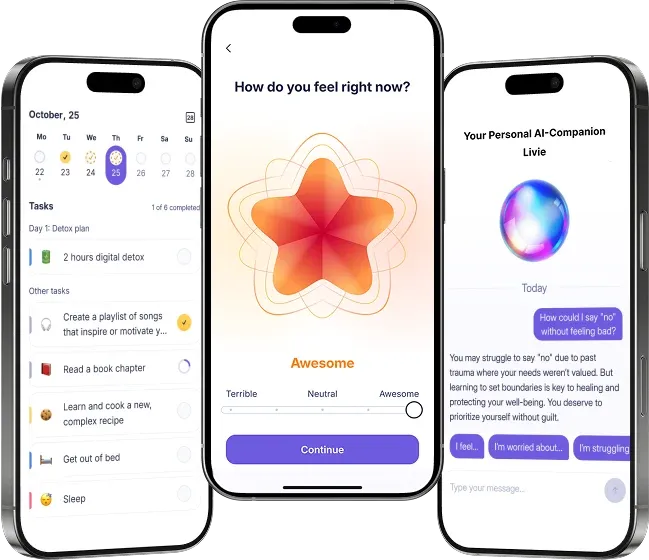
If you want support building this practice, the Liven app can be a useful tool. It gives you a Mood Tracker to notice patterns, a Journal to unpack where your expectations come from, and a guided plan called Journey that helps you build self-awareness and healthier responses over time.
Remember that guilt is just a messenger. Read it, respond to it, and enjoy living!
References
- Wegerer, M. (2024). Cognitive-behavioral treatment of perfectionism: An overview of the state of research and practical therapeutical procedures. Verhaltenstherapie, 34(1), 1–10. https://doi.org/10.1159/000532044
FAQ: How to Stop Guilt-Tripping
What's the difference between healthy and unhealthy guilt?
Why do I feel guilty even when I haven't done anything wrong?
How do I stop constant guilt about resting or setting boundaries?
Is guilt-tripping yourself ever useful?
What if I'm highly sensitive and can't tell if my guilt is healthy?
How do I know if I’m guilt-tripping myself?
What should I do in the moment when guilt hits?