
Is Liven Worth It? An Honest Look at What the App Offers


Written by
Nadine M., Editorial Team Lead at Liven


Wellness apps have become a go-to tool for emotional regulation, and the options keep growing. But as the category expands, so does a question: "What separates an app that helps you feel better in the short term from one that builds something more lasting?"
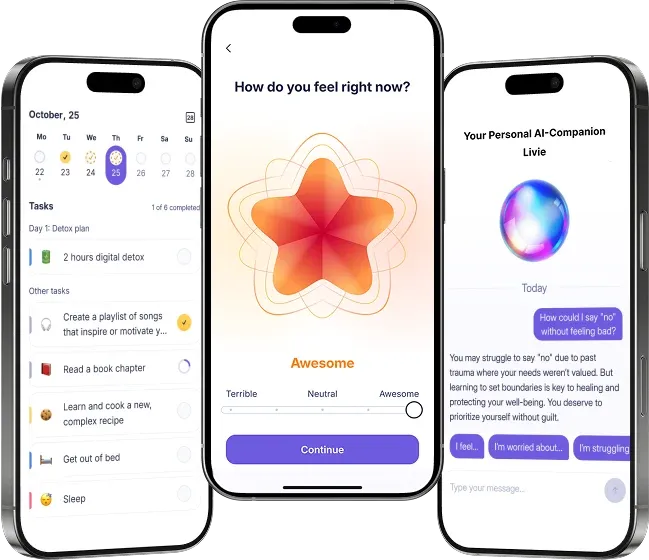
For example, breathwork is one way to regulate your nervous system, but it's not the only one. Liven brings together the full toolkit: mood tracking, journaling, educational content for self-awareness, a streak system, tests, and more. You can choose what works for you and pair it with whatever else supports your practice, e.g., therapy, meditation, or movement.
That's what makes the approach different. Let's take a closer look at how it works.
Key Learnings
- Liven's approach focuses on nervous system regulation rather than only mindfulness or meditation.
- Its microcycle method uses short, repeatable practices designed to work with your brain's reward system.
- The app may help with stress management, sleep, and focus when used consistently.
- Liven is built for people who want a structured, science-informed routine.
What Liven Does and Doesn't
Wellness apps take many forms: content libraries with guided meditations and sleep stories, habit trackers, breathwork tools, and more. Liven's approach sits closer to a daily practice system, built around the idea that lasting wellbeing comes from regulating the system underneath the stress rather than soothing it in the moment. That means working with the balance between your sympathetic state (activated, stressed, reactive) and your parasympathetic state (calm, restored, focused).
Liven's practices are designed to help you shift that balance through small, consistent inputs.
| ✅ | ❌ |
|---|---|
| Short daily practices (2–5 min) | Long-form guided meditations or sleep stories |
| Nervous system regulation through sound | Replace therapy or professional mental health support |
| Mood tracking | Diagnose or treat any condition |
| Journaling | Function as a passive content library to browse |
| Educational content to understand your patterns | Offer a one-size-fits-all program |
| A streak system to support consistency | Work as a standalone fix without consistent use |
| Tests for self-awareness | |
| Pairs with therapy, meditation, or somatic practices |
The microcycle method drives this process from the moment you sign up for the Liven app. It gives you brief practices to repeat daily and adapt over time. As the practice becomes routine, the nervous system gradually consolidates the pattern. This is what neuroplasticity research points to: the brain can rewire through repeated, consistent experience.
Who Is Liven for?
Liven is a good fit for people who are curious about what's happening in their body when stress shows up.
The app particularly suits people who:
- Experience stress as a physical sensation in the body, e.g., tension, shallow breathing, difficulty relaxing.
- Want a structured daily routine they can build on over time.
- Have limited time and need something that works in under ten minutes.
- Are interested in the science behind what they're practicing.
Does the App Work for Emotional Regulation?
No app works in isolation, and Liven makes no claim to be a substitute for professional mental health support. What the research does support is the underlying mechanism.
Breathwork and slow-paced breathing have been shown to activate the parasympathetic nervous system and reduce cortisol levels. For example, brief mindfulness practices have demonstrated effects on emotional reactivity and perceived stress within weeks of consistent use. The practices Liven uses are grounded in these and more findings.
Consistency is another aspect that most apps can't control, and Liven's microcycle method is specifically designed to make it easier to maintain. Shorter sessions mean a lower activation energy required to show up each day.
If you use it consistently for a few weeks, you may notice shifts in your stress response, sleep quality, and emotional resilience. For example, 1 in 2 users reported feeling calmer after using the Liven app (based on an internal survey of active users; individual results may vary). That's not a guarantee, and outcomes vary from person to person, so the only way to find out if it works for you is to try.
If you want a starting point, you can take an emotional regulation test and check where your nervous system is right now.
The Honest Answer to "Is Liven Worth It?"
Worth it depends on what you're comparing it to. For people who struggle with consistency, its short sessions and progressive method can be an advantage.
If you're comparing it to doing nothing, the question is what staying in chronic stress is costing you. Prolonged stress can affect sleep, cognitive function, the immune response, and cardiovascular health. A tool that helps support emotional regulation, even modestly, can be a life-changing solution.
If you're comparing it to therapy or medical support, it's not a substitute and doesn't claim to be. For people dealing with diagnosed anxiety, depression, or trauma, professional support remains the appropriate first step.
For people managing everyday stress, struggling with sleep, or feeling emotionally drained, the Liven app offers a method that fits into real life.
References
- Cavanagh, K., Strauss, C., Cicconi, F., Griffiths, N., Wyper, A., & Jones, F. (2021). A randomised controlled trial of a brief online mindfulness-based intervention. Frontiers in Psychology, 12, 613853. https://doi.org/10.3389/fpsyg.2021.613853
- Mariotti, A. (2015). The effects of chronic stress on health: new insights into the molecular mechanisms of brain–body communication. Future Science OA, 1(3). https://doi.org/10.4155/fso.15.21
- Ma, X., Yue, Z. Q., Gong, Z. Q., Zhang, H., Duan, N. Y., Shi, Y. T., Wei, G. X., & Li, Y. F. (2017). The effect of diaphragmatic breathing on attention, negative affect, and stress in healthy adults. Frontiers in Psychology, 8, 874. https://doi.org/10.3389/fpsyg.2017.00874
- McEwen, B. S. (2008). Central effects of stress hormones in health and disease: Understanding the protective and damaging effects of stress and stress mediators. Annals of the New York Academy of Sciences, 1148, 174–185. https://doi.org/10.1196/annals.1410.014
- Porges, S. W. (2011). The Polyvagal Theory: Neurophysiological Foundations of Emotions, Attachment, Communication, and Self-Regulation. W. W. Norton & Company.
Zeidan, F., Johnson, S. K., Diamond, B. J., David, Z., & Goolkasian, P. (2010). Mindfulness meditation improves cognition: Evidence of brief mental training. Consciousness and Cognition, 19(2), 597–605. https://doi.org/10.1016/j.concog.2010.03.014
FAQ: Is Liven Worth It?
Is Liven a replacement for therapy?
How much time do I need each day to use Liven?