Feelings vs. Emotions: What’s the Real Difference and Why It Matters for Your Mental Health



Reviewed by
Tara Passaretti, M.S., LMHC
It’s easy to mix fear with anxiety or sadness with emptiness — we all do. Why? Because we confuse feelings with emotions. Unable to see what’s really happening inside us at the moment, we let small worries turn into big storms like chronic stress or anxiety.
Let’s unpack how feelings vs emotions relate and differ, and how knowing this difference can improve your mental health in the long run.
Key Learnings
- Feelings are the internal awareness and interpretation of our emotional states. For example, emotion = anger vs. feeling = “I feel irritated” or “I feel frustrated.”
- Small daily practices, such as breathwork, body scans, and gratitude journaling, among others, can transform how one builds relationships and experiences life.
- Cultivating positive emotions is as essential as managing difficult ones; it builds resilience and mental well-being.
Feelings vs. Emotions: Main Differences
Before we explore how to manage your emotional world, let’s understand what’s really going on inside your brain, body, and mind.
What are Emotions?
Emotions are the body’s automatic, physiological reactions to stimuli. Your emotional brain automatically reacts when it detects a potential threat, a reward, or any other significant change in your environment. It prepares you to act and prompts your body to respond with physiological sensations, such as a racing heart, tense muscles, or sweaty palms.
Neurobiologist Joseph LeDoux discovered that information from your surroundings travels to your amygdala (the brain’s fear center) at lightning-fast speed — about 70 milliseconds. That’s why you might jump at a shadow and immediately get a racing heart.
Further, your prefrontal cortex, the brain’s reasoning and regulation center, activates shortly after the amygdala, typically within 100 to 300 milliseconds of detecting potential danger. Although the prefrontal cortex can start calming the amygdala within seconds, it often takes a few minutes for the body’s physiological stress response to return to baseline.
What are Feelings?
Feelings are your mind’s interpretation of your emotional reactions. First, the limbic system responds — fast, automatic, and often outside your awareness. Then the prefrontal cortex and the insula step in. These areas help you notice what’s happening inside your body and make sense of it.
They translate a raw emotional surge into a conscious experience.
That’s the moment when a reaction becomes a feeling, when you can finally say, “I feel anxious,” “I feel sad,” or “I feel calm.”
According to neuroanatomist Dr. Jill Bolte Taylor, author of Whole Brain Living, the body’s initial emotional reaction, triggered by the surge of stress hormones and physiological arousal in the amygdala, lasts approximately 90 seconds. Suppose you don’t continue to feed that reaction with additional thoughts or stories. In that case, the chemical response naturally subsides, allowing the prefrontal cortex (the reasoning center) to fully re-engage and transform that raw emotion into a conscious feeling.
The Difference between Emotions and Feelings
Here are some real-life examples of emotions vs. feelings, which illustrate the crucial difference between the two: one is raw and fast, while the other is thoughtful and meaningful.
Scenario #1: Fear
You hear a sudden loud noise. Instantly, the body reacts: your heart jumps, your muscles tense, and your breathing quickens. If there is no actual danger, you might feel surprise or even a spark of curiosity. If there is danger, however, your feelings might shift to anxiety or panic.
Scenario #2: Sadness
You receive upsetting news. Your body feels heavy, your chest tightens, and your brain registers the emotional wave: sadness. Later, that sadness might turn into disappointment, a feeling of loss, or regret, depending on the context.
Scenario #3: Anger
Someone cuts you off in traffic. Your anger spikes immediately: muscles tense and your face flushes. That’s the raw emotion. The feeling that follows might be frustration, resentment, or even shame.
Feelings vs. Emotions, Compared
| Aspect | Emotions | Feelings |
| Origin | Amygdala, emotional brain | Prefrontal cortex (reasoning brain) and insula regions |
| Speed | Immediate, milliseconds | Slower, seconds to minutes |
| Nature | Automatic, physiological reactions | Conscious, interpretive, subjective |
| Purpose | Alerts to danger or opportunity | Guides decision-making, life choices, and emotional awareness |
| Universality | Shared across all people regardless of gender, race, ethnicity, etc. | Shaped by one’s beliefs, thought patterns, and personal experiences |
| Duration | Short-lived, seconds | Longer, can persist for hours or days |
| Examples in daily life | Making a minor mistake publicly: flushed face, trembling hands; Receiving high praise, recognition: rush of warmth, automatic smile | Shame, embarrassment Joy, pride |
How Understanding Emotions and Feelings Can Transform Your Mental Health
Here is what makes your knowledge about experiencing emotions vs feelings a game-changer for your mental health, relationships, and how you respond to the world.
Helps You Boost Your Emotional Intelligence
Emotional intelligence is the ability to recognize, understand, and manage your own emotions while showing empathy to others.
When you acknowledge and, even better, understand what triggers your emotional responses, you can pause, reflect, and respond thoughtfully rather than act on autopilot.
Let’s say you and your friend had a disagreement. It’s natural for anger to start bubbling. However, once you learn that it’s an emotion first (more based on your primary physical sensations like a racing heart or tense muscles) rather than the truth about the situation, you can easily manage the actual feeling that follows: frustration, resentment, or irritation.
This, in turn, improves your relationships, as you treat others with respect.
Changes How You Work and Heal
When you notice experiencing emotions like fear or anger early, you don’t let negative reactions take the lead in your brain and body. Instead, you create space for awareness.
This awareness helps you build better and healthier relationships, communicate effectively, and reduce burnout because you:
- Respond with clarity instead of reacting on impulse.
- You understand your emotional state and can communicate it clearly, which improves teamwork and empathy at work.
- You make decisions based on facts and values, not momentary emotions;
- You allow your body and brain to recover faster from negative emotional experiences, reducing long-term fatigue before it turns into chronic stress, depression, or anxiety.
Helps You Decode the Cultural Play in Communication
Most people express emotions according to the cultural norms they were taught — what feels like passion in one culture may appear as aggression in another.
That’s how different humans are: in one Javanese culture, feelings are even linked to the liver, not the heart!
Cultivating emotional self-awareness and understanding how cultural beliefs influence emotional responses helps you avoid misunderstandings and connect more effectively in a global world. You start to:
- Recognize emotional nuances in tone, gestures, and silence.
- Adjust your communication style to show empathy and respect.
- Respond thoughtfully rather than assuming others feel as you do.
Practical Strategies to Cultivate Better Emotional Awareness on a Daily Basis
The more you practice self-awareness, the better you interpret your physical sensations and the words your mind uses to describe your individual experiences.
Here are a few methods that might help you tap into your emotions and feelings.
#1: Tune into Your Physical Sensations at the Moment
Your physical sensations are raw data that gives you the first, most honest reading of your emotional state.
The "Emotional Stoplight" Exercise
Try doing micro-check-ins throughout the day. Think of your emotional state as a stoplight — red for intense, yellow for moderate, green for calm. Ask: “What is my body telling me right now? What raw physical sensations am I noticing? What is the core emotion right now?”
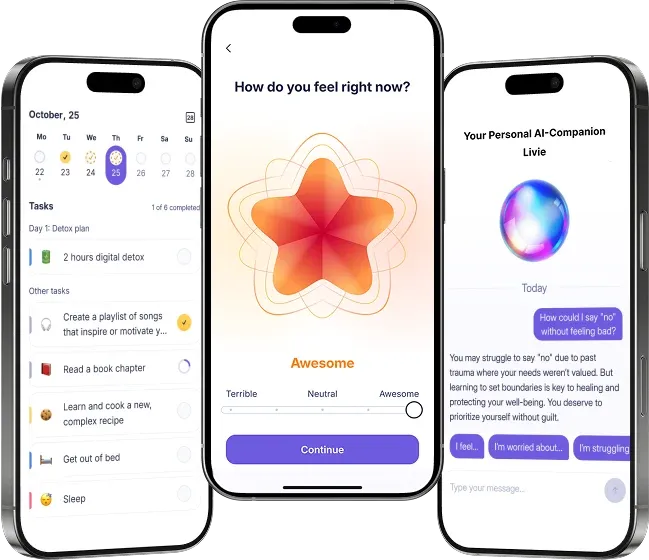
To further enhance consistency with this practice, consider using a digital mood tracker like Liven to log your emotions and triggers directly within the app. Over time, Liven will help you identify emotional trends and patterns, allowing you to recognize what triggers stress, joy, or calm in your daily life.
Body Scans
A body scan is a slow, mindful sweep from head to toe, during which you focus on different body areas and try to notice any tension or discomfort in muscles and relax them. Commonly, one does it with closed eyes while lying on the ground.
Beginners can benefit from guided body-scan meditations on apps like Calm or Insight Timer. Or you can make the session more engaging with Liven soundscapes, which include binaural and deep sleep tracks.
5 Whys for Physical Discomfort
The 5 Whys is a simple yet powerful exercise to help you uncover the root cause of physical discomfort and the emotions that underlie it. The idea is to keep asking “Why?” until you get to the underlying source of tension, pain, or unease in your body.
If you notice any discomfort in your body during the micro-check-ins, try giving yourself 5 reasons why you feel these negative physical sensations. You’d be surprised to find out how often our bodily sensations are manifestations of our internal emotional state.
How to practice:
Notice the discomfort. Focus on a part of your body where you feel tension, pain, or stress. Ask “Why?” Ask yourself: “Why do I feel this tightness, ache, or tension?” Answer honestly. Give yourself a truthful, reflective response. Repeat four more times. Each time, ask “Why?” about your previous answer until you reach the root cause, often an emotion, thought, or unmet need. Reflect and act.:
Discomfort: Tight shoulders
- Why #1: I feel tense.
- Why #2: I’ve been worrying about work deadlines.
- Why #3: I feel I’m not keeping up with expectations.
- Why #4: I’m afraid of disappointing my boss.
- Why #5: I feel anxious because I haven’t communicated clearly about my workload.
By uncovering the root cause, you can address the actual source of stress or discomfort rather than just treating the physical symptom.
Emotion-to-Body Mapping
Grab a sheet of paper and sketch a simple outline of your body. Take your favorite medium — colored pencils, watercolors, markers, whatever sparks joy. Pick a color for each emotion you’d like to track (red for anger, yellow for joy, blue for sadness — you get the gist) and start shading, a.k.a. mapping, the areas where you physically feel those emotions.
Next time you don’t quite understand what’s going on inside, just take out your map and use it as a guide to decode what your body is trying to tell you.
Rejuvenating Yoga Nidra
If you’re not a fan of traditional sit-in-a-lotus-pose meditation, try Yoga Nidra — often called “yogic sleep.” It’s a deeply relaxing practice where you simply lie down, close your eyes, and follow a guided meditation that takes you through stages of awareness between wakefulness and sleep.
According to a randomized controlled trial, practicing just 30 minutes of Yoga Nidra daily for two months led to a 19% drop in stress, 10% less anxiety, and 9% lower depression, while also improving sleep by 12%.
#2: Nurture Positive Emotions for Daily Well-Being
Positive emotions, such as joy, gratitude, and calm, make life feel lighter and help you build emotional resilience over time. Here is how to start cultivating them on a daily basis.
Gratitude Journaling
One of the largest gratitude research analyses shows that practices such as journaling or writing thank-you notes increase life satisfaction by nearly 7% and mental health by about 6%, while anxiety and depression drop by roughly 7% each.
And if a pen-and-paper method is not your cup of tea, you can switch to a digital journaling tool like Liven.
Create a Playlist for Positive Emotions
Music can calm your anxiety, lift your mood, and even ease physical pain. In one large study of over 1,000 hospital patients, just 30 minutes of music therapy reduced pain by about two points (on a 10-point scale) and lowered anxiety and stress levels by nearly three points each.
Here are a few types of playlists you can curate:
- Calming. Bilateral stimulation music, soft piano, ambient sounds, or lo-fi. For example, bilateral stimulation music involves audio that alternates between the left and right ears, essentially panning or switching the sound so each hemisphere of the brain is engaged in turn. By calming nervous system arousal, bilateral stimulation music may help bring the body from a fight-or-flight state toward a state of rest.
- Energizing. Upbeat pop, dance, or Latin rhythms help spark joy and motivation.
- Productivity lists. Pomodoro focus sessions, instrumental jazz, or binaural beats help keep your brain alert but relaxed.
The main idea is to use music intentionally.
If you have time to create playlists, you can use digital tools like Liven, which already offer soundscapes for various purposes and keep those playlists in one place — your smartphone.
Savor Moments to Stay Grounded and Grateful
Savoring means fully engaging one's senses — sight, smell, hearing, taste, and touch — to anchor oneself in the moment.
Research in social psychology indicates that sensory input, such as listening to pleasant music or smelling something you love, can instantly boost a positive outlook on life and reduce negative emotions.
Here is what you can try:
- Take mindful photos of small daily beauties (a shadow, a smile, a cup of tea);
- Turn eating into a micro-meditation. Eat slowly, noticing texture, aroma, and flavor;
- Take a stroll in a park and pay attention to sounds, colors, and the rhythm of your breathing;
- Keep a short “joy list” in your journal — add one good moment from each day.
The more you savor, the more you train your brain to look for joy.
Schedule Things You Enjoy Doing
Make a simple “one-thing-a-day” rule — schedule at least one healthy activity you enjoy that boosts dopamine, the hormone of motivation, pleasure, and focus.
These moments also help release serotonin and endorphins, your natural mood stabilizers that fuel happiness, calm, and joy.
Here are some activities that science shows can elevate these feel-good chemicals:
- Spend time outdoors and soak up the sunlight or touch the grass (for instance, you can do your breathing exercises outside).
- Do some sports activities or dance to your favorite playlist.
- Connect with friends (send something which is more than a meme: send a voice message with a story about a good thing that happened to you today).
- Try new creative hobbies like painting or cooking.
If this task feels too overwhelming, you can use a mental health tool like Liven with a dopamine-friendly calendar full of activities to choose from and schedule, whether it’s spending time with your pet, getting out to catch sunlight, or creating your perfectly healthy morning and self-care routines.
Liven can also create your personalized dopamine management plan, tailored to your emotional state, energy levels, and daily goals, helping you stay consistent and balanced over time.
#3: Same Emotion, Different Feeling: Build Empathy for Others
Understanding that one emotion can evoke different feelings in most people is a game-changer for relationships. It helps you respond with more empathy and communicate without judgment.
Here is what you can do.
Try a Perspective Swap Challenge
This exercise helps you learn that most times, emotions aren’t personal attacks.
When a coworker snaps during a meeting or a friend repeatedly cancels plans, it’s easy to feel frustrated and deeply offended. But here is why one’s emotions are never about you as a person: they’re reflections of that person’s internal state — their stress levels, beliefs, past experiences, and unmet needs.
That angry coworker? Perhaps, they feel unheard or overwhelmed. The friend who always cancels? They might be struggling with burnout or anxiety.
When you feel triggered, ask yourself the following questions:
- What might this person be feeling beneath their reaction?
- Could their response be shaped by stress, fatigue, or negative experiences?
- How might I respond in a way that acknowledges their emotion without taking it personally?
- What can I learn from this moment about empathy and human behavior?
Observe Emotional Nuance in Media
Watch movies, shows, or read stories, paying attention to how characters express the same emotion in different ways. Why? Because when you explore emotional diversity, you see how the same emotion unfolds completely differently depending on the character’s background, culture, or beliefs. For instance, in The Whale, sadness manifests as despair and isolation, but in Little Miss Sunshine, it turns into quiet acceptance and hope.
Ask yourself:
- What core emotion is this character experiencing — fear, anger, sadness, joy, or something else?
- How does their body language or tone reveal what they’re feeling beneath the surface?
- What might have triggered this emotion for them?
- Can I relate to this emotion? When have I felt something similar in my own life?
- What emotion or feeling does this moment stir up in me as I watch or read it?
Final Thoughts: Coming Home to Your Feelings
The whole difference between emotions and feelings is simple: your emotions are your brain’s data; your feelings are your mind’s interpretation of that data. And when you know how to distinguish these two, you strengthen your emotional intelligence, build emotional resilience, and train your nervous system to respond with calm.
To go deeper in your self-discovery, check out the Liven app on Google Play or the App Store, visit the Liven Blog for more science-backed insights, or dive into the Liven personality and wellness tests designed to help you understand yourself from the inside out.
References
- Diniz t al. (2023). The effects of gratitude interventions: A systematic review and meta-analysis. Einstein (São Paulo), 21, eRW0371. https://doi.org/10.31744/einstein_journal/2023RW0371
- Heelas, P. (2007). Emotion talk across cultures. In The emotions (1st ed., p. 6). Routledge. https://www.taylorfrancis.com/chapters/edit/10.4324/9781003579557-4/emotion-talk-across-cultures-paul-heelas
- Joseph LeDoux - What makes brains conscious? (2023, May). Closer to Truth [Video]. YouTube. https://www.youtube.com/watch?v=bp8BSpt3PIM
- Moszeik et al. (2025). The effects of an online Yoga Nidra meditation on subjective well-being and diurnal salivary cortisol: A randomised controlled trial. Stress and Health, 41(3), e70049. https://doi.org/10.1002/smi.70049
- Rodgers-Melnick et al. (2023). Effectiveness of music therapy within community hospitals: An EMMPIRE retrospective study. Pain Reports, 8(3), e1074. https://doi.org/10.1097/PR9.0000000000001074
- Rodriguez, M., & Kross, E. (2023). Sensory emotion regulation. Trends in Cognitive Sciences, 27(4), 379-390. https://doi.org/10.1016/j.tics.2023.01.008.
- The 90-second life cycle of an emotion. (2021, June). WUSA9 [Video]. YouTube. https://www.youtube.com/watch?v=vxARXvljKBA&t=9s
- Cowen, A. S., & Keltner, D. (2017). Self-report captures 27 distinct categories of emotion bridged by continuous gradients. Proceedings of the National Academy of Sciences, 114(38), E7900–E7909. https://pubmed.ncbi.nlm.nih.gov/28874542/
- Ekman, P. (1992). An argument for basic emotions. Cognition & Emotion, 6(3–4), 169–200. https://www.tandfonline.com/doi/abs/10.1080/02699939208411068
FAQ: Feelings vs. Emotions
What are feelings vs emotions?
What are some feelings vs emotions examples?
Why is understanding emotions important?
What if my emotions feel too strong?
Do emotions and feelings depend on an individual’s temperament?