Building Your ADHD Coping Skills Toolkit



Reviewed by
Tara Passaretti, M.S., LMHC
Around 2.2% of people in the world have attention deficit hyperactivity disorder, which means that just in 2017, this number was around 165 million people. In the U.S. alone, childhood ADHD affects around 7 million. Symptoms vary in severity, but many people with ADHD face challenges with organization, time management, impulsivity, concentration, and motivation challenges that can sometimes affect self-esteem and relationships.
The good news is that with the right tools and strategies, anyone can develop a personalized "self-help kit" to reach their goals. In this article, we explore practical ADHD management tips across key areas of life, including real-life tricks used by people with ADHD, sometimes even out-of-the-box ones that help turn "worried" into "getting stuff done."
Key Learnings
- Tools like body doubling, environmental changes, reminders, and time blocks reduce cognitive load and help turn intention into action, without relying solely on motivation.
- Small, flexible strategies outperform rigid systems. Tiny adjustments help us more than large, intimidating steps.
- Emotional regulation, movement, social support, and self-compassion are as important as focus and time management.
Coping Strategies for Focus and Attention
For many adults with ADHD, improving attention and reducing distractibility is a top priority. Here are some practical strategies to try.
Try Body Doubling
Body doubling refers to working or studying alongside another person. This doesn't mean we have to study with someone else and actively discuss it. What we need is for another person to be there as a gentle reminder to keep our focus. Yes, simply sitting with others can be effective, and this holds true for both adults and children.
ADHD Coach Ryan Mayer highlights: "My clients experience increased focus and productivity, reduced procrastination, enhanced motivation, improved self-esteem, and better results."
If an in-person option isn’t available, online body-doubling sessions are widely accessible. For example, content creator Hayley Honeyman hosts sessions where you can join her and thousands of other participants, providing recorded videos for extended work periods.
Here are a few apps and platforms that offer similar solutions for individuals with ADHD or those who simply need to manage distractions.
Manage Your Environment
People with ADHD often struggle with distractibility more than neurotypical adults. Reducing sensory input, such as noise, clutter, and other interruptions, can help your mind settle. Creating a quiet, organized space makes it easier to engage in tasks that require sustained attention and deep focus. Things that can help:
- Noise-canceling headphones
- Using Liven's soundscapes or other background noise tools, particularly brown and white noise
- Areas with low visual impact
- Opening up all folders before starting
- Closing the doors to your office or room to avoid distractions from people.
Don't know how to make your own plan? Take the quiz and get your personalized ADHD plan.
Do One Task At a Time... Or Not?
Multitasking isn't a one-size-fits-all solution, even for people who have an ADHD diagnosis. Research shows that while productivity can sometimes match that of neurotypical peers, multitasking often comes with increased anxiety and cognitive load.
However, if you're engaging in a creative activity (for instance, writing a novel and creating a painting), multitasking can actually motivate you. A reduced cognitive fixation can spark motivation.
Break Tasks Into Steps
Sometimes, people with ADHD find it difficult to complete tasks that require a large time commitment or are perceived as boring. Large tasks seem overwhelming, and this feeling is entirely valid. Instead, you can divide your work into manageable steps.
In her TEDx video, a licensed therapist, KC David, offers this gentle example of why we don't have to be afraid of accomplishing even something simple:
"While it might feel like an accomplishment to do a giant pile of laundry, it is valid to do three pairs of underwear and have clean underwear. That's self-care. Good enough is perfect!"
Use Structure
Strategies like the Pomodoro technique help us stay organized and achieve our goals. The Pomodoro Technique is a time-management method that involves working for a set period, typically 25 minutes, followed by a short break, and then repeating the cycle. By committing to a focused interval, your brain reduces procrastination, maintains attention more effectively, and treats each session as a manageable “chunk,” which can make large tasks feel less overwhelming.
Some people prefer more frequent breaks, while others need time to get into the flow, so adjust your rest/work sessions accordingly. Here are a few YouTube videos to choose from:
ADHD Coping Strategies for Deadlines
Adult ADHD can sometimes cause us to forget important dates or tasks until just before the deadline.
🔋 Work with your natural energy levels
Although we associate staying focused with discipline and ignoring our bodies' cues, people with ADHD may benefit from organizing their most complex tasks for the time of day when they feel most energized. For example, if you're a night owl, set aside some time at night to complete the task.
⏰ Add buffering "times," just in case
When we try to meet deadlines, we might feel it's necessary to build a strict schedule to minimize distractions. However, this additional pressure in a day-to-day life can have an opposite effect. The UK Council for Psychotherapy suggests adding buffer periods to switch between tasks:
"Break your day into chunks and assign each task or type of work a specific time block. Add a 10 to 15-minute buffer between tasks because transitions can take more energy for ADHD brains."
📅 Use reminders
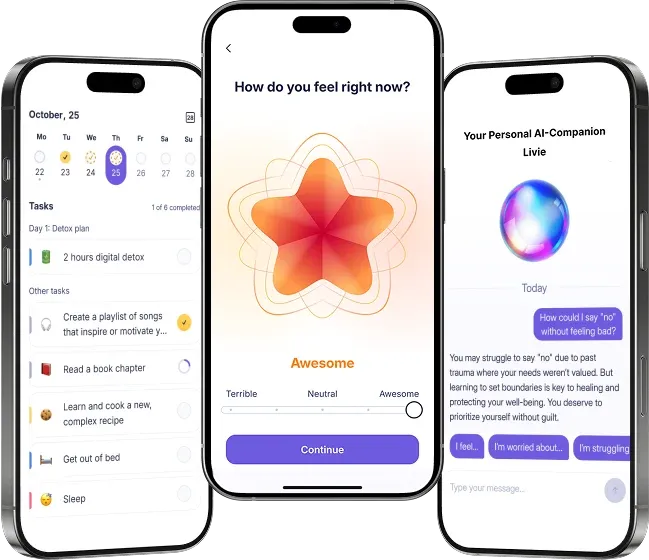
Using digital calendars like Google Calendar or adding your current tasks to Liven's Habit Builder and to-do list are among the best approaches for better managing ADHD. Instead of returning to your paper daily planner, you can create a digital one and get regular updates about the upcoming important papers, professional phone calls, or birthdays of family members. Setting reminders online will help you integrate your plans into an overall well-being path and manage your schedule in a centralized way.
🗒️ Unite small tasks for sharp bursts
You know those tiny tasks that make it challenging to stay focused? This happens because switching from one task to another can be energy-consuming for people with ADHD, even if it takes only five minutes.
When you need to make phone calls or respond to emails, try grouping them into a single time block. Setting aside a short “admin window” each day prevents these tasks from constantly interrupting your flow and helps you stay focused on more important work.
Adult ADHD Management Tips for Home
When we strive to stay on top of our professional or academic goals, we often overlook household chores and home organization. These tips might be what we all sometimes need for a simpler life.
Make Placements Predictable
Do you often forget where you put your sketchbook? Assign a designated spot for essentials using labeled storage containers or specific storage items, such as bright bowls for change or a noticeable box for documents and bills to review later. Begin by conducting a systematic review of all items that require a designated place. Label each item or container, and gradually build an organized system that reduces daily frustration.
Find a Landing Zone
Designate one visible area for keys, wallet, important papers, chargers, and other essential items that you bring into your home as soon as you enter. It can be especially useful for people who have children or many family members.
This helps you remember details before rushing outside in the mornings and ensures you have a quiet workspace and a resting zone without visual overwhelm.
Clutterbug showcases the creation and purpose of a landing zone for a specific family, as well as the way it declutters various spaces.
Effective Strategies for Emotions and Relationships
Adult ADHD can affect our emotions, relationships, and ability to stay committed just as much as it influences focus and organization. Fortunately, there are practical steps you can take to manage emotional dysregulation and strengthen connections with others.
Try Relaxation Techniques
Meditation, mindfulness, and grounding can help us manage our symptoms of ADHD that sometimes show up in the form of impulsivity. If you don't know where to start, you can always reach out to a mental health professional for advice. However, in between sessions, you can try the following for extra support:
- 10-minute meditation for adult ADHD
- Grounding techniques for women with ADHD (not gender-specific practices)
- Somatic exercises to release anger.
Move Your Body to Support Focus and Emotional Regulation
Physical activity is helpful for ADHD coping since it boosts dopamine and balances our cortisol levels. Since impulsivity and hyperactivity are common ADHD symptoms, incorporating fun, enjoyable movement into your routine can help address both, making it easier to stay calm, focused, and resilient.
If you're a parent seeking a sport to help your child manage ADHD, this article from the ADHD Center is helpful for those looking to support their child's improved academic and social performance at school and at home.
Be Open About Your Feelings
Sometimes, we are so worried that others won't understand us or will think badly of us that we are afraid to share with those we love most. And yet, managing emotions starts with our social support.
Even saying things like, "I am so tired" or "I really need a hug" is a brave thing. If you aren't ready to talk to a real person, Liven's AI companion, Livie, can be here to listen and offer compassion.
Final Thoughts
As you explore these ADHD coping strategies, remember that you're not alone and you don’t have to tackle everything by yourself. Regardless of where you are in your journey, seeking support can make a significant difference.
When you feel others standing beside you, it can spark motivation and excitement, helping you see just how much you’re capable of achieving with growing hope and confidence.
References
- ADHD game plan: The best sports for kids with ADHD. The ADHD Centre. (2018, March 21). https://www.adhdcentre.co.uk/adhd-game-plan-the-best-sports-for-kids-with-adhd/
- ADHD rates by country 2025. World Population Review. (2025, December 12). https://worldpopulationreview.com/country-rankings/adhd-rates-by-country
- ADHD tips for the Workplace. UK Council for Psychotherapists. (2025). https://www.psychotherapy.org.uk/news/adhd-tips-for-the-workplace/
- Arruda, W. (2025). Body doubling–the productivity hack you didn’t know you needed. Forbes. https://www.forbes.com/sites/williamarruda/2025/04/28/body-doublingthe-productivity-hack-you-didnt-know-you-needed/
- Data and statistics on ADHD. Centers for Disease Control and Prevention. (2024). https://www.cdc.gov/adhd/data/index.html
- Ershad, J. (2025, April 23). How exercise balances cortisol levels. Lifestyle Medicine. https://lifestylemedicine.stanford.edu/how-exercise-balances-cortisol-levels/
- Gawrilow, C., Merkt, J., Goossens–Merkt, H., Bodenburg, S., & Wendt, M. (2011\). Multitasking in adults with ADHD. ADHD Attention Deficit and Hyperactivity Disorders, 3(3), 253–264. https://doi.org/10.1007/s12402-011-0056-0
- Lu, J. G., Akinola, M., & Mason, M. F. (2017). “Switching on” creativity: Task switching can increase creativity by reducing cognitive fixation. Organizational Behavior and Human Decision Processes, 139, 63–75. https://doi.org/10.1016/j.obhdp.2017.01.005
- Söderlund, G., Sikström, S., & Smart, A. (2007). Listen to the noise: Noise is beneficial for cognitive performance in ADHD. Journal of Child Psychology and Psychiatry, 48(8), 840–847. https://doi.org/10.1111/j.1469-7610.2007.01749.x
FAQ: ADHD Coping Skills
What are common risk factors for adult ADHD?
Why does adult ADHD make everyday tasks feel overwhelming?
Can children and adults use the same coping strategies?
How can color coding help with organization?
When should someone with ADHD seek professional support?
Can building one small habit really help with ADHD management?