Why Do People Ghost? Tools for Healthy Communication and Emotional Boundaries

Ghosting is one of the most confusing behaviors in modern dating. However, it doesn’t thrive only in online dating culture; ghosting also appears in friendships, family dynamics, and even the workplace. And while people ghost for many reasons, the outcome is often the same: hurt, confusion, and a sharp hit to self-esteem.
Let’s explore why people ghost and how to navigate it, whether you’re someone who tends to ghost others and wants to understand your behavior, or someone who’s been on the receiving end of the silence.
Key Learnings
- Dating and relationships are the most common places where ghosting happens.
- Ghosting comes from fear, discomfort, and past experiences.
- Healthy responses like avoiding toxic positivity and acknowledging your anger protect your mental health.
Why Do People Ghost You? Top 5 Most Common Reasons
In most cases, people ghost because they don’t know how to healthily manage their own feelings and discomfort. Hence, they often do it at the expense of the other person’s feelings.
1. Fear of Difficult Conversations
Most people ghost because they hate confrontation and feel awkward or scared to say, “I don’t want this anymore.” They are afraid of the person’s reaction; therefore, they choose the easiest way out.
The reasons might differ:
- They worry about hurting the other person’s feelings.
- They’re going through burnout and are emotionally depleted.
- They fear rejection or backlash.
- They lack tools for honest conversations.
- For them, an uncomfortable conversation is always an awkward conversation they'd rather avoid dealing with.
2. Attachment Style
Attachment style refers to the way we form emotional bonds with others. According to Dr. Judy Ho, we learn how to form relationships through our early connections with primary caregivers, and we carry that imprint into our further intimate relationships.
A few insights on attachment styles and ghosting include:
- People will secure attachment ghost less: they’re okay with emotional closeness,
can talk about feelings, and generally handle conflict better. - People with anxious attachment are less likely to be ghosted.
- People with avoidant and disorganized attachment styles have the highest ghosting rates.
3. Past Trauma
As you’ve seen from the previous subsection, past experiences shape the way we feel and behave today.
- Family trauma. It’s way more difficult to form healthy relationships when one comes from a dysfunctional family themselves.
- Past romantic betrayal or abandonment. It’s hard to open up when one was cheated on, ghosted, or suddenly rejected.
- Emotional abuse in past relationships. Manipulation and criticism can lead one to adopt avoidance as a coping mechanism.
- Loss of a loved one or sudden grief. Early or sudden losses can teach someone to emotionally detach.
4. Dating Apps Fuel the Abundance Mindset
Why do people ghost others in online dating? Some people treat relationships as fully replaceable because an endless row of profiles, combined with constant novelty, creates an illusion of endless choices in dating apps.
Additionally, online dating culture often involves brief conversations and a lack of face-to-face interactions. Because of that, it’s easier to ghost or flake (cancel plans at the last minute).
All that swiping and matching are elements of gamification, which bring instant gratification and make the user easily distracted and less invested in any one connection.
5. Narcissistic or Self-Centered Behavior
Why do people love bomb then ghost? Well, this is a very typical behavior of a narcissist.
Some people lack empathy. In the words of Dr. Ramani, a licensed clinical psychologist, “Their [narcissist’s] lack of empathy makes it easy because they only account for their own discomfort… The ghoster is not likely to apologize or take responsibility for their behavior.”
How to Respond When Someone Ghosts You
Here is how to protect your own mental health and emotional energy.
🤡 Avoid Toxic Positivity
It’s tempting to tell yourself, “just get over it,” or “it wasn’t that serious anyway,” for self-preservation. But such a tactic doesn’t erase your feelings. Later, they’ll quietly resurface as resentment, self-doubt, and avoidance of situations that can break your heart.
So, be honest with yourself: yes, you feel hurt, angry, and frustrated (continue the list as you see fit).
Once you acknowledge your feelings, process them:
- Write freely in a journal or a separate letter to that person, but don't send it. You can also use Liven’s journaling feature so you don’t have to carry a pen and paper everywhere you go.
- Talk it through with a trusted friend or take a therapy session with a licensed therapist who’ll teach you how to deal with the uncomfortable emotions of dating rejection.
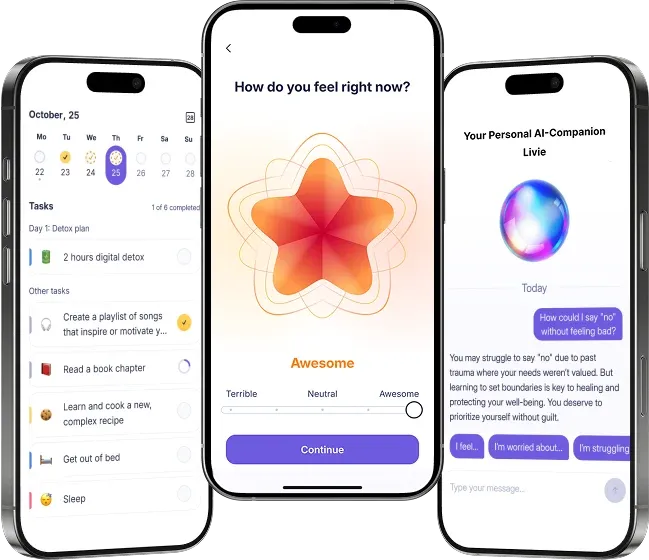
- Vent to Livie, Liven’s AI self-discovery companion that can support you 24/7, help you reflect on your feelings, and offer self-soothing tips.
- Utilize creative outlets such as music, drawing, or movement to release emotions.
😾 You Have Every Right to Be Angry
Anger makes perfect sense in the context of ghosting because someone has crossed a boundary, didn’t respect your time and energy, and denied you proper closure.
The key is to use anger as a positive emotion in your personalized plan for healthier relationships, an emotion that highlights things you can learn from the situation and keeps you keenly aware of them.
These might be (you can even take a pen and paper and write down answers):
- Where your boundaries were crossed and how you can protect them in your future relationships.
- What kind of communication feels non-negotiable for you?
- Which behaviors are you no longer willing to excuse in romantic relationships?
- What respect actually looks like to you in practice, not just in theory?
😌 Reclaim Your Sense of Control
You cannot control others’ words or actions, but you can control your emotional responses to them. Plus, you can control your daily routines to avoid falling into the endless ‘Why?” trap.
- Stop looking for closure where it won’t come from. Finding closure comes from within, and it’s your decision to stop chasing.
- Limit rumination with boundaries. Try setting soft limits with phrases like, “I’ll allow myself 10 minutes to think about this, then I’ll redirect,” or “I’ll read a book instead of re-reading older messages.” You can also start a Liven’s short CBT-based course on how to deal with anxiety and rumination.
- Separate their behavior from your worth. Someone’s inability to have honest conversations and engage in healthy conflict doesn’t reflect their worthiness as a human being.
Why Do I Ghost? Understanding Your Own Patterns
If you've ever caught yourself wondering, “Why do I ghost people?” you’re not alone. The great news is that you’re taking accountability for your actions and want to change the pattern.
Here are a few exercises to help you understand your own behavior.
1. Give a Name to Things You’re Avoiding
Ghosting someone happens when things start feeling too much. This might be the other person’s need for emotional closeness, your fear of disappointing someone, or an uneasy feeling that you’re no longer interested in the relationship, but don’t know how to express it without hurting the other.
Ask yourself:
- What conversation was I avoiding?
- Why did this conversation feel scary or uncomfortable?
- Was I afraid of conflict or the other person’s reaction?
- Did I worry that being honest would make me look “wrong,” selfish, or unkind?
- Did this situation demand more energy than I had at the time?
2. Turn Your Answers Into Healthier Actions
Below are the most common responses to the questions above and actions you can take depending on your answer.
| If your honest answer is… | A healthier alternative | A message example |
| “I was afraid of hurting the other person.” | Practice kind, respectful clarity | “I’ve enjoyed getting to know you, but I don’t feel the connection. I didn’t want to disappear without any explanation.” |
| “I was afraid of conflict or their reaction.” | Set a calm, firm boundary | “I don’t think dating is the right thing for me right now, and I wanted to be honest.” |
| “I didn’t have the emotional energy.” | Acknowledge your limits to avoid confusion | “I’m feeling overwhelmed right now and can’t show up the way this deserves. That’s about where I am, not anything you did.” |
| “Ghosting felt like the easiest way out.” | Choose clarity over short-term comfort | “I should’ve said this sooner — I’m not in a place to continue this.” |
| “I was afraid of emotional labor.” | Be clear without over-explaining | “I need to step back. I won’t continue the conversation, but I wanted to let you know directly.” |
3. Reflect on How You Learned to Handle Conflict
Home is the first place where we build conflict resolution skills with other family members. But families differ, and if you grew up in a place where silence was the only coping skill, then no wonder that you avoid conflict as a plague.
Here is a list of resources to start from if you want to learn how to healthily express your needs in life.
Books about Conflict, Needs, and Emotions
- The Conflict Resolution Playbook by Jeremy Pollack
- Nonviolent Communication: A Language of Life by Marshall B. Rosenberg
- The Anatomy of Peace: Resolving the Heart of Conflict by Arbinger Institute
- The Mindful Guide to Conflict Resolution by Rosalie Puiman
When It Is Perfectly Legitimate to Ghost Someone and Not Feel Guilty
Here are a few practical reasons where ghosting someone might be necessary:
- Someone gaslights, manipulates, and disrespects you.
- Someone is unavailable or inconsistent with their attention.
- You feel emotionally, physically, and mentally unsafe or uncomfortable (for instance, one of your former partners starts stalking you online).
- You’ve tried to communicate your intentions respectfully, but the other person refuses to accept the change.
Final Thoughts
You can’t control the ghoster’s behavior, but you can definitely choose how to respond to their actions with self-compassion and self-respect.
Meanwhile, if you’re a ghoster yourself, remember that awareness is the first step. Acknowledge and accept your own fears and the consequences they lead to, and choose proper resources to work on them.
Continue exploring your emotional world with Liven: try the Liven app (Google Play or App Store), dive into insights on the Liven blog, and discover your current mental health state with Liven’s free wellness tests.
References
- Ganguly, S. (2024). A correlational study between ghosting phenomenon and social anxiety, attachment style, self-esteem among youth population. International Journal of Indian Psychology, 12(4), 1251–1260. https://ijip.in/wp-content/uploads/2024/11/18.01.117.20241204.pdf
- Liang t al. (2025). Avoidance attachment and depression among Chinese online daters. Acta Psychologica, 258, 105282. https://doi.org/10.1016/j.actpsy.2025.105282
- MedCircle. (2023). The 4 attachment styles [Video]. YouTube. http://youtube.com/watch?v=o7RqjhBP4D4
- Narr, G., & Luong, A. (2023). Bored ghosts in the dating app assemblage. The Communication Review, 26(1), 1–23. https://doi.org/10.1080/10714421.2022.2129949
- What is “narcissistic ghosting”? (n.d.) [Video]. YouTube. https://www.youtube.com/watch?v=Y1zQrViVj3s
- Wu, K., & Bamishigbin, O. (2023). When silence speaks louder than words: Experiences of ghosters. Personality and Mental Health. https://doi.org/10.1111/pere.12518
FAQ: Why Do People Ghost?
Why do people ghost, and how can I recognize it in dating or relationships?
How should I respond when a partner ghosts?
How can I prevent repeating ghosting behaviors myself?