💬 Ask Shanen Norlin about Loving Someone With BPD [Licensed Therapist Column]
![💬 Ask Shanen Norlin about Loving Someone With BPD [Licensed Therapist Column]](https://cdn-blog.theliven.com/43de8e1cbcc461d827d17a0c6306a10c.webp)


Loving someone with Borderline Personality Disorder (BPD) can feel like trying to hold something together that keeps shifting in your hands. One moment, the connection feels real and close. Next, a small misread triggers something larger, and you're left trying to figure out what just happened and how to respond without making it worse.
BPD relationships have a particular emotional intensity that can quietly erode the supporting partner's sense of self if there's no structure holding both people. That doesn't mean the relationship isn't worth fighting for. It means it needs a different kind of framework.

Shanen Norlin is a clinical therapist, behavioral health specialist, and a member of Liven's Board of Health Professionals. Below, Shanen offers insights into the borderline personality disorder relationship cycle, why boundaries matter more here than almost anywhere else, and what support looks like for both partners.
Key Learnings
- BPD is typically characterized by intense emotional experiences and sensitivity to perceived rejection, patterns that develop in response to early relational trauma.
- For the supporting partner, clear and consistent boundaries create stability for both people.
- Couples therapy with a therapist who understands personality dynamics can help transform how conflict is navigated.
Shanen's advice on supporting a partner with BPD while protecting your own wellbeing:
Supporting a partner with Borderline Personality Disorder can be deeply meaningful and, at times, emotionally demanding. BPD is typically characterized by intense emotional experiences, sensitivity to perceived rejection or abandonment, and difficulty regulating those emotions. These patterns often develop in response to early relational trauma, invalidating environments, or inconsistent caregiving as an adaptation to survive emotionally overwhelming experiences. Because of this heightened sensitivity, certain stressors, ike conflict, distance, or changes in routine, can feel especially intense. What might seem like a small interaction can be experienced as much bigger internally, which can impact how your partner responds.
For spouses like yourself, one of the most important and often most challenging pieces is maintaining clear, consistent boundaries. Boundaries are about creating stability and protecting both people in the relationship. Without them, it's easy to slip into patterns of over-accommodating, walking on eggshells, or losing sight of your own needs, especially if there are any tendencies toward codependency. Taking care of your own well-being is necessary. This might look like maintaining your own support system, setting limits around what you can and cannot take on emotionally, and recognizing when you need space to regulate yourself.
Couples therapy can be a valuable resource, particularly with a therapist who understands personality dynamics. It provides a structured space where you can express your experiences openly, while also ensuring your partner feels supported rather than criticized. Given how sensitive BPD can be to perceived rejection, having a therapist help guide these conversations can make a significant difference. It ensures the conversations don't escalate, and also gives you a space to feel heard while your spouse is safely supported in any emotional reactions they might have.
Individual therapy can also be helpful for both of you. For the person with BPD, treatments like Dialectical Behavior Therapy (DBT) are often highly effective in building emotional regulation and interpersonal skills. For the supporting partner, therapy can offer space to process your own emotions, strengthen boundaries, and stay grounded in your role without becoming overwhelmed. Ultimately, a healthy relationship in this context is about creating enough structure, communication, and support so that both people can feel safe, respected, and emotionally intact.
How to Stay Grounded While Showing Up for Your Partner
Shanen's framework makes something important explicit that often goes unsaid in conversations about loving someone with BPD: the supporting partner's needs are not secondary. They're structural. A relationship where one person quietly disappears into the role of caretaker may be a delayed breaking point.
Here's how to build something more sustainable:
- The borderline personality disorder relationship cycle makes more sense when you understand what's underneath it. It's an emotional system that was shaped by environments where regulation and consistency weren't available. That context doesn't excuse everything, but it changes how you respond.
- Vague limits don't work in high-emotion environments. "I need some space when things escalate" means something different to different people. The more clearly you can define what you can and can't take on, and the more consistently you hold to it, the more predictable and safe the relationship becomes for both of you.
- Living with someone with BPD can gradually pull a partner into over-functioning, e.g., managing emotions that aren't yours, suppressing your own reactions to keep the peace, and measuring every interaction against how your partner might receive it. That erosion is slow and often goes unnoticed until it becomes significant. A therapist of your own is one of the most practical tools for catching it early.
- Couples therapy, specifically with someone who understands personality dynamics, can change the architecture of the conversation itself. With a therapist in the room, emotionally charged moments have somewhere to land that isn't on you alone to absorb.
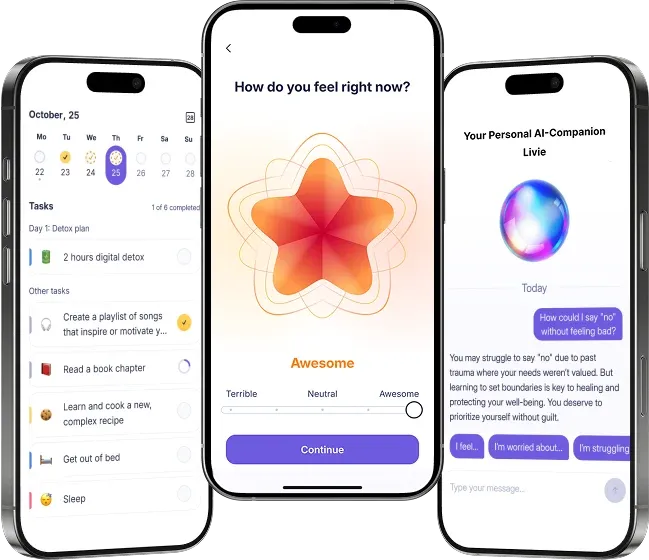
- Processing what it means to love someone with BPD needs its own dedicated space. That's what the Liven app gives you: somewhere to be honest about your experience without managing how it lands.
FAQ: Loving Someone with BPD
What is the BPD relationship cycle?
How do I set boundaries with a BPD partner without triggering them?
Is codependency common in BPD relationships?
Can a relationship with someone with BPD be healthy?