How to Handle Conflict in a Relationship So You Both Feel Heard? 7 Tips to Try



Reviewed by
Tara Passaretti, M.S., LMHC


It’s late, you’re tired, and another disagreement arises. You want to explain your side, but your partner interrupts. You feel unheard. They feel attacked. Now you're both sitting in silence on opposite ends of the couch, wondering how things got here so fast.
Spoiler alert: you don’t have to avoid disagreements if you want to learn how to handle conflict in a relationship. What you need is a set of practical skills, such as how to stay calm, communicate clearly, and reconnect after tension.
Let’s see how to make it happen.
Key Learnings
- Conflict is a normal part of any relationship.
- Healthy communication skills like using “I” statements, actively listening, and staying focused on one issue can prevent arguments from escalating.
- Taking breaks when emotions run high helps your nervous system reset.
- Treating conflict like a shared problem to solve helps couples build trust and resilience.
How to Have a Healthy Disagreement in a Relationship
The tips below will teach you how to make disagreements safer and more constructive so both parties feel understood.
1. Think of Conflict as an Opportunity for Growth
Start your personalized plan for healthier relationships with this simple idea: conflict isn't a threat to your relationship.
Disagreements arise in every partnership, and that's not a red flag. It's just two people with their own experiences, needs, and communication styles trying to figure out how to build something together.
Conflict can help you discover what needs attention in your relationship and what each person needs in order to feel more understood and valued. In this way, it can become a useful tool for improving communication and strengthening connection over time.
2. Have Difficult Conversations in Real Time
It’s easy to misinterpret the text as there are no facial expressions, gestures, or tone.
If things are tense, resist the urge to resolve it via messages and schedule (yes, literally schedule) a face-to-face conversation when you’re both calm.
Also, schedule that conversation in a comfortable and quiet space where you both feel relaxed and no one will interrupt you.
3. Focus on One Issue at a Time
It might be very tempting to bring up that thing your partner said at a dinner party two years ago.
Try these tips to stay on topic:
- Name the issue at the start and how it made you feel. Keep it clear and specific, something like "I want to talk about what happened this morning. I felt confused and wanted to get some clarity."
- If the conversation starts to drift, bring it back. "I hear you, and I think that's worth talking about too, but can we finish with this first?"
- Write down the secondary issues if they come up so you both know you can bring them up later or during the future talks.
4. Build Connection With Your Words
It’s often the way we communicate during a conflict, more than the issue itself, that shapes how the conversation unfolds.
Healthy communication helps both people feel safe enough to stay engaged.
Use "I" Statements
When you lead with you, the other person often goes on the defensive immediately and stops really listening.
"I" statements keep the focus on your experience rather than your partner's behavior. Instead of: "You never listen to me." Try: "I feel unheard when I'm talking and you're looking at your phone."
Listen and Paraphrase
Paraphrase what your partner just shared (in your own words). This does two things: it ensures you understood correctly, and it signals to them that they've been heard. Example: "So what I'm hearing is that you felt like your needs were being dismissed when I didn't ask about your day. Is that right?" Then let them confirm or clarify.
Lead With Compassion
Showing compassion and empathy in conflict doesn't mean you excuse one's harmful behavior. It means you recognize your partner is a human being with their own fears, history, and emotional experiences.
Example: "I know you've been under a lot of pressure at work lately, and I wonder if that's part of why this landed differently today. I'm not dismissing what happened - I just want to understand where you're coming from, too."
5. Recognize When to Pause and Regulate
When emotions get intense enough, the rational part of your brain goes offline, and, eventually, cuts your productive conversation. That’s why taking a break to calm down is so important.
Some couples agree on a temperature-based check-in sometimes called the Kettle exercise during heated moments. Imagine you're a kettle on the stove. Each person names their temperature on a scale of 1 to 10. If someone's at a 7 or above, it's time to pause for at least 20 minutes. Research shows it takes about that long for heart rate and stress hormones to return to baseline after physiological arousal during conflict
It’s also important you set a time to return so the break doesn’t feel like abandonment or stonewalling. This is crucial if you or your partner have an anxious attachment style, since silence might be a trigger for fear of abandonment.
During the break, do something genuinely calming: go for a walk, listen to Liven’s Soundscapes with binaural beats and nature sounds, or do some deep breathing.
You can continue the talk with a reconnection ritual like a hug, making a tea, or reminding yourselves how much you love each other with a few warm words.
6. Think of Your Conflict as a Project
When you stop seeing conflict as something to survive and start seeing it as something to solve together, everything shifts.
- After the conflict cools, schedule a debrief - a short, calm conversation about what happened and what you both learned from it.
- Name the problem like a shared challenge, something like "We have a communication breakdown when one of us is stressed. How do we want to handle that going forward?"
- Set small, specific agreements. For instance, "Next time we disagree about plans, we'll talk it through before making a final call."
- Use Liven's journaling feature to reflect on what keeps coming up and what seems to trigger things. Later, bring those insights into the conversation with your partner.
Sometimes it helps to see it, not just read it:
7. Try Therapy
Even couples in generally healthy relationships go to therapy for support, growth, and communication tune-ups.
Liven's Structured Courses on anxiety management, burnout, childhood trauma, and more are co-created with a Board of Health Professionals, so the inner work you do here is grounded in real science. Work through them at your own pace and show up to your next difficult conversation with a little more self-awareness and a little less unprocessed baggage.
Final Thoughts: Strong Relationships Aren’t Conflict-Free
Conflict isn’t the problem. The way we handle it is.
Most of us never explicitly learned these skills growing up. But with practice and the right tools, you can build and strengthen them. And the more you use them, the more naturally they'll come even in the hardest moments.
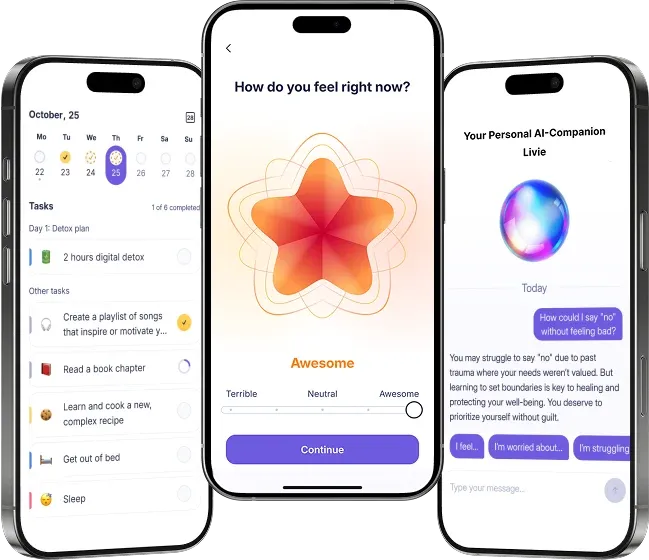
If you're ready to take the next step in your self-discovery journey, Liven is here for it. Try the Liven app (Google Play or App Store) to track your mood, reflect in your journal, and develop healthier responses to stress and conflict.
Or explore more insights like this on the Liven blog and get a clearer picture of where you're starting with Liven's wellness tests.
References
Anya, S. (2023). 5 steps to repair conflict in your relationships [Video]. YouTube. https://www.youtube.com/watch?v=LEG8xOuvAEc
Dermody, S. S., Earle, E. A., Fairbairn, C. E., & Testa, M. (2025). Time-varying relational interaction dynamics in couples discussing conflict. Journal of Social and Personal Relationships, 42(5), 1199–1218. https://doi.org/10.1177/02654075251317168
Gottman, J. M. (1994). What predicts divorce? The relationship between marital processes and marital outcomes. Lawrence Erlbaum Associates.
Gottman, J. M., & Levenson, R. W. (1992). Marital processes predictive of later dissolution: Behavior, physiology, and health. Journal of Personality and Social Psychology, 63(2), 221–233. https://doi.org/10.1037/0022-3514.63.2.221
Waghmare, R. D. (2023). A study of conflict resolution styles among married couples. Educational Administration: Theory and Practice, 29(4). https://doi.org/10.53555/kuey.v29i4.11121
FAQ: How to Handle Conflict in a Relationship
Can healthy conflict resolution work if my partner is a narcissist or compulsive liar?
How do I begin hard conversations in everyday life?
How to handle conflict in a relationship without damaging the connection?
Can conflict resolution support personal growth, or does it only help the relationship?
What should I do when disagreements arise again and again over the same issue?
How does trauma affect the way people handle conflict in relationships?