



Emotions are so integral to our lives that it seems impossible not to feel them. But while we are taught how to write, spell, and make friends, we are rarely introduced to the art of emotional expression. Most of the time, we are taught that feelings are allowed only if they are quiet, positive, acceptable, utterly un-bothersome.
And if we repeat "I'm fine" often enough, we might forget what exists outside of the familiar space of neutral. Hesitating to express emotions is often a self-protective response.
Now that you are here and know how to build a safe space around yourself, you can start this journey into your inner world, knowing that wherever you go, you've got a compass to help you figure things out. We'd like to present you with this compass in the following article.
Key Learnings
- Expressing your emotions begins with identifying your physical state using practices such as the body-to-breath scan.
- Practicing self-compassion is about small, private moments of self-expression and opening up through creative outlets for clarity.
How to Express Emotions Safely
As you learn to express your emotions when you feel comfortable, your path begins with self-understanding and continues into expression and communication.
A Step Toward Emotional Intelligence
Before we can express an emotion, we have to identify it. Often, we experience feelings as a vague, heavy weather system rather than a specific state. To move from vagueness to something authentic, we use a process called emotional granularity. This is the psychological ability to distinguish among similar emotions, such as the difference between annoyance, disappointment, and betrayal.
To begin, try the "Body-to-Breath Scan." This exercise helps bypass the intellectual filter and goes straight to the physiological data.
- Settle. Close your eyes and take two deep breaths. Don't look for a feeling yet; just look for a sensation.
- Locate. Scan your body. Where is the energy? Is there a tightness in your chest? A heat in your face? A hollowness in your stomach?
- Label. Attach a "raw" word to it. Instead of saying "I feel sad," try "I feel a heaviness in my shoulders."
- Query. Ask yourself, "If this feeling had a name, what would it be?" Let the answer bubble up without judging it.
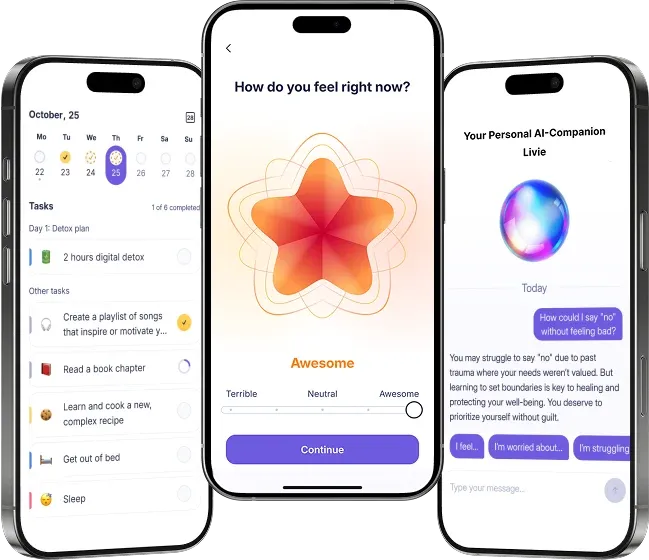
Liven's Mood Tracker can help you with learning to identify your emotions and analyze how you feel.
We might feel confused when thinking about our emotions due to various factors:
- Fear of feeling vulnerable
- Trauma caused by loved ones
- Lack of vocabulary for self-expression
- History of being emotionally dismissed.
Express Your Feelings Privately First
Before you can communicate feelings to anyone else, you need to create space for them within yourself. When we experience an intense emotion, our nervous system often goes into overdrive, triggering physical symptoms such as a racing heart, shallow breathing, or a knot in the stomach.
If it's new to you, you might like the chance to express emotions privately first.
- Somatic Experiencing. If you feel angry or overwhelmed, your body may still be holding physical tension from the stress response. Gentle movements, like shaking your arms and legs for about a minute, can help release tension and support nervous system regulation.
- Unfiltered Brain Dump. Take a few minutes to write down every uncomfortable or chaotic thought and emotion you’re experiencing. Don’t edit yourself. The goal is to externalize your thoughts, moving them from your mind onto the page so they become easier to process.
- Sensory Grounding. Focus on the present moment. Name three physical sensations you feel right now (e.g., "the cold air on my skin," "the weight of my feet on the floor"). This keeps you anchored so you don't get swept away by complex emotions.
If expressing your emotions fills you with worry, it may be a good time to take a quiz and get your personalized plan for a calmer mind.
Communicate Feelings to Loved Ones
People struggle to express feelings with family members and partners for different reasons: from not knowing how to talk about difficult emotions to not knowing if they have "permission" to do so. In healthy relationships, sharing feelings helps us be ourselves with others and also actually let ourselves live all of our own feelings.
To communicate feelings effectively, try the "I-Statement" framework:
"I feel [Emotion] + when [Event] + because [Need]."
For example, if you have been overthinking in your relationship, you can tell your partner something like, "I feel anxious when you don't text back for hours because I need to feel connected to know we're okay."
Try Creative Outlets to Feel Your Strong Emotions
When you feel uncomfortable or stuck in emotional numbness, it's often because your feelings are trapped in a loop inside your nervous system. Creative externalization helps you process emotions by giving them a physical shape, color, or sound. It is so effective because it doesn't just appeal to your mind but also to your body, which is a great way to process your past experiences and current needs and build stronger emotional awareness without falling back into rationalization.
Scribble release. If you feel angry or overwhelmed, grab a piece of paper and some crayons or markers. Don’t try to draw a picture. Instead, focus on your physical sensations and let your hand move accordingly.
- Is the feeling sharp? Use jagged lines.
- Is it heavy? Press down hard.
- This translates a chaotic emotional state into a visual representation you can finally "see."
Whether you're working on negative feelings or something positive, try to experiment with paint, pastels, or pencils. Use your fingers if you're okay with getting your hands dirty.
The emotional playlist. Music is one of the fastest ways to shift our physical symptoms and tap into the present moment. If you are struggling with uncomfortable feelings that you can’t quite name, find a song that matches the vibe of your heart.
- Listen to it fully.
- Notice where you feel the music in your body.
- Sometimes letting a song "speak" for you is the first step toward sharing your feelings with someone else later.
When you're ready or have accumulated more songs to resonate with you, you can create separate playlists for negative or positive feelings, for a specific emotion, or just a general situation that you know you want to go through.
Invite Curiosity Into Your Journey
If you've made it this far, you've already done the hardest part: you've brought kindness to your life. By acknowledging your physical sensations and choosing to process emotions rather than bury them, you are already rewriting your story. And the best thing is that you don't have to become "perfect" about revealing your true feelings to yourself overnight. It would feel overwhelming.
Instead, stay curious. Give your body permission to open up to your feelings more often. It’s okay if you still feel uncomfortable sometimes, and it’s okay if you still face emotional numbness on the hard days. Just remember that you now carry the compass.
You have the tools to navigate the complex emotions of being human, and you no longer have to walk the path alone.
References
- Rauch, M., & Ansari, S. S. (2024). Reframing silence as purposeful: Emotions in extreme contexts. Journal of Management Studies, 62(3), 1191–1219. https://doi.org/10.1111/joms.13079
FAQ: How to Express Emotions
Is it bad to feel "negative" emotions like anger or jealousy?
What if I start expressing feelings and can’t stop crying?
How can I practice emotional expression if I’ve always been "the quiet one"?
Why do I feel hurt even when I know the other person didn’t mean it?
How can I make sure the general tone of a hard conversation stays productive?
Will learning to express feelings immediately change my life?
What if I’m afraid of how others will react to my honesty?