How to Stop Self-Criticism and Be Kinder to Yourself




How do you feel when you accidentally make a tiny mistake at work? Perhaps, not good enough, right?
Somewhere along the way, you might’ve learnt that listening to your inner critic meant you cared about doing things right. But contrary to this idea, harsh self-criticism keeps you stuck because it turns every mistake into a negative verdict about who you are. Healthy self-reflection, on the other hand, focuses on what went wrong and what you can do differently next time.
Check out the tips on how to stop self-criticism and build a healthier relationship with yourself so you can finally break the cycle of harsh self-judgment.
Key Learnings
- Evolutionarily, self-criticism developed as a protective mechanism, but today it often creates shame rather than personal growth.
- Practical tools like evidence-checking, mindfulness, and compassionate self-talk help retrain your inner dialogue.
- Consistent self-awareness and small daily practices build lasting trust, confidence, and emotional balance.
Why Your Brain Created Self-Criticism?
Before you can change your inner dialogue, it helps to understand why your brain learned to speak to you this way in the first place.
- The inner critic is a protection system. From an evolutionary standpoint, you had to pay attention to your missteps so your tribe wouldn’t cast you. But your “modern” brain hasn’t caught up with the fact that a stumbled sentence doesn’t pose the same threat of exile as accidentally burning down the communal shelter. Also, the harshest inner critics are often the result of depression and anxiety, which amplify negative self-judgments and worry.
- Childhood, perfectionism & comparison shape it. Maybe you were praised mainly for achievement, compared to others, or grew up in a bad-parent dynamic where mistakes felt like a big deal. When all your formative years are full of proof that love and belonging are conditional on performance, you internalize the belief and later become the one who reinforces it.
- Trying to stop thinking negative thoughts backfires. Research in applied psychology shows that the harder you try to suppress a thought, the more power you give it, which is called the “ironic process theory.” Same deal with self-criticism: the stronger you fight the thoughts, the louder they get. What actually works is shifting how you relate to them, which is exactly what's coming next.
5 Practical Ways to Quiet Your Inner Critic
The goal here is to transform your inner dialogue so that your harsh self-critic becomes a compassionate guide by noticing unhelpful thoughts, managing feelings of shame, practicing self-kindness, and understanding the different “parts” of yourself that show up.
1. Introduce an ‘Experiment’ Mindset
What if you thought of failures and mistakes as experiments? When scientists run experiments in a lab, they can only hope the outcomes will match their hypothesis. And when they don't? They don't write in their notebooks, “I'm a total failure.” They write down what they learned and use this valuable data to design the next experiment.
You can apply the same logic to your life. Every attempt gives you information. You tried something. Here's what happened. Here's what you’ll do differently next time.
2. Look for Facts and Evidence
Here's a detective exercise. The next time your inner critic fires up and says something like "I’m a complete failure," treat that claim the way a good detective would treat an unverified tip: with healthy skepticism. Ask yourself, “What's the actual evidence for this?”
Think of a colleague who missed one deadline but nailed the next ten. By the logic of the inner critic, one mistake = failure. But by the logic of evidence? That's just one data point in a much bigger picture.
The same applies to you. Is your negative self-evaluation based on one moment, or does it reflect the full picture of who you are? The key is to find out whether the voice in your head is a harsh interpretation that might not reflect the full picture or a useful signal worth acting on.
3. Write Down Your Triggers
Before you can change your response to self-criticism, you need to know what triggers it. That means getting intentional about noticing and documenting the situations, people, and places that reliably make you feel bad about yourself.
4. Use Mindfulness Practices to Control Your Reactions
Mindfulness teaches you to pay closer attention to what's happening in the present moment, which includes your thoughts and how your body responds to them.
When you learn to notice these signals, you can pause and choose how to respond instead of letting the situation sweep you away.
You might want to try the following practices:
- Body scan meditation. In this practice, you move your attention through different parts of your body and notice sensations as they appear. For newbies, meditation apps are a good place to start if one feels confused or unsure about the practice.
- Mindful breathing (box breathing or 4-7-8). Slow, structured breaths help activate your body’s relaxation response and reduce stress-driven tension that fuels negative self-talk.
- Label emotions. Put simple words to what you feel (“I notice shame right now”). Naming emotions helps the thinking brain regain control and lowers emotional reactivity.
- Mindful journaling. Write about experiences with curiosity rather than judgment.
🤔 Did you know? Practicing self-compassion may actually change how the brain responds to self-critical thoughts. After an 8-week program in one study, participants became less self-judgmental and showed brain changes associated with reduced fear and improved self-regulation. People who experienced childhood trauma had the most significant improvements.
5. Talk to Your Inner Self-Critic with Compassion
One of the most effective exercises for this comes from Internal Family Systems therapy. In the exercise, you imagine your critical thoughts as characters whom you seek to understand and thank.
- Describe your Critic. Why did they show up? What are they worried about?
- Thank them for coming.
- Create a “healthier” thought to replace what they were guarding against.
- Let them go.
Imagine you notice a typo in a presentation you already sent. The Perfectionist Work Critic (who might look like an overworked manager in your imagination) shows up immediately: "You always mess things up." You don't argue. You picture the Critic, thank them for caring about your reputation, and remind them: "One imperfect slide doesn't define the overall quality of my work." Then you let it go.
By the way, people experience different “types” of inner critics. One study identified 6 critic types, each linked to different emotional experiences and coping needs: the Teamster, Non-feeler, Worrier, Not Good Enough for Self, Not Good Enough for Others, and Hated Self.
If self-criticism is affecting your work, relationships, or daily functioning significantly and comes with persistent feelings of anxiety, shame, or depression, it may be a good moment to reach out to a mental health professional who can help you explore these patterns safely and with support.
The Inner Critic Had Its Say. Now It's Your Turn.
Growth starts the moment you notice the harsh voice and decide to answer it differently. As time goes on and you learn to accept every part of yourself, the voice that once criticized you can become a voice that guides you.
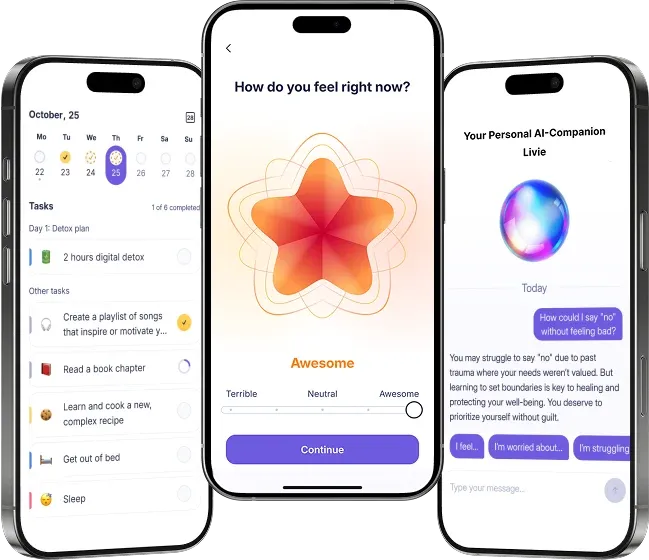
Your self-discovery journey doesn't have to happen alone or all at once. Start small: download the Liven app (Google Play or App Store) and try one mood check-in today. Browse the Liven blog when you want a deeper dive into a topic that's been on your mind. Or take one of Liven's free wellness tests to get a baseline on your current mental health.
References
- Joss et al. (2025). Neural correlates of reduction in self-judgment after mindful self-compassion training. Journal of Mood & Anxiety Disorders, 9, 100096. https://doi.org/10.1016/j.xjmad.2024.100096
- Lee et al. (2024). The negative effect of solving the ‘white bear’ problem with mindfulness. Personality and Individual Differences, 217, 112447. https://doi.org/10.1016/j.paid.2023.112447
- Šoková et al. (2025). Breaking the vicious cycles of self-criticism. BMC Psychology, 13(1), 266. https://doi.org/10.1186/s40359-024-02250-2
FAQ: How to Stop Self-Criticism
Is self-criticism ever helpful?
How do I practice self-compassion when I'm feeling disappointed in myself?
Can self-compassion really improve my mental health?