How to Identify Emotional Triggers and Reduce Intense Negative Emotions



You spill coffee, miss a deadline, or hear a familiar tone of voice. Suddenly, the emotional reaction feels bigger than the situation itself. “Why is this happening again?” you might think.
These moments are part of everyday life and often signal unrecognized triggers. In this article, we'll explore how to identify emotional triggers so you know what your system is responding to, along with strategies to help you deal with them.
Key Learnings
- Emotional triggers often appear as intense emotional or physical responses.
- Practices like body scans, mindful pausing, and HALT self-check help you respond healthily.
- Sensory grounding, deep breathing, and somatic exercises reduce intense emotional reactions.
- Once you learn how to identify and manage emotional triggers, you can turn moments of distress into opportunities for self-awareness and growth.
How to Identify Emotional Triggers Step by Step
Before you can manage emotional triggers, it helps to understand how they show up in real time. The steps below will help you notice your emotional reactions and build awareness of patterns that signal personal triggers.
1. Pay Attention to Your Reaction
The first step in learning how to identify your emotional triggers is noticing what happens the moment you feel triggered. Triggers often reveal themselves through strong emotional responses that feel disproportionate to the situation.
- Sudden anger, shame, fear, or sadness
- A strong urge to escape, argue, or shut down
- Intense emotional reactions that linger longer than expected
Why does it happen?
When your brain perceives an emotional or physical threat, the amygdala interacts with the prefrontal cortex, past experience, and individual sensitivity. This is why certain emotional reactions can feel automatic and hard to control, which is completely normal.
2. Notice Physical and Emotional Cues
When you feel an intense emotion, your heart, breathing, muscles, hormones, and even your face react automatically.
Common emotional and physical reactions include:
- Tight chest or throat
- Racing heart
- Shallow breathing
- Nausea or stomach tension
- Muscle clenching or restlessness.
🤔 Did you know? Positive emotions like happiness can protect your body, while prolonged stress or anger can cause serious health problems.
3. Detect Your Emotional Triggers with Mindfulness
One study found that after 8 weeks of mindfulness practice, participants became more aware of their emotions and responded with less automatic suppression.
A few mindfulness practices that help improve emotional regulation skills:
- Body scan: Briefly notice areas of tension or discomfort in your body.
- Breath awareness: Pay attention to your natural breathing for a few moments.
- Mindful pausing: Take one intentional pause before responding.
- HALT Self-Check: Ask whether you’re Hungry, Angry, Lonely, or Tired (internal states often amplify emotional reactions).
4. Label Your Emotion
When you label your emotion, you activate the reasoning center in your brain and decrease the amygdala activity, your brain’s fear center.
Instead of admitting the vague “I feel bad,” be more specific about your current emotional state: try “I feel anxious and tense,” “I feel hurt and rejected,” or “I feel overwhelmed and frustrated.”
5. Journal Your Emotional Triggers
A trigger journal is a great tool to identify patterns over time. This approach is especially helpful if you’re learning to identify emotional eating issues.
You might find surprising patterns like:
- Certain people or relationship dynamics
- Specific days of the week or times of day
- Activities, colors, sounds, or even scents
- Environmental factors like loud noises or crowded spaces.
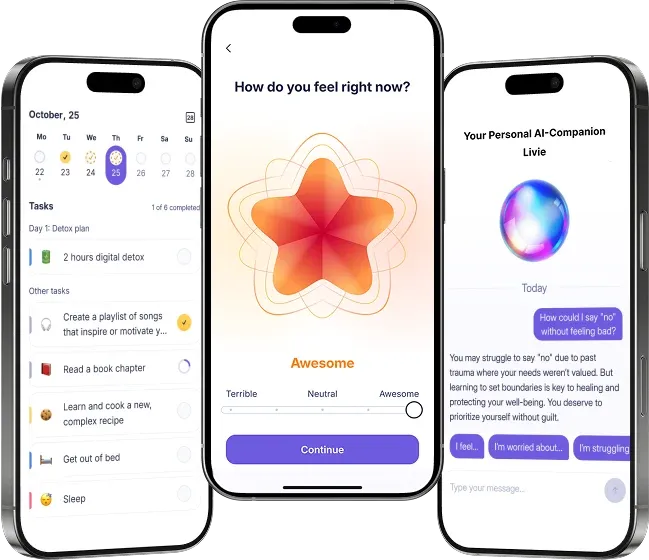
💡 Tip: Use Liven’s Mood Tracker to note triggering situations with details like place, who you’re with, and what you’re doing in the moment to see recurring patterns.
You can also jot down things like your body responses and the automatic thoughts into Liven’s journal.
Your Steps After Identifying Emotional Triggers
Now that you’ve learned how to spot emotional triggers, it’s time to understand what they mean and how to respond healthily when they appear.
Step 1: Explore the Root
Triggers are rarely about the present moment alone. Often, they’re connected to past trauma, painful memories, or unresolved emotional needs. When exploring psychological triggers, please ensure you are in a secure environment or under the guidance of a licensed mental health professional.
Ask yourself:
- Have I felt this way before?
- Does this remind me of a past event or traumatic event?
- Is this reaction protecting me from something?
We also advise you to categorize your emotional triggers. When you understand the nature of your triggers, you can plan better supportive coping mechanisms.
| Trigger Type | What It Looks Like | Emotional & Physical Reactions | Helpful First Step |
| Relational | Criticism, rejection, conflict | Strong emotional reaction, self-doubt, urge to withdraw or defend | Pause and label the emotion before responding |
| Environmental | Loud noises, crowded spaces, bright lights | Anxiety, irritability, headaches | Ground through senses (touch, temperature, breath) |
| Internal | Hunger, fatigue, negative self-talk, stress | Low mood, impatience, overwhelm | Meet basic needs (rest, food, breaks) |
| Trauma-related | Smells, sounds, and phrases linked to a traumatic event | Intense emotional responses, panic, dissociation, and physical reactions | Remind yourself you are safe now |
| Situational | Deadlines, uncertainty, significant life changes | Feeling overwhelmed, restlessness | Break the situation into smaller, manageable steps |
Step 2: Learn Grounding Techniques
Grounding techniques help you regain a sense of safety in your body and mind when a triggering event activates strong emotions. They calm the fight-or-flight response and reduce intense negative emotion.
✋ 5-4-3-2-1 Sensory Grounding
Shifts attention from overwhelming thoughts to the present moment. For instance: name 5 things you can see; 4 things you can touch; 3 things you can hear; 2 things you can smell; and 1 thing you can taste.
🧘♀️ Deep Belly Breathing
Activates the parasympathetic nervous system and reduces physical signs of stress, like a racing heart or shallow breathing.
Try the following. Place one hand on your chest, one on your belly. Then, inhale slowly through your nose, letting your belly rise. Exhale gently through your mouth. Repeat for 5–10 breaths.
🤸 Grounding with Movement
Physical motion helps release strong emotions stored in the body. You can shake out your hands and legs for 1–2 minutes, take a brisk walk, stretch, dance, or move in rhythm with music.
Individuals with a history of PTSD should approach this activity with caution, as certain elements may trigger trauma-related symptoms or flashbacks.
💡 Tip: You can integrate daily micro-movement sessions with Liven’s Routine Builder to prevent emotional overwhelm.
🌿 Object or Focus Anchoring
Provides a simple, reliable anchor for attention when emotions tied to past experiences arise.
Try the next exercise. Hold an object with texture, such as a stone, stress ball, or piece of fabric. Describe its color, weight, temperature, and shape in detail. If your mind wanders, gently bring your attention back to the object. Continue the exercise until your emotional intensity decreases.
“Set an alarm for 10 minutes, and during this time, you will only focus on your sense of touch, focusing on your preferred object for 10 minutes. An alternative is to go outside and walk on the grass barefoot, focusing on how the grass feels on your feet for 10 minutes.” — Amanda Jensen, Psy.D., L.P.
💡 Tip: Record each grounding method, how you felt, and what helped with Liven's Mood Tracker and Journaling. Review your entries to identify which techniques are most effective for gradually shaping your personalized dopamine management plan for stress regulation.
Step 3: Access Professional Help
❗ For people with post-traumatic stress disorder, anxiety disorders, or other mental health conditions, emotional triggers may be linked to distressing memories stored in the nervous system rather than conscious recall.
Therapies that Help with Emotional Triggers
| Type of Therapy | How It Helps |
| Cognitive Behavioral Therapy (CBT) | Identifies and reshapes unhelpful thought patterns |
| Trauma-Focused CBT | Integrates trauma awareness with cognitive tools |
| EMDR (Eye Movement Desensitization & Reprocessing) | Reprocesses trauma memories stored in the nervous system |
| Somatic Therapy | Works with physical sensations and bodily responses |
| Dialectical Behavior Therapy (DBT) | Builds emotional regulation and distress tolerance |
💡 Tip: Liven’s anxiety management course and Livie, the smart companion in the Liven app, can support your reflection between sessions, helping you gain valuable insights and practice emotional regulation skills consistently.
Taking the Next Step with Awareness
When you know how to identify personal emotional triggers, you can finally make sense of why certain situations spark strong emotions.
Continue your self-discovery journey with Liven: try the Liven app (Google Play or App Store), explore more insights on the Liven blog, and take free wellness tests to learn more about your current mental health state.
References
- Galvano, F. (2024). Physiological Changes Associated with Emotions. Behavior Analysis Team – NOC.
- Marks, T. (2024). Claim Your Emotions: How to Identify and Name What You're Feeling. YouTube.
- Shuxia Chen (2024). Pathways to Emotional Self-Regulation through Mindfulness Meditation. Academic Journal of Management and Social Sciences, 9(2).
- Therapy in a Nutshell (2024). Manage Trauma Triggers and PTSD — Journaling Prompts for Mental Health. YouTube.
FAQ: How to Identify Emotional Triggers
What are emotional triggers, and how do they affect mental health?
How can I identify my own emotional triggers?
What helps with managing emotional triggers long-term?