How to Track Your Mood Using Journals, Apps, and Simple Habits

If you’ve ever wondered why you wake up in a good mood one day and feel low the next, you’re not alone. Numerous internal and external factors, including brain chemicals, sleep patterns, stress levels, and daily habits, influence your mood throughout the day.
But once you learn how to track your mood, you can turn vague feelings into something you can understand, reflect on, and work with. Here is how to do it right.
Key Learnings
- Learning how to track your mood helps you understand emotions and notice patterns over time.
- Consistent mood tracking makes it easier to spot early signs of stress, anxiety, or low mood.
- Using a mood tracker or mood journal helps turn feelings into insights that you can act on.
5 Reasons to Try Mood Tracking
- Helps you learn how to improve emotional regulation.
- Contributes to better self-awareness and self-reflection.
- Helps identify patterns behind mood changes.
- Makes your therapy sessions more intentional.
- Helps you feel more in control of difficult emotions, such as anger, worry, or sadness.
How to Track Your Mood?
Here is a brief guide to help you get started quickly and stay consistent with your practice.
1. Pick a Mood Tracker You’ll Actually Use
The best mood tracker is the one you’ll stick with.
The Classic Mood Journal
You can write down simple daily prompts in a notebook:
“Today I’m feeling ___ because ___” or “My energy in this moment is ___.”
Or you can get more creative and use color coding (here are a few color-coded mood journal systems beautifully explained).
Digital Journals & Mood Trackers
A mood tracking app saves time and effort because everything you need is already on your phone.
| Type | Focus | Best For | Examples of Apps |
| Simple mood loggers | Quick mood check-ins with emojis, colors, or scales | Individuals who want quick, regular mood check-ins | Daylio, Moodly |
| Holistic wellness apps | Mood + habit tracker; self-care routine builders | Those who want to understand how daily activities affect their emotional state and build healthy habits | Liven vs Fabulous |
| Detailed journaling tools | Long-form writing and deep reflection prompts | Individuals who prefer deeper self-reflection | Day One, Journey |
| Mood + symptom-and-medication trackers | Mood tracking alongside physical symptoms, medications, and health data | People managing chronic conditions, mood disorders, or working closely with a therapist or doctor | CareClinic, MyTherapy |
Feelings Wheel
A feelings wheel helps you identify emotions when words don’t come easily. Instead of “okay,” you might land on “overwhelmed,” “hopeful,” or “sad.”
How to combine the wheel with your daily entries:
- Pick a broader emotion on the wheel.
- Narrow it down.
- Add it to your entry and provide context about why it appeared.
2. Identify Triggers and External Factors
Your mood doesn’t exist in a vacuum. Daily activities affect how you feel.
That’s why, if possible, track:
- Sleep
- Diet
- Exercise
- Stress levels
- Social interactions
- Workload.
For instance, you might notice your sleep schedule is chaotic. Suddenly, your “I’m constantly feeling low” diary entries start making sense.
Mini-example of a diary entry
Mood: low
Trigger: poor sleep + skipped lunch
Context: stressful meeting
Body: tense shoulders
🤔 Did you know? Research shows that mood disorders like depression are closely linked to disrupted sleep and the body’s internal clock.
3. Be Consistent with the Practice
One study shows that mood tracking becomes a habit when done for 6 weeks, with moods tracked 3 times per day, triggers recorded, weekly anxiety & depression tests completed, and passive data like sleep and exercise collected continuously.
- Set a fixed time each day. Choose a consistent moment, such as the first thing in the morning or before bed, to reflect on your daily activities and record your thoughts and feelings.
- Use app reminders. Most mood tracking apps have notifications to nudge you at regular intervals.
- Bundle mood tracking with other routines. Pair it with a morning coffee or jotting down tasks in your daily planner.
- Review and adjust. Look at your mood journal weekly to see what’s working and what’s slipping. You can also use the insight to refine your personalized dopamine management plan so your habits and routines help you feel better.
4. Assess Your Emotions Every Week and Month
To strengthen your mood tracking, consider using standardized tests that help you gain a deeper understanding of your mental state.
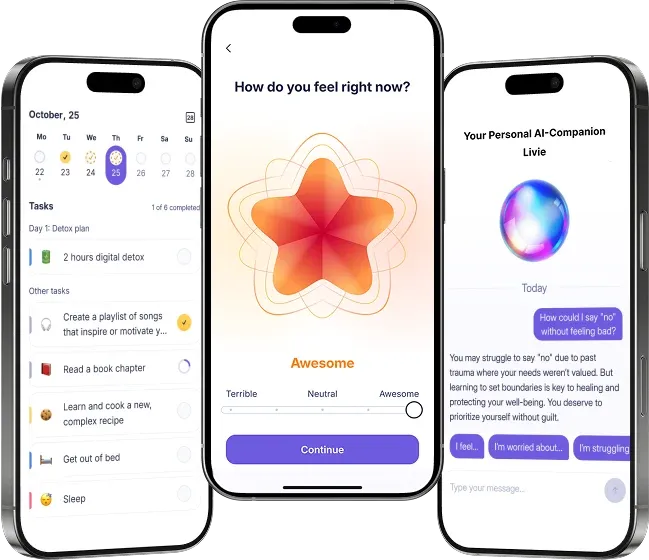
For instance, the Liven app offers the DASS-21 (Depression, Anxiety, and Stress Scales) as a weekly assessment. The app saves your results chronologically, which allows you to compare your progress over time.
You can also explore other Liven assessments that focus on personality type, motivation, procrastination, and other related aspects.
🤔 Did you know? Some studies predicted depression with over 80% accuracy using phone data.
5. Combine Your Mood Tracking Sessions With Educational Content
Tracking helps you see what is happening in the moment, while courses and exercises help you see the reasons why you’re experiencing a certain mood.
For instance, Liven offers CBT-informed courses on anxiety, stress, procrastination, brain chemistry, and its correlation with mood, and other topics. Plus, you get personalized video and text content from Liven’s certified mental health experts.
6. Bring Your Mood Tracking Data to a Therapist
Track your mood between therapy sessions to collect more data.
For instance, Liven’s mood tracker helps you record the mood, tap the underlying feeling, and document the context of the situation (who you’re with, where, and what you’re doing). Meanwhile, you can also make some journaling notes while tracking your mood.
Top Beginner Challenges and How to Overcome Them
| If this… | Then… |
| “I can’t remember to track my mood every day.” | Set app reminders, pair mood tracking with another routine |
| “I don’t know what I’m feeling.” | Use a feelings wheel to identify emotions |
| “My moods fluctuate too much to track.” | Log short check-ins throughout the day and focus on patterns rather than single moments |
| “I feel guilty or stressed about bad moods.” | Remind yourself that negative moods are part of life |
| “I don’t see the point or insights.” | Review a mood journal weekly, look for triggers, and get inspired with personal stories on YouTube |
| “Apps are overwhelming or complicated.” | Start with a simple emotion tracking app (many offer 5-second check-ins where you have to choose an emoji or one word which describes your emotional state the best) |
Final Thoughts
When you track your moods regularly, you start to understand how your body, mind, and life interact with each other. This, in turn, helps you see what lies behind the unhelpful emotional patterns, hence, add practices that can regulate your nervous system and shift those patterns over time.
To keep learning, continue your journey with Liven: try the Liven app (Google Play or App Store), discover more science-backed insights on the Liven blog, and check in with yourself using Liven’s free wellness tests.
References
- Alamoudi et al. (2023). The feasibility of using smartphone sensors to track insomnia, depression, and anxiety in adults and young adults: Narrative review. JMIR mHealth and uHealth, 11, e44123. https://doi.org/10.2196/44123
- Bhatnagar et al. (2023). Circadian biology to advance therapeutics for mood disorders. Trends in Pharmacological Sciences, 44(10), 689–704.
- Coolout. (n.d.). Free online emotions wheel. https://www.coolout.co/interactive-emotions-wheel
- Schröter et al (2025). Mobile data collection for depression analysis. In Proceedings of BIOSTEC 2025: HEALTHINF (pp. 781–788). SCITEPRESS. https://doi.org/10.5220/0013298700003911