Feeling Stuck in Career? Here’s How to Move Forward



You open your laptop one day, look at the screen, and feel absolutely nothing. You realize you haven't been motivated or engaged for weeks. You wake up tired even after a whole night's sleep. Each day is simply a burden you're going through. Most people feel lost in their careers at least once in their lives. And that's OK. No career goes in a straight line.
According to CBC News, around 60% of people don't experience job satisfaction in their current company. If you feel stuck in your career, we'll explore strategies to help you get unstuck, whether that means a career change or adjusting your approach in your current position.
Key Learnings
- Career dissatisfaction often indicates unmet needs, such as autonomy, growth, or connection, rather than a clear desire to quit.
- Internal mobility, new projects, or skill development within your current company can help restore motivation and meet psychological needs without the risks associated with an abrupt career switch.
- Testing new interests through short courses, side projects, or informational conversations helps reduce fear and build confidence.
- When change isn’t possible yet, shifting identity and perspective matters.
A Few Key Steps to Get Unstuck
There are different reasons we don't feel engaged, so there's no one-size-fits-all solution. Sometimes, we can make a career change immediately, and this section is for those situations.
🌱 Explore Your Reasons Why
Although some people feel like leaving their job immediately, we don't recommend quitting without at least a plan B. If you don't have a backup plan and a supportive family to help you financially, this decision can be risky.
Instead, the first step is exploring the reasons you're feeling stuck. Dr. Bethany Peters, a leadership coach with a PhD in Organizational Leadership, writes that next-level growth happens "when we pause longer, look deeper, and examine the beliefs, assumptions, and habits shaping our actions" - a process that encourages breaking free from automatic patterns and reshaping how we approach challenges.
Try asking yourself:
- What has triggered your dissatisfaction with your current job?
- How long has this been happening to you?
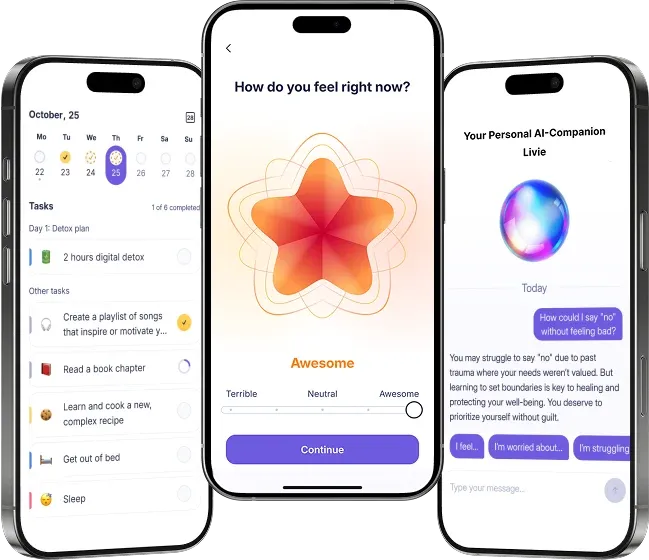
It's important to distinguish between a temporary struggle and a genuine desire to find a new job. One way to understand what frustrates you is to use Liven's Mood Tracker, which helps you uncover the patterns that lead to burnout.

As you reflect, you can write down these factors:
- What works in your current role
- What feels off about it
- What can you imagine yourself doing in the next five years
- What brings you the most motivation
- What values you would like to bring into the future
- What drives your feeling of being stuck: environment, people, or the job itself
- What activities you do for pleasure, not money, in your spare time
You can do a more extensive reflection using this worksheet from the University of Wisconsin-Stevens Point.
💭 Reflect on Your Career Goals
If you are happy with your current company, it may be a good idea not to leave your job. After all, finding a place with a great company culture and connections can be difficult — so it's totally possible to move from your current position to another one.
Before choosing a complete career switch, it’s worth checking whether the growth, learning, or variety you're craving can be found inside your current workplace. Self-Determination Theory (SDT) explains what actually motivates us in our workplace. The theory states that a person feels fulfilled when three needs are met:
- Autonomy: How much control over your tasks do you want to have?
- Competence: What field can give you a sense of growth and improvement?
- Relatedness: What people do you want to surround yourself with, and how close do you want to be?
Map the job opportunities in your company. Are there internal job postings or projects that you could join? If not, is there a path that interests you that fits these three criteria? Try not to let overthinking lead to self-doubt; instead, be realistic and open to curiosity.
"In my experience, people spend 80% thinking about career change and 20% on doing. Reverse those percentages and accept you don't (can't!) have all the answers before you begin the process." — Ian Hanreck, Accredited Coach, Mentor and Facilitator
You can approach your manager or HR and identify your needs without making it feel like you want to quit. For example, you can use phrases like:
- “I'm looking to develop new skills this year.”
- “I'd love more exposure to X area; is that possible?”
- “Are there upcoming projects where I could contribute more?”
And if you're up to it, you can start working on something new, such as collaborating with another team or partially shadowing someone's workday. In many cases, companies are happy to support their workers in career growth since it's easier for them to find an internal hire rather than training a new candidate.
👩🏼🔬 Run Low-Risk Experiments to Explore Career Paths
When you feel stuck in your career and want to look into entirely new fields rather than just moving within the company, you can start to figure things out slowly. Career development begins with running small career experiments. They help you see what you can do, not just what you fear you can't.
This aligns with the growth mindset introduced by a famous psychologist, Carol Dweck, and means believing that you can learn new skills: "Having a growth mindset can improve an individual's professional development, leading to improved performance, enhanced creativity, and improved relationships. These attributes may enhance overall organizational performance and organizational learning."
As you explore career options through LinkedIn or search engines like Google, continue drafting ideas for future experiments. These can look like:
- Taking a short online course in a field you're curious about (many of these are free, just search for "MOOC courses")
- Shadowing someone internally or externally
- Trying a one-off freelance project
- Volunteering in areas aligned with your interests
- Experimenting with a new task within your current role (presentations, analytics, coordination, etc.).
Here are a few platforms that can help you learn new skills:
If you want to find a short-term internship, these platforms might help you get a bit of extra information, make you more confident, and provide you with a better knowledge of the field, clients, and other specifics:
- Riipen (for students)
- Forage
- Parker Dewey.
🗣️ Network for Career Advice
Regardless of what life you plan on, when you're stuck in your career, you might still be unsure about where to begin. That's when it's a good idea to start networking, because the internet is great for information, but you want to go deeper — you want knowledge, and that comes from talking to people.
A 20-minute talk with someone already in your dream role can give you:
- A realistic sense of day-to-day work
- How they got into that field
- What skills you need
- Red flags you wouldn't have known
- A network connection, if you do choose to switch.
If you decide to find people and ask them about other jobs, being honest can be one of the best strategies to determine the gap between what you expect and what you will get. This includes all the things related to a totally different life: Will you have less money than now? Will the job be flexible? What about family life? These answers can determine whether you will proceed with the new position.
Here are a few platforms where you can find professionals to talk to:
When Career Change Isn't Possible Yet
Not everyone has the option to switch careers immediately. If you need to earn more money or stabilize your life before moving to a new role, you may need to wait before quitting.
But just because you need to stay in your day job for now doesn't mean you have to feel stuck in your career and struggle every day. For most of us, there is a "grey period" when we are still doing our day job while making inroads into our new career.
1. Enjoy New Passions, New Skills, and New People
When a career change isn’t possible, over-identifying with work increases suffering. According to Self-Complexity Theory, our mental well-being improves when our identity is spread across multiple roles rather than concentrated in a single role. Building identity outside of work (through new hobbies, relationships, learning, creativity, or physical activity) increases our self-complexity.
This means that when you examine your life, the first place is not given to the job you currently dislike, but to an identity beyond that. And think in terms of your future you. What do you want your identity to be, not what it is today? You can explore:
- Creative outlets
- Physical practices
- Helping vulnerable communities or volunteering
- Traveling/exploring cultures
- Fun games, puzzles, improvisation, and more.
2. Reframe Your Perception
We are only stuck if we allow ourselves to approach our current life in that way. Part of it can be our negative self-talk and thoughts, such as, "How do I get out?" and "How not to despair for another week?" But we can develop a mental shift that will make our job more comfortable and meaningful.
Cognitive reframing, a common approach in cognitive-behavioral therapy, offers an opportunity to change our perception. It doesn't mean lying to ourselves; instead, it's finding answers to these questions: "What do I give to the world by being here? What's the point of being here on a larger scale?"
Neri Karra Sillaman, an author and an entrepreneur, states that reframing shows us how what we do aligns with our or societal long-term goals: "When my mother worked as a cleaner at a medical factory, she viewed her work as a calling. She achieved that by framing the job in terms of how it helped others."
3. Adjust What Doesn't Work
Even rigid jobs have minor areas of flexibility. Look for ways to adjust:
- When you do specific tasks
- How you batch or sequence work
- How you structure breaks
- Which tasks you protect your energy for.
You can talk to your boss about better pay or to give you fewer clients to work with. Alternatively, if you're struggling with a particular team member, you can maintain a distance from them. These small changes may seem negligible in the moment, but they can have a significant impact on how you feel over time.
If you feel you're at a point of exhaustion, consider taking a quiz to dive deeper and explore the root cause of the issue.
Final Thoughts
Even if you're not sure where your career path will lead, you don't need to have all the answers to start searching your heart. Instead of jumping straight into the solution, you can wait and reflect on what matters to you and what your body and mind can be telling right now.
The following changes will involve deep soul-searching, resting, and only then planning. When we let our minds rest for a bit, it gets easier to find the right direction.
References
- Catanzano, T., Azizaddini, S., Clayton, M. J., Pham, T., Methratta, S. T., Fishman, M. D. C., Moser, F. G., & Dunnick, N. R. (2023). Framed and reframed! The art of using cognitive behavioral techniques to combat burnout. Current Problems in Diagnostic Radiology, 52(2), 130–133. https://doi.org/10.1067/j.cpradiol.2022.07.010
- Cerullo, M. (2025, October 21). 60% of workers are unhappy with key aspects of their job, survey finds. CBS News. https://www.cbsnews.com/news/us-workers-lack-quality-jobs-study/
- Chen, C. P. (2017). Career self-determination theory. Psychology of Career Adaptability, Employability and Resilience, 329–347. https://doi.org/10.1007/978-3-319-66954-0_20
- Han, S. J., & Stieha, V. (2020). Growth Mindset for human resource development: A scoping review of the literature with recommended interventions. Human Resource Development Review, 19(3), 309–331. https://doi.org/10.1177/1534484320939739
- Peters, B. (2025, August 30). 10 impactful coaching questions for deeper self-reflection. The Leadership Coaching Lab. https://www.theleadershipcoachinglab.com/blog/10-impactful-coaching-questions-for-deeper-self-reflection
- Rafaeli-Mor, E., & Steinberg, J. (2002). Self-complexity and well-being: A review and Research Synthesis. Personality and Social Psychology Review, 6(1), 31–58. https://doi.org/10.1207/s15327957pspr0601_2
- Sillaman, N. K. (2023, January 31). When you’re stuck in a job you can’t quit. Harvard Business Review. https://hbr.org/2023/01/when-youre-stuck-in-a-job-you-cant-quit
FAQ: Feeling Stuck in a Career
How can I figure out what’s actually wrong with my current job?
Is it normal to feel lost even if my job looks “good” on paper?
How do I decide on my next step without making a risky decision?
What advice should I follow when everyone gives me conflicting information?
How can I stay motivated while remaining in the same role?
What if I can’t figure everything out right now?