Post-Breakup Guilt: Why You Feel It and How to Move Forward




You ended things. You had good reasons. But instead of relief, all you feel is that you’ve done something wrong. You wonder, "Did I hurt them too much? Could I have done more to save it? What if I was wrong?" That's post-breakup guilt, but it doesn't mean you made the wrong call.
Let’s take a closer look at why post-breakup guilt happens and what you can do to process it.
Key Learnings
- Post-breakup guilt is common and often comes from empathy, attachment patterns, and uncertainty.
- Your brain may replay the breakup because it’s trying to regain certainty and control after a difficult decision.
- Practical steps like limiting contact, challenging intrusive thoughts, and practicing self-compassion can help you process post-breakup guilt in a healthier way.
Why You Feel Guilty After Breaking Up With Someone
Guilt after a breakup often has less to do with wrongdoing and more with attachment, empathy, and fear of uncertainty.
1. You Were the One Who Initiated It
There’s even a term for this: dumper’s guilt. When you're the one who pulls the plug, you hold the active role in the story. That sense of agency causes guilt because you feel fully responsible for bringing pain to someone.
2. You’re Afraid You Made the Wrong Decision
The mind loves certainty, and breakups are anything but. Once you’ve made a decision, your brain, especially if you’re prone to overthinking, will start scanning for evidence that you got it wrong.
3. You Still Care About Them
If the relationship had no abuse, and they're a genuinely good human being, the guilt can hit even harder. It’s totally normal to still care about them, but caring doesn't mean you have to stay in a relationship that’s no longer right for you
4. The Relationship Wasn’t Bad Enough to Justify Leaving
One of the most insidious sources of post-breakup guilt is the belief that you need a dramatic reason to leave.
That’s why you think just incompatibility or an absence of the future you wanted isn’t a good enough reason to end things.
How to Work Through Post-Breakup Guilt Without Torturing Yourself
Guilt doesn’t disappear overnight, but with a little time and the right steps, you’ll start to feel better and gain some perspective.
1. Stop Bargaining With the Past
"What if I'd said it differently? What if I'd tried harder? What if I'd waited a little longer?"
Bargaining is sneaky - it shows up as obsessive replaying of what could have been and makes you believe that somehow, you can undo the past.
How to Get Out of the Bargain Loop
- Remember: it takes two to tango. The relationship didn't fail because of you alone. Your partner shared that responsibility equally.
- Write down every reason the relationship had to end. Keep it somewhere accessible. On the hard days when guilt floods in, re-read it to reconnect with the clarity.
- Schedule a worry window. Give yourself 10 minutes a day to think about it. When the thoughts come outside that window, remind yourself: "I'll think about this at 6 p.m."
2. Go No-Contact For Some Time
Studies consistently show that staying in contact with your ex-partner makes it harder to move on. Every "how are you?" message and every social media check is like picking at a wound right before it starts to close.
Even if you've decided you want to stay friends, give each other time to process your feelings separately first. Only then revisit the friendship question.
How to Go No-Contact
- Mute or unfollow (not block, unless necessary) on social media.
- Ask a friend to be your accountability person when the urge to check in feels overwhelming.
- Write the message you want to send in order to get the urge out, but don't send it.
- Set a date for when you'll revisit the "can we be friends" question at least 90 days out.
⚠️ Reminder: Going no-contact is a non-negotiable if there was any abuse in the relationship.
3. Work With Intrusive Thoughts
Common guilt-driven thoughts might sound like “I ruined their life,” “They’ll never find someone else,” or “What if I destroyed something good?”
Try this CBT cognitive reframing exercise.
When a guilt thought strikes, run it through these 3 questions:
- What's the actual evidence for this thought? Let’s say you think, “I ruined their life.” The evidence is: they cried and said they were devastated.
- What's the evidence against it? They have a full life, close friends, a job they love, and their own resilience.
- What would I tell a close friend who was thinking this about themselves? "You didn't ruin someone's life because you got honest about what you needed."
4. Forgive Yourself
If you didn't cheat, lie, or cause abuse, then your post-breakup guilt isn't about what you did wrong. It's about who you are: someone who cares, who doesn't want to cause harm, and who holds themselves to a high standard. That's actually something to respect, not punish.
Use the Self-Compassion Framework
Back in the early 2000s, Dr. Kristin Neff, a researcher at the University of Texas, built a three-part framework for self-compassion that's now one of the most evidence-backed tools in the field.
#1: Self-kindness
Self-kindness is the first piece. Talk to yourself the way you'd talk to a close friend in the same situation. You wouldn't call a friend a monster for ending a relationship that wasn't working, right?
#2: Common humanity principle
Remind yourself that breakups are a universal human experience. Millions of people have ended relationships that needed to end and sat with exactly this weight afterward.
#3: Mindfulness
This is where you create distance between yourself and your thoughts and feelings. Let yourself observe the feeling, but don’t become it. "I notice I'm feeling guilty right now" is a fundamentally different experience than "I am guilty."
Dr. Kristin Neff, one of the world's leading researchers on self-compassion, breaks down why self-criticism backfires, and what the science says to do instead:
5. Try Therapy
Articles published in the Journal of Clinical Psychology show therapy can help people manage jealousy, grief, and fear after breakups.
Choose your therapy approach to rebuild self-trust and self-compassion after a breakup.
| Therapy type | How it helps with post-breakup guilt |
| Cognitive Behavioral Therapy (CBT) | Helps you identify and challenge distorted guilt-driven thoughts |
| Psychodynamic Therapy | Explores how past relationships and attachment patterns shape the way you handle guilt and endings |
| Acceptance & Commitment Therapy (ACT) | Helps act according to your values, even while guilty feelings are present |
| Compassion-Focused Therapy (CFT) | Directly targets self-criticism and shame |
| Narrative Therapy | Helps you rewrite the "I'm the villain" story |
Final Thoughts
Post-breakup guilt doesn't mean you did something wrong. It's the cost of being someone who takes relationships seriously.
You absolutely deserve to heal and move forward, and it's okay to give yourself permission to do so. Both of you get to heal. Just not together, and not on a shared schedule.
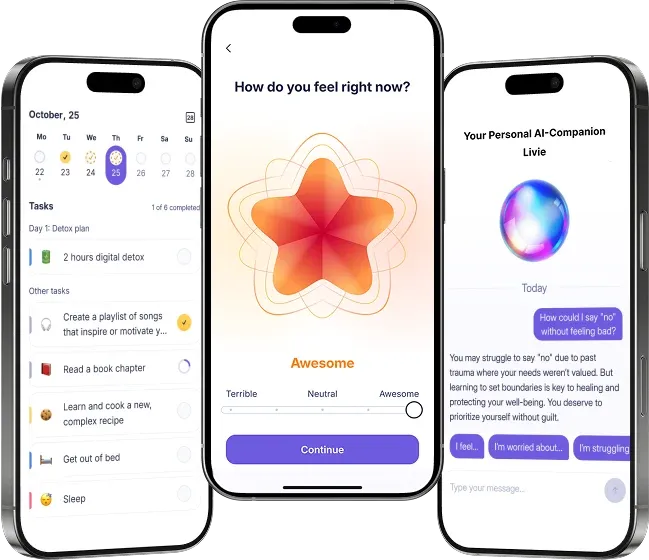
You can try the Liven app (Google Play or App Store) to observe your emotional patterns over time or explore self-discovery topics on the Liven blog.
References
- Cai, S. (2025). Factors influencing post-breakup recovery. SHS Web of Conferences, 222, Article 02023. https://doi.org/10.1051/shsconf/202522202023
- Farber, B. A., & Roe, D. (2026). Clinical perspectives on the nature and treatment of romantic breakups. Journal of Clinical Psychology. https://doi.org/10.1002/jclp.70118
- FitMind Podcast. (2025). The science of self-compassion: How to stop negative self-talk – Kristin Neff, PhD [Video]. YouTube. https://www.youtube.com/watch?v=IbXof945dx4
- Gehl et al. (2024). Attachment and breakup distress. Emerging Adulthood, 12(1), 41–54. https://doi.org/10.1177/21676968231209232
FAQ: Post-Breakup Guilt
How long does post-breakup guilt last?
Is it normal to feel guilty after breaking up?
Should I text my ex if I feel guilty?
Does guilt mean I still love them?