



You’re in the kitchen. Your child is upset about something that seems small to you but huge to them. You pause. Should you correct them, comfort them, or teach a lesson?
The right answer changes every time, and that's exactly what makes parenting so hard.
In this article, we’ll explore the real signs of a healthy parent-child relationship, grounded in psychology and real-life parenting experiences, so you can show up with a little less second-guessing.
Key Learnings
- A healthy relationship between a child and a parent is built on emotional safety, empathy, clear boundaries, and consistent open communication.
- Children thrive when parents balance guidance with independence.
- Healthy conflict and repair teach kids emotional regulation, accountability, and how strong adult relationships work in real life.
What a Healthy Parent-Child Bond Really Looks Like
What works at five won't work at fifteen. But the foundations of a healthy bond stay consistent: safety, mutual respect, empathy, and open communication.
1. Your Child Shares the Hard Stuff with You
If your kid brings their worries, embarrassments, and even bad news to you, that's a signal of deep trust. This means you’ve been meeting your child’s feelings with curiosity rather than criticism.
Psychologists call this emotional availability, the parent's ability to be genuinely present and responsive when their child needs to be heard.
🤔 Did you know? A study of 414 university students found that emotionally distant parenting can make it harder for young adults to understand and express their feelings. This happens because emotional neglect may lead to insecure relationships, which then affect emotional awareness later in adult life.
2. You Respond with Empathy
Empathy means you acknowledge what your kids feel before jumping to solutions or lectures. Neurologically, this matters because when children feel heard, their nervous system regulates.
3. Rules Are Clear and Make Sense
You also teach your child that there are always consequences, proportionate to the situation, and that they never feel like unfair punishment designed to cause fear. For example, you might say: “If you keep using your phone after bedtime, then the phone stays in the kitchen tomorrow evening.”
And boundaries exist on both sides. This is especially true during the teenage years: if your teen asks you to knock before entering their room, you respect that.
4. You Respect Their Growing Independence
You support your kid in making age-appropriate decisions, and you encourage them to explore the world in healthy ways.
Self-determination theory suggests children thrive when parents provide three things: support for independence, clear structure, and emotional involvement. Together, these parenting behaviors help improve motivation, adjustment, and well-being, although how they feel may differ across cultures and situations.
5. Love Is Unconditional
Children quickly notice whether praise depends only on performance.
When children know that your love isn't contingent on their performance, they're free to take risks, make mistakes, and be those curious learners who grow without fear of losing your approval.
6. You Have Healthy Conflicts
You still set boundaries, treat your kid with respect, and don't stonewall them or call them names, because you know how to self-regulate. And when you get it wrong, which, honestly, every parent does, you apologize.
7. Your Child Can Be Themselves Around You
This one ties everything together. When a child can show up in their family as their full, unfiltered self —with weird interests, big feelings, awkward phases, and all — that's the clearest sign of psychological safety.
🤔 Did you know? Carl Rogers, the founder of humanistic psychology, called it “unconditional positive regard” — the experience of feeling accepted and supported simply for being who you are.
Healthy vs. Unhealthy Parent-Child Dynamics
| Healthy Dynamic | Unhealthy Dynamic |
| Child feels safe sharing emotions | Child hides feelings |
| Rules are explained clearly | “Because I said so” rules |
| Mistakes become learning moments | Mistakes lead to shame |
| Independence is encouraged | Control replaces guidance |
| Conflicts end with respect and repair | Conflicts turn into blame or silence |
| Parents take responsibility and apologize | Parents never admit fault |
| Love feels unconditional | Love depends on performance |
| Boundaries work both ways | Only parent’s limits matter |
5 Things You Can Do to Have a Strong Parent-Child Relationship
Try these evidence-based, practical approaches to architect a more intentional parenting for your kid.
1. Start With Your Own Emotional Well-Being
A parent's ability to self-regulate is one of the biggest predictors of how emotionally safe their child feels at home.
Build small, consistent practices into your day:
- A 60-second mood check-in before school pickup
- Two minutes of box breathing when tension rises. It involves inhaling, holding the breath, exhaling, and holding again
,each for the same number of seconds, usually four. - A quick journal note about what triggered you and why. Also, be kind to yourself if you can't identify the why in this moment.
- Or simply naming your emotional state out loud before a hard conversation.
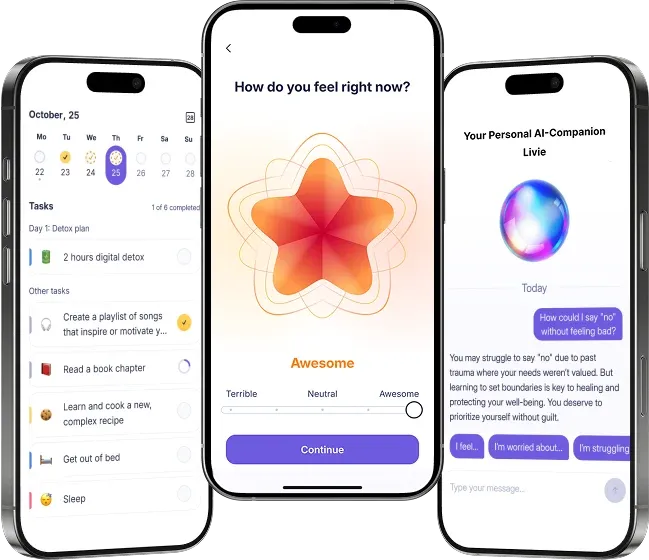
💡 Tip: Liven’s Today's Routine helps you plan and stick to the small self-care habits as a part of your personalized plan for a stress-free parenting that supports your emotional balance and helps you show up more calmly and intentionally.
2. Ask More Open-Ended Questions
Swap "How was school?" for "What was the most boring part of your day?" or "What made you giggle today, and/or was there anything that happened that you didn't like?'
Open-ended, slightly unexpected questions encourage real answers. They signal that you're genuinely curious, not just checking a box.
3. Create Rituals That Are Just Yours
A special handshake, a silly nickname, a Saturday morning tradition. Rituals create a shared identity between you and your child — a "this is us" feeling that strengthens connection even during difficult periods.
4. Let Them Lead Sometimes
Allow your child to make decisions you might not have chosen yourself to show that their preferences matter. Those might include choosing the new route to school, deciding what's for dinner on Friday, or rearranging the living room.
A simple strategy is to offer two choices rather than a single directive. For example, you might ask: “Do you want to do homework before dinner or after?” Giving kids options helps them feel a sense of control and shows that their voice matters, while you still keep healthy boundaries.
This is especially valuable during the teenage years, when the need for autonomy intensifies developmentally.
5. Prioritize Quality Time Over Quantity
5-20 minutes of genuinely focused attention, no phone in hand, no half-listening, means more to your child than a whole evening spent in the same room but worlds apart.
Some ideas to get you started:
- Cook or bake something together
- Take a walk with no destination in mind
- Play a board game or card game
- Read the same book and talk about it
- Watch their favorite show and actually ask questions about it
- Do a puzzle, draw, or build something with your hands
- Let them teach you something they're into — a game, a skill, a song
Final Thoughts: Connection Matters More Than Perfection
A healthy relationship between a child and a parent is one in which conflicts are resolved, the child's emotions are welcomed, and both the parent and the child feel safe about honesty.
The signs we’ve discussed are just a guide, not a checklist. Some days you'll nail them; some days you'll fall short. What matters most is the intention you bring to quality time, open communication, and mutual respect.
If you're curious to understand yourself a little better, try the Liven app (Google Play or App Store), explore fresh perspectives on the Liven blog, or start with free wellness tests to get a clear picture of where you are right now.
FAQ: Signs of a Healthy Parent-Child Relationship
How do I know if my parenting style is actually supporting my child's well-being?
How do parenting choices affect a child's adulthood?
What if my good intentions still hurt my child?