AI Journaling Tools: A Smarter Way to Reflect, Track, and Grow



A modern AI journal helps you slow down and listen to yourself. It also goes one step further: it helps you notice patterns and guides you with valuable questions on the path to self-awareness.
Here are the top AI journaling tools on the market that feel more like a supportive companion than software.
Key Learnings
- AI journaling tools facilitate self-reflection, enabling users to gain valuable insights from their entries.
- A great AI journaling app strikes a balance between AI-generated prompts, daily reflections, and human agency.
- AI journaling tools can serve as companions rather than decision-makers.
What Makes AI Journaling Apps Effective?
The best AI journaling app is like a personal coach, ready to support you 24/7 and provide active feedback on your thoughts and actions. However, research suggests that if AI does too much thinking for you, it can actually hurt your ability to understand yourself.
Here are the key features that truly good journaling tools offer:
- AI-generated prompts that help you dig deeper, without telling you what to feel.
- Smart prompts that adapt based on your past entries.
- Thoughtful AI analysis of your past entries to help you identify patterns over time.
- Fully encrypted data and privacy-first design.
- ‘It’s time to journal’ reminders that help build a consistent journaling habit.
- A writing experience that still feels human, creative, and reflective.
Meanwhile, optional features include:
- Mood tracking and emotional check-ins that build self-awareness.
- Support for voice journaling and voice-to-text feature with accurate transcriptions.
- Built-in habit tracker or goal-setting features.
The Best AI Journaling Tools for Mental Wellness
Below are some of the most relevant and widely used AI journaling tools today, with a note on what makes each one unique compared to the others on this list.
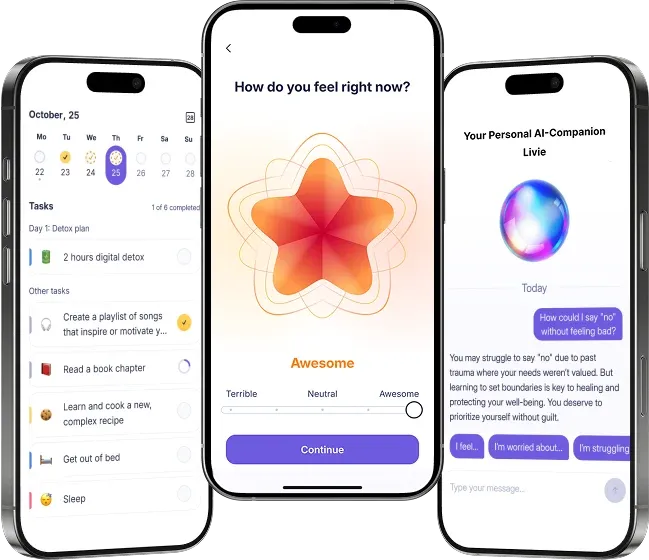
1. Liven: Best for Guided Self-Discovery
At its core, Liven bridges the gap between a journaling app + mood tracker, a therapy-style workbook, and a supportive 24/7 AI assistant.
Top AI Features
- Livie. A 24/7 smart companion who you can vent to and ask for emotional support or real-time guidance when you feel stuck and don’t know how to deal with unhelpful thoughts and emotions.
- Smart trigger mapping. Connects mood tracking with habits to reveal hidden stressors or dopamine loops.
- Personalized course paths: Smart Companion can recommend CBT-informed courses, which are very easy to grasp, based on your prevailing emotional state (which, by the way, you can assess with Liven’s multiple tests on anxiety, procrastination, burnout, depression, and adult ADHD). You can also get your personalized dopamine management plan.
💸 Pricing: Starts at $7.99/week
❗ Please always check the app’s official website for current plans and details.
Additionally, the Liven app integrates certified expert video content. It may be helpful for those seeking to enhance their mental health with a holistic approach, particularly if their goal is to manage stress.
2. Rosebud: Best for Highly Interactive Conversations
Rosebud actively engages with a user once they submit their diary entry. The app asks thoughtful follow-up questions to help the user dig deeper into their emotions and motivations.
Top AI Features
- Interactive follow-up questions for further reflection.
- This amazing app creates weekly summaries that frame your journaling journey as evolving life “stories”.
- High-quality voice-to-text feature for hands-free reflection.
💸 Pricing:
| Plan | Price | Key Features |
| Bloom (Free) | $0 | Limited interactive journal entries |
| Bloom Pro | ~$12.99/mo | Unlimited AI conversations & personalized insights |
| Lifetime | Varies | One-time payment option |
Rosebud offers a specialized Internal Family Systems (IFS) approach. It helps you identify parts of your personality, such as the “People Pleaser” or “Inner Critic,” and provides you with more insight into why the conflict occurred in the first place.
3. Stoic: Best for Developing Emotional Resilience
Stoic teaches users the main Stoic principle: to accept what they can’t change or control and focus on what they can.
Recent research indicates that Stoic practices, such as imagining worst-case scenarios or distancing oneself from negative thoughts, align with modern therapeutic approaches, including CBT and ACT.
Top AI Features
- Philosophical prompts. AI-generated reflections inspired by Seneca or Marcus Aurelius;
- Writing analysis. Highlights emotional friction across areas like work, relationships, or health;
- Smart Shield is a focus mode that reduces distractions during reflection.
💸 Pricing:
| Plan | Price | Key Features |
| Basic | $0 | Quotes and simple prompts |
| Premium | ~$39.99/yr | AI analysis, guided journals, sync |
Stoic also offers a “Memento Mori” visualizer, which provides a visual representation of your life in weeks, creating a sense of urgency and helping you prioritize things that truly matter.
4. Reflectly: Best for Beginners & Quick Emotional Check-Ins
Reflectly is bright, friendly, and fast — built for users who prefer structured emotional journaling check-ins without long writing sessions.
Top AI Features
- Dynamic daily prompts include 1 personalized question per day.
- Visual mood analytics comprises clear graphs that display emotional trends over time.
- Daily challenges consist of AI-suggested actions that help one improve mood.
- Emoji-based entries make the entire journaling experience easy.
💸 Pricing:
| Plan | Price | Key Features |
| Free | $0 | Key features with ads |
| Premium | ~$59.99/yr | Ad-free, advanced insights |
5. Mindsera: Best for Deep Thinking Improvement
Mindsera analyzes one’s thinking patterns. That’s how the app helps users improve their logic, gain insights, and develop stronger thinking habits.
As Kyle Chayka put it in his essay for “The New Yorker,” “I found Mindsera to be the more useful model of AI-writing tool, but only because it made me do more work myself.”
Top AI Features
- Flags distorted thinking patterns;
- Offers conversations with simulated thinkers and historical figures;
- Offers “Mental Models” library, which includes frameworks for problem-solving and reflection.
💸 Pricing:
| Plan | Price | Key Features |
| Curious (Free) | $0 | Basic journaling |
| Genius | ~$14.99/mo | Voice mode, analysis, mentorship |
Additionally, Mindsera offers a “Minds” library of AI personas, based on historical figures or modern thinkers, with which a user can engage in conversation.
6. Resonance: Best for Voice-First Journaling
Resonance is built for people who think faster than they type. It transcribes voice entries, analyzes tone, and surfaces emotional trends over time.
One study shows that people who used the Resonance app were happier and had fewer signs of depression.
Top AI Features
- Cleans up filler words while preserving meaning during transcription;
- Tracks emotional shifts across voice entries in a sentiment timeline;
- Auto-generates highlights for each entry.
💸 Pricing:
| Plan | Price | Key Features |
| Standard | ~$15/mo | Voice-to-text and storage |
| Pro | ~$29/mo | Deep sentiment analysis |
7. Reflection: Best for Structured Self-Coaching
Reflection provides a structured review of one’s journal entries. It combines journaling with coaching and is particularly beneficial for users who are focused on progress and long-term goals.
Top AI Features
- Post-entry insights.
- Growth pattern analysis links your entries to bigger goals.
- Offers year-in-review growth reports.
- Conducts smart resurfacing of past entries.
💸 Pricing:
| Plan | Price | Key Features |
| Free | $0 | Unlimited basic entries |
| Premium | ~$60/yr | Full AI coaching & reviews |
Final Thoughts
Although AI tools can’t substitute for qualified mental health specialists, AI-powered tools help us understand and process our thoughts and feelings more effectively.
Ready to go deeper? Continue your journey with the Liven app (Google Play or App Store), get more insights on the Liven blog, or take Liven’s free wellness tests to better understand your mental health and emotional patterns.
References
- Aziz, A. (2025). Stoic philosophy and emotional regulation. International Journal of Innovative Science and Research Technology.
- Chayka, K. (2023). My A.I. writing robot. The New Yorker.
- Ghosh, P., & Bhattacharya, R. (2025). Mood journaling. Indian Journal of Private Psychiatry.
- Kim, M., et al. (2025). Reflective agency. AAAI/ACM Conference on AI, Ethics, and Society.
- Zulfikar, W., et al. (2025). Resonance. Augmented Humans Conference.
FAQ: AI Journaling Tools
Are AI journaling tools safe for mental health?
Can AI journaling tools replace therapy?