What Are Post-Traumatic Resilience and Post-Traumatic Growth?



Trauma can stay with us for a long time, affecting both our bodies and our minds. Even years later, you might still feel those heavy echoes. But there is a path forward: by leaning into resilience, you can heal and truly grow from what you’ve been through.
Although we didn't always control what happened to us in the past, we have control over our future — our life, our mental health, and the meaning we bring.
This article explores how people can cope with their traumatic experiences, what post-traumatic resilience and growth are, and how we can achieve positive growth afterward.
Key Learnings
- Post-traumatic resilience is the ability to recover and function after trauma by restoring nervous system balance, coping skills, and daily routines, even while distress lingers.
- Posttraumatic growth is a deeper shift in meaning, values, or identity that emerges only after a sense of safety is reestablished.
- Self-care, regulation, loved ones, new relationships, volunteering, and therapy can all support resilience and growth when chosen freely and at the right pace.
What Is Post-Traumatic Resilience?
Although each person's ability to deal with trauma is different, many people develop post-traumatic resilience after going through a painful event in their lives. But what does this concept mean, and how does it work?
The International Society for Traumatic Stress Studies explains that post-traumatic resilience is "often thought of as bouncing back or the ability to maintain or regain functioning after adversity. It's actually the most common response to trauma, even when the stressor is severe."
Resilience means having the internal and external capacity to recover, cope, and continue moving forward. In daily life, psychological resilience manifests in the following ways:
- Feeling safer and more regulated in the body
- Managing emotions without becoming overwhelmed
- Returning to daily life and routines
- Using coping tools to recover from stress
- Greater flexibility in the stress response
- Moving forward despite trauma reminders.
Post-Traumatic Resilience vs. Post-Traumatic Growth
Many individuals confuse post-traumatic growth with resilience, but these concepts aren't identical. Coined by psychologists Richard Tedeschi and Lawrence Calhoun, it refers to a positive change that can result from long-term work through trauma, such as a deeper sense of meaning, new possibilities in life, or even changes in one's belief systems.
While resilience focuses on restoring balance and functioning, growth goes a step further by describing a transformation that may occur after stability is regained.
🤲 Resilience is about adaptation and recovery
🌱 Growth is about expansion and redefinition.
This doesn't mean viewing trauma as something positive. We deserve to feel safe all the time, and trauma exposure isn't something that anyone has to experience for growth. However, if the traumatic event has happened, we can take the aftermath and let it guide us into the light, not stay in the dark.
Neither resilience nor growth is linear. Healing takes many forms. We can take care of ourselves and slowly regain our personal strength until we feel comfortable trying again. If you feel lost and don't know where to begin, take a free quiz to get your personalized wellbeing management plan.
First Gentle Steps Build Resilience and Growth
There is nothing you have to do to be resilient or to grow. Trauma already asks a lot of the body and mind, and healing is not a task to complete or a standard to meet. You deserve care, rest, and support simply because you've been through something difficult. Sometimes, the smallest, intentional actions can help your body and mind find balance, rebuild strength, and open space for growth.
Rebuild a Sense of Safety In Your Nervous System
Resilience starts in the body. After trauma, the nervous system of trauma survivors often remains in a heightened or shut-down state, even when danger has passed. To give yourself a sense of security, you can try:
- Gentle breathing
- Grounding exercises
- Gentle movement, such as stretching or walking
- Establishing a stable and predictable routine.
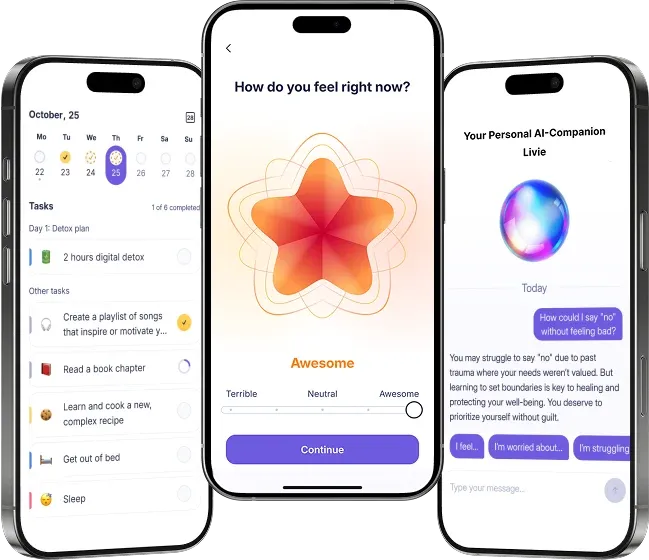
💡Tip: If you're struggling with keeping up with your daily self-care goals, you can use Liven's Routine Builder to establish a routine and use notifications to keep your plan active.
Prioritize Self-Care to Invite Healing
Experiencing trauma makes us feel uncomfortable and lost. Self-care allows us to reclaim this sense of safety and connection with our bodies.
Caring for our own well-being starts from the basics: getting enough sleep, finding nourishing, comforting foods, and picking clothes that feel comfortable. Engaging in intentional self-care signals to the body that it is safe to relax and recover.
Here are some ideas that can help you figure out what works for you:
- Enjoy your favorite treat or snack
- Listen to a comforting podcast or audiobook
- Drink water - if usual water doesn't taste good, add a flavor/juice/fruit to it
- Hold a stuffed animal or any other comfort item
- Change your sheets into the clean ones
- Spend time in a cafe, a bookshop, or a museum
- Do a simple hands-on activity (e.g., painting or collaging)
- Schedule a doctor's appointment.
💡Tip: If you want some healthy ideas to return you the appreciation for the simple beauty of life, try to use Livie, Liven's smart companion, who will chat with you, analyze your needs, and brainstorm self-care activities that fit your energy level.
Get Social Support to Feel Connected
Sometimes, posttraumatic stress makes us feel as if we're alone. But being with others is what helps us develop resilience and rebuild our own sense of self. When we don't have enough of our own strength, others will be strong for us. Socialization and focus on the future rather than the damage of the past can help us heal our abandonment wounds and painful memories.
Whether you decide to reach out to your loved ones, meet your hobby buddies, or look for support groups, these changes can contribute to your post-traumatic growth. Connection doesn't require sharing everything or finding the "right words." Sometimes it's enough to feel seen, listened to, or simply not alone.
Try Volunteering
Post-traumatic growth often begins with an evaluation of one's core beliefs. Personal growth can be found in activities that are focused on helping others. Volunteering can gently support post-traumatic resilience and growth by restoring a sense of agency, purpose, and connection that trauma often disrupts.
Consider Therapy for Your Mental Health
For some people, therapy can be a helpful and containing space to explore trauma at a safe pace. It is not required, and it does not mean anything is "wrong" with you. A skilled therapist can help support nervous system regulation, emotional processing, and meaning-making while respecting your boundaries and readiness. Therapy is effective in many contexts, and it's often used, for example, to overcome childhood trauma.
Here's when some people consider therapy:
- They have developed Post-Traumatic Stress Disorder (PTSD)
- They struggle with emotional regulation
- The traumatic experience keeps replaying over and over
- They only notice new challenges instead of opportunities
- Their social life has suffered severely
- Regular tasks seem overwhelming for them.
In Search of a Brighter Future
Developing resilience can take effort and time we don't even know we have. But we do. With every positive message, simple activity, hug from friends, new possibility, and relationship, we grow stronger. When we let ourselves think about how many people love us and how this love and support add just a bit of color, the world seems larger and fuller.
References
- Posttraumatic Resilience and Growth. International Society for Traumatic Stress Studies. (n.d.). https://istss.org/public-resources/friday-fast-facts/posttraumatic-resilience-and-growth/
- Rousseau, D. (2022, April 21). Volunteerism as trauma therapy. Boston University. https://sites.bu.edu/daniellerousseau/2022/04/21/volunteerism-as-trauma-therapy/
- Tedeschi, R. G., & Calhoun, L. G. (2004). Target article: “Posttraumatic growth: Conceptual foundations and empirical evidence.” Psychological Inquiry, 15(1), 1–18. https://doi.org/10.1207/s15327965pli1501_01
FAQ: Post-Traumatic Resilience
What is posttraumatic growth, and what does it mean for life after trauma?
How is this different from posttraumatic stress disorder?
What factors influence recovery?
Does emotional regulation play a role?
Can growth include spiritual change?
How does building resilience relate to anxiety and depression?