Liven vs. Calm? Choosing the Right Well-Being App for You




You've done your research. You've heard of both apps. Now you just need to know: Liven vs. Calm?
Both sit in the mental well-being space, but they serve different roles in your life. Calm focuses on helping you relax and sleep better through guided meditation and audio content. Liven takes a different angle: a structured, science-based toolkit for self-discovery and emotional growth.
If you’re trying to decide, this guide compares Liven vs. Calm so you can pick the companion that matches how you want to relate to your inner world.
Key Learnings
- Calm is a meditation-first app: guided audio, Sleep Stories, and breathwork to settle your nervous system in the moment.
- Liven is a science-based self-regulation toolkit: CBT-centered lessons, mood tracking, and a smart companion named Livie to help you understand your triggers and patterns.
- The two solve different problems. Calm helps you relax in the moment, while Liven helps you notice patterns and build long-term habits.
Liven
Liven is a 360 well-being toolkit co-created with a Board of Health Professionals. It is built on a clear premise: understanding your emotional patterns is a prerequisite for changing them.
The Liven app brings together mood tracking, journaling, AI-guided conversation, self-assessments, and a personalized learning path into a single daily practice. It is not a meditation app, and not a replacement for therapy.
The Science Behind Liven
Liven's core framework is the micro-cycle method, a three-step behavior-change loop:
- Reflect: tap through a short, interactive lesson that lands on something true about your own experience.
- Collect: check in with yourself by logging your mood, your context, and whatever's on your mind.
- Act: try one small practice Liven suggests based on what you logged.
Across the broader app, Liven draws on a wider set of evidence-based methodologies:
- Cognitive Behavioral Therapy (CBT)
- Dialectical Behavior Therapy (DBT)
- Acceptance and Commitment Therapy (ACT)
- Emotion Regulation Therapy
- Solution-Focused Brief Therapy
- Behavioral Activation Therapy
- Adapted clinical assessments (e.g., DASS-21, ACE)
- Structured Psychoeducation
- Psychological First Aid
- Neuroimaging and affective neuroscience studies
Liven's Key Features
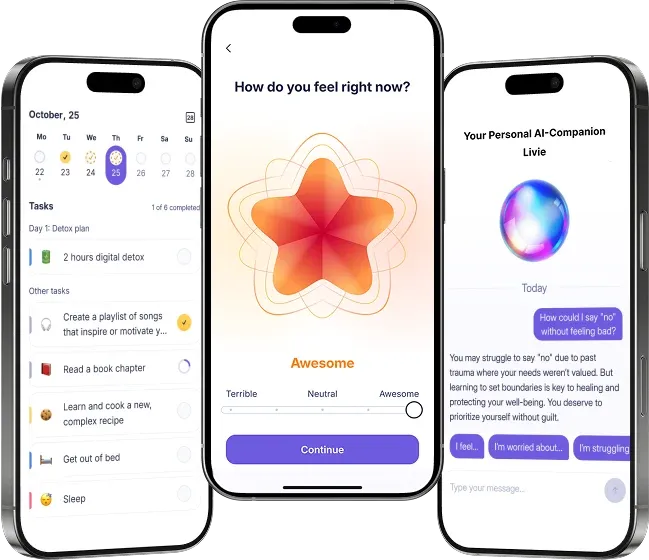
- Mood Tracker: Daily check-ins where you name what you feel and add context. Over time, interactive charts surface triggers and patterns easy to miss in the moment.
- Livie (Smart Companion): A 24/7 reflective companion. Helps you process emotions, reframe unhelpful thoughts, and notice patterns.
- Journey (Personalized Program): A learning path built from your onboarding quiz. Lessons unlock step by step across topics like procrastination, stress, self-image, and emotional regulation.
- Self-Assessment Tools: Self-checks covering stress, emotional intelligence, and other well-being dimensions. Results form a history log so you can spot recurring patterns over time.
- Journal: Prompted or free-form journaling for moments when you do not know where to start. A tool for breaking out of emotional autopilot.
- Today's Routine: A 3-step daily structure (lesson, daily task, check-in) that takes about 10 minutes.
- Sounds: A library of nature sounds, binaural beats, lo-fi music, and focus tracks.
- Explore: A personalized content hub with articles and expert videos surfaced based on your app data.
Liven Pricing
App pricing usually varies by device, region, and where you are in the purchase flow. Treat the figures below as starting points; your App Store or Google Play page is the source of truth.
| Plan | Price |
| Free trial | 3 days, full access |
| Weekly | Starting at $7.99 |
| Monthly | Starting at $49.99 |
| Annual | Starting at $59.99 |
Source: Liven pricing information, May 2026.
Liven Ratings and Recognition
- Best Mobile App Awards: Silver Award, September 2025
- App Store: 4.5/5 stars
- Google Play: 4.0/5 stars
- Trustpilot: 4.2/5 (Great) from over 24,000 reviews
- Downloads: Over 2.5 million
- Media coverage: Featured in HELLO!, Woman's World, Muscle & Fitness, The Everygirl, and TechTimes.
Strengths
- Highly personalized from the first session
- Behavioral pattern tracking that deepens over time
- Broad methodological foundation (CBT, DBT, ACT, neuroscience)
- 24/7 AI companion (Livie) for reflective support
- Short daily commitment (about 10 minutes)
- Oversight from licensed therapists and counselors
Things to Consider
- Newer platform with a shorter public track record
- Dynamic pricing can make upfront cost comparison harder
- Smaller content library compared to Calm's meditation and sleep catalog
Who Liven Fits
Liven is a strong fit if you have already done some self-reflection and want to go deeper. If you understand your patterns intellectually but struggle to change them in the moment, the micro-cycle method is designed to fill that gap. It also suits anyone who wants a daily practice that builds self-awareness over time.
Calm
Calm is one of the most established meditation and sleep apps available. It is built around guided audio: meditations, Sleep Stories narrated by well-known voices, breathwork sessions, and soundscapes. Its core promise is to settle your nervous system in the moment.
The Science Behind Calm
Calm's content is grounded in meditation and mindfulness traditions. Mindfulness can lower stress and anxiety when practiced consistently, particularly through short daily sessions. The app has also published research on its own program through partnerships with academic institutions.
Like Liven, Calm is not intended to diagnose or treat mental health conditions and is not a replacement for professional clinical care.
Calm's Key Features
- Guided Meditations: A library of more than 1,000 guided sessions organized into multi-week courses across focus, anxiety, relationships, sleep, and more.
- Sleep Stories: Bedtime audio narrated in calming voices, often by celebrity narrators. One of the app's most popular features.
- Breathwork: Short guided breathing sessions for stress moments and grounding.
- Soundscapes and Music: Calming ambient audio, lo-fi tracks, and instrumental music for focus or rest.
- Daily Calm: A 10-minute meditation, refreshed each day.
- Masterclasses: Longer audio lessons from experts on creativity, relationships, and resilience.
- Calm Body: Gentle stretching and movement videos for physical recovery.
Calm Pricing
Calm's plans run across monthly, annual, family, and lifetime tiers, with most features sitting behind a paid subscription.
| Plan | Price |
| Free trial | 7 to 14 days (App Store/Web) |
| Monthly | $16.99 |
| Annual | $69.99 to $79.99 |
| Family plan | $99.99 per year, up to 6 accounts |
| Lifetime access | $399.99 to $499.99 |
Source: Calm subscription plans, May 2026.
Calm Ratings and Recognition
- Apple App of the Year, 2017; Apple Best of 2018
- App Store: 4.8/5 stars (1.9M+ reviews)
- Google Play: 4.4/5 stars (599K+ reviews)
- Trustpilot: 1.5/5 (~440 reviews); reflects feedback around subscription management and customer service
- Downloads: Over 140 million worldwide
Strengths
- Extensive content library (1,000+ meditations, sleep, movement)
- Strong sleep content, especially Sleep Stories
- Beginner-friendly meditation entry point
- Flat, transparent pricing with family and lifetime plans
- Long-established research base
Things to Consider
- Free content is limited; most features require a paid subscription
- Trustpilot reviews flag subscription management and billing support issues
- No AI companion, no personalized learning path, no pattern-based mood analytics
- Library-style navigation
Who Calm Fits
Calm is a natural fit if you are new to meditation and want a structured, well-designed starting point. It is well-suited for people who want guided audio for sleep, a commute, or a desk break, and who prefer to browse a library rather than follow a guided personal path.
Liven vs. Calm: Feature-by-Feature Comparison
The fastest way to see where the two apps overlap and where they diverge is to put them side by side on the features each one is built around.
| Feature | Liven | Calm |
| Primary focus | Self-regulation and patterns | Meditation and sleep |
| Smart companion | ✅ Livie (24/7 AI support) | ❌ |
| Mood tracking | ✅ Connects feelings to context | ⚠️ Basic check-ins |
| Personalized program | ✅ Built from your quiz | ❌ Library-style |
| Therapeutic methods | ✅ CBT, DBT, ACT, SFBT | ✅ Mindfulness-based |
| Self-assessment tools | ✅ Monitor emotional state | ❌ |
Read the table top to bottom, and a clear pattern shows up. Liven is built for self-discovery, while Calm is built for meditation and sleep. Both rest on clinically supported methods, just different ones.
How to Choose: Liven vs. Calm
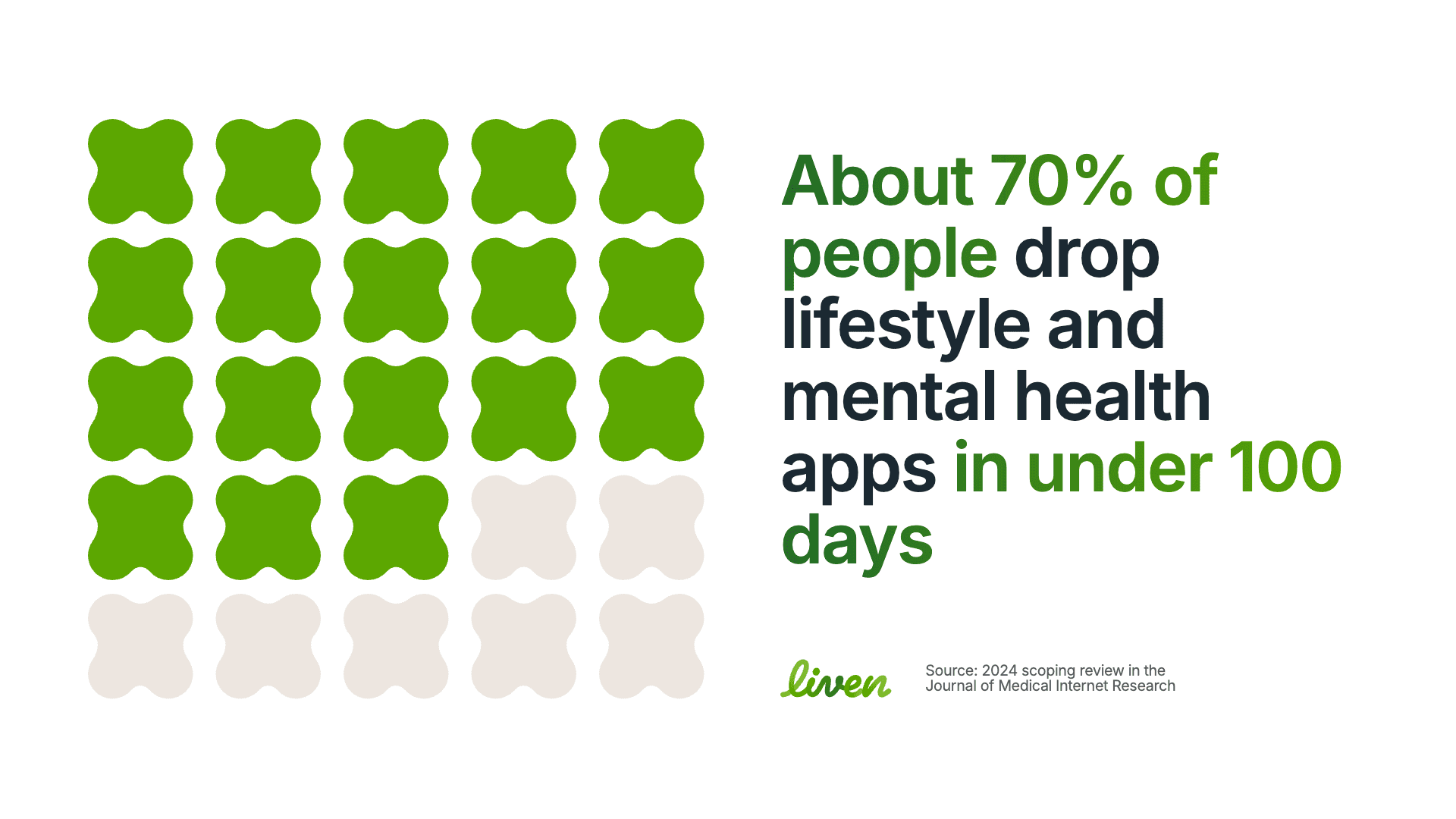
Most well-being apps get abandoned. 70% of users quit within 100 days, usually because of cost, content that did not match their goals, or gradually losing interest.
Pick the one you will still open three months from now. Ask yourself three questions before you commit to a yearly plan:
| Ask yourself | Lean Calm | Lean Liven |
| What do I want to feel different in 30 days? | Less stress in the moment | More awareness of why I get stressed |
| Do I want guided audio or guided reflection? | Audio-first | Reflection-first, with sounds as support |
| Do I need structure? | A library you navigate on your own | A Personalized Plan, lesson by lesson |
Tracking Your Progress Honestly
Whichever app you pick, track something more meaningful than a streak. Real progress looks like:
- Less mental chatter before bed.
- Catching yourself in a thought loop and stepping out of it sooner.
- Logging a mood and naming the trigger instead of guessing at it.
Liven's Mood Breakdown and Test History give you weekly, monthly, and yearly views of how your inner state is shifting. Calm shows session streaks and minutes meditated. Decide which signal matters more, then build around it.
What's Next for You
There is no single best well-being app, only the one that fits the change you are trying to build.
If you want a calmer pause at the end of a hard day, Calm has a deep library waiting. If you want to understand the patterns underneath the stress, Liven is built for that work.
Disclaimer: This article is for informational purposes only and reflects publicly available data as of May 2026. Pricing, features, and ratings are subject to change. This content does not constitute medical advice. If you are experiencing a mental-health crisis, contact a licensed professional or the 988 Suicide and Crisis Lifeline (US).
References
- Kidman, P. G., Curtis, R. G., Watson, A., & Maher, C. A. (2024). When and why adults abandon lifestyle behavior and mental health mobile apps: Scoping review. Journal of Medical Internet Research, 26, e56897. https://doi.org/10.2196/56897
- Linardon, J., Torous, J., Firth, J., Cuijpers, P., Messer, M., & Fuller-Tyszkiewicz, M. (2024). Current evidence on the efficacy of mental health smartphone apps for symptoms of depression and anxiety: A meta-analysis of 176 randomized controlled trials. World Psychiatry, 23(1), 139–149. https://doi.org/10.1002/wps.21183
- National Center for Complementary and Integrative Health. (2022). Meditation and mindfulness: Effectiveness and safety. U.S. Department of Health and Human Services. https://www.nccih.nih.gov/health/meditation-and-mindfulness-effectiveness-and-safety
- Singh, B., Murphy, A., Maher, C., & Smith, A. E. (2024). Time to form a habit: A systematic review and meta-analysis of health behaviour habit formation and its determinants. Healthcare, 12(23), 2488. https://doi.org/10.3390/healthcare12232488
FAQ: Liven vs Calm
Is Liven better than Calm for anxiety?
Can I use both Liven and Calm at the same time?
Is Liven a meditation app?
Does Calm offer therapy-based content?
Does Liven have an AI chatbot?
How long does it take to see results with Liven?
Is my data private on Liven?
Does Calm have a mood tracker?
Which app is more affordable, Liven or Calm?
Is Liven suitable for beginners?