A 3-Step Method for Clearing Emotional Clutter




It's 10 PM on a Tuesday. The house is quiet, your to-do list is done, and yet your mind is buzzing. You're replaying an awkward comment from a meeting, worrying about a conversation you need to have tomorrow, and feeling a vague sense of guilt about a text you forgot to answer. Nothing is wrong, but nothing feels quite right. You feel… full.
This mental and emotional weight is often called emotional clutter: the accumulation of unprocessed feelings, lingering anxieties, past regrets, and future worries that take up valuable space in your head. And it's not just a feeling. A chaotic or cluttered environment triggers a measurable stress response, raising cortisol levels and draining your energy throughout the day. Your brain treats mental clutter the same way.
But you don't have to live with that unseen weight. Your mind will never be completely quiet, and it doesn't need to be. The goal is just a little more room to breathe. This article will walk you through a simple, science-backed 3-step framework to help you do just that.
Key Takeaways
- Emotional clutter is your unprocessed thoughts and feelings, like past regrets or future worries.
- Living with clutter, both physical and mental, is linked to higher levels of cortisol, the body's primary stress hormone, which can impact sleep, focus, and overall well-being.
- A simple framework for clearing this clutter involves three steps: Capture (getting thoughts out of your head), Categorize (understanding what they are), and Compost (transforming them into growth or letting them go).
- When your brain is full of unresolved thoughts, there's no room left to focus, decide, or think clearly.
Step 1: Capture Your Clutter, Don't Just Carry It
The first step to clearing emotional clutter is to get it out of your head. When thoughts and feelings swirl around internally, they feel abstract, overwhelming, and infinite. Your brain's working memory gets overloaded, and trying to think your way out of feeling cluttered often makes it worse.
Getting your thoughts out of your head and onto paper frees up those cognitive resources. Writing about worries before a high-pressure situation consistently improves performance and reduces the mental interference that anxiety creates. The act of writing offloads the anxiety so you can actually focus.
How to Put This Into Practice:
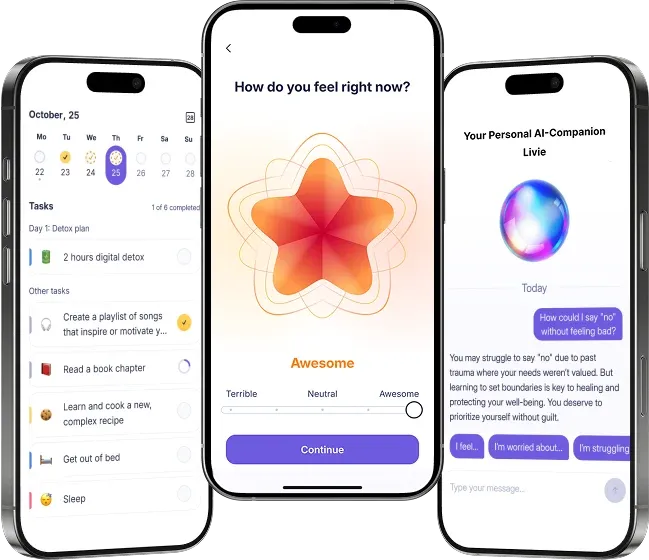
- Start a Brain Dump Journal. Set aside 5-10 minutes each day. Don't try to be profound or organized. Just write down everything that's on your mind: the worries, the to-do lists, the frustrations, the random ideas. Think of it as taking out the mental trash. Tools like Liven's Journal are designed for this, giving you a private space to capture thoughts without judgment.
- Use Voice Memos. If writing feels like a chore, talk it out. Use the voice memo app on your phone to record yourself talking through what's bothering you on your commute or while walking the dog. The goal isn't to solve anything yet, just to get it out into the open.
The key here is quantity over quality. Don't filter yourself. The more you can get out of your head and onto a page or into a recording, the lighter you will immediately begin to feel.
Step 2: Categorize the Piles to See What's There
Once you've captured your thoughts, you can begin to make sense of them. Just like you'd sort a pile of physical mail into bills, letters, and junk, you can sort your emotional clutter. This step is about moving from feeling overwhelmed to gaining clarity. When you categorize, you give your prefrontal cortex, the logical, problem-solving part of your brain, a clear job to do.
Naming what you feel changes what you feel. Putting a specific word to an emotion dials down activity in the amygdala, the part of your brain that sounds the alarm. The feeling doesn't disappear, but it becomes smaller and easier to work with.
Common categories of emotional clutter:
| Type of clutter | What it is | What it sounds like |
|---|---|---|
| Past regrets | Things you wish you'd done differently | "I should have spoken up in that meeting." |
| Future worries | Anxieties about things that haven't happened yet | "What if I fail this presentation?" |
| Unfinished business | Lingering tasks or conversations that feel incomplete | "I still need to have that talk with my friend." |
| Other people's expectations | The perceived judgments or needs of others | "My boss probably thinks I'm not working hard enough." |
| Negative self-talk | The critical inner voice that questions your worth | "I'm not good enough for this role." |
Take your brain dump from Step 1 and assign each thought to a category.
Step 3: Compost What No Longer Serves You
The final step is to decide what to do with your sorted clutter. Some emotional clutter has nothing to do with overthinking. It's the residue of emotions that never got space to move through the body in the first place. Composting is about transforming old, heavy material into something that nourishes new growth. In this case, you're turning worries into wisdom and regrets into lessons.
This is where you actively challenge and reframe your thoughts, a core technique in Cognitive Behavioral Therapy (CBT). CBT has strong, consistent evidence behind it as one of the most effective approaches for reducing anxiety and depression symptoms.
How to Compost Your Emotional Clutter
- For past regrets: Reframe them as lessons. Instead of dwelling on a mistake, ask what you learned from that experience that you can use today.
- For future worries: Create a concrete action plan for what you can control. For the rest, practice mindful acceptance. Acknowledge the worry without letting it rule you. Ask yourself whether the worry is productive or just noise.
- For unfinished business: Schedule it. Put the task on your calendar or decide on a specific time to have that difficult conversation. Your brain keeps unfinished tasks active in memory until they're resolved or planned for. Simply making a plan can quiet the noise far more effectively than trying to push the thought away.
- For other people's expectations and negative self-talk: Challenge them directly. Ask for evidence. Where is the proof that someone is disappointed in you? What is the evidence that you aren't capable? Often, you'll find these are stories you're telling yourself, not facts.
Your Path to a Lighter Mind
Your mind is not a storage unit for every worry, regret, and stray thought you've ever had. By practicing this 3-step process, Capture, Categorize, and Compost, you can regularly clear out the noise and make room for what truly matters.
You won't eliminate difficult thoughts entirely, and that's not the goal. The goal is to build a healthier relationship with your inner world, one where you are in control of what you carry. Relief usually arrives in pieces. Small moments where your body finally stops carrying what it thought it had to hold onto forever.
Start where it's easiest, be consistent, and notice how with each piece of clutter you clear, you feel a little more present, a little more focused, and a whole lot lighter.
If you want support working through your own emotional clutter, Liven's personalized plan is built around the same principles - helping you identify your patterns and build the habits to manage them consistently.
Sources
- Bhattacharya, S., Goicoechea, C., Heshmati, S., Carpenter, J. K., & Hofmann, S. G. (2023). Efficacy of cognitive behavioral therapy for anxiety-related disorders: A meta-analysis of recent literature. Current Psychiatry Reports, 25(1), 19–30. https://doi.org/10.1007/s11920-022-01402-8
- Dusseldorp, E. et al. (2022). The causal effect of household chaos on stress and caregiving: An experimental study. PMC. https://pmc.ncbi.nlm.nih.gov/articles/PMC9216699/
- Rakers, F. et al. (2023). A field experiment on the effects of weekly planning behaviour on work engagement, unfinished tasks, rumination, and cognitive flexibility. Journal of Occupational and Organizational Psychology. https://pmc.ncbi.nlm.nih.gov/articles/PMC10952538/
- Watanabe, A., et al. (2022). Changes in neural activity during the combining affect labeling and reappraisal. Neuroscience Research. https://www.sciencedirect.com/science/article/pii/S0168010222002929
- Yu, Y., & Zhang, X. (2022). Effects of expressive writing on "choking under pressure" in high test-anxious individuals. International Journal of Environmental Research and Public Health, 20(1), 302. https://www.ncbi.nlm.nih.gov/pmc/articles/PMC9819959/
FAQ: Emotional Clutter
What is emotional clutter?
How do I know if I have emotional clutter?
Can emotional clutter affect my physical health?
What is a brain dump, and how does it help?
How is emotional clutter different from stress?
How long does it take to clear emotional clutter?
What if I don't know what I'm feeling?
Is this the same as therapy?