Do I Have a Dopamine Addiction?




You told yourself you'd check the phone for five minutes. Yet, somehow, it's been two hours. You've scrolled through social media, doom-scrolled the news, and now you feel weirdly depleted of energy and motivation. Still, there is an urge to pick the phone back up.
"Do I have a dopamine addiction?" is one of those questions that feels dramatic until you really sit with it. Just think: the way most of us engage with our phones, food, and entertainment has a lot more to do with dopamine than we'd expect.
Check out what's actually going on with our brains in a world of constant stimulation and what can help change the pattern.
Key Learnings
- Dopamine addiction means one is addicted to habits that repeatedly overstimulate the brain’s reward system.
- Changes like understanding emotional triggers and tracking behavior patterns are more effective than extreme detox approaches.
- Support, self-awareness, and structured routines can help reset behavior patterns and restore motivation.
What is Dopamine Addiction?
Dopamine is a naturally occurring neurotransmitter that your brain uses to signal reward, motivation, and anticipation. Your brain releases dopamine when you eat something delicious, fall in love, accomplish a goal, or expect something good to happen.
Dopamine addiction means you are not addicted to the chemical itself but substances, behaviors, or stimuli that help your brain get those feel-good dopamine spikes at a frequency and intensity that's hard to sustain.
Do I Have a Dopamine Addiction? Short Test
How to Reset Your Behavior Patterns
The strategies below are designed to help you build your personalized dopamine management plan, step by step, so your brain can gradually return to a healthier rhythm.
1. Find the Why Behind Each Behavior
Every addictive behavior meets a need. The scroll that never ends might be loneliness, anxiety, or just a brain craving novelty. Emotional eating might be a form of stress regulation. The compulsive gaming might be the only place someone feels competent and in control.
When you notice yourself reaching for a high-stimulation activity, pause for just two seconds and ask: "What am I feeling right now?" As time goes on, you'll start to see patterns.
2. Redefine When and Where Behaviors Happen
Assign specific behaviors to specific contexts. Instead of "I'm going to use my phone less" (vague, hard to track), you define "I check social media only during my lunch break, on my laptop, at my desk." You've bound the behavior to a category of time and place.
This works because the brain forms habits through contextual cues. Changing the context interrupts the automatic loop.
Pick one behavior you want to limit. Define exactly when, where, and how long it's allowed. Write it down. For the first week, don't try to fully eliminate the behavior; just stick to the context you've set. Right now, you're training the association, not fighting the urge.
3. Try Healthier Sources of Satisfaction
Introduce activities that provide genuine, sustainable reward through naturally rewarding stimulation. Think: creating art, cooking a meal from scratch, physical movement like yoga, time in nature, and a real conversation.
Start small and specific. "I'll go for a 15-minute walk when I feel the urge to scroll" is actionable. "I'll get off my phone" is not.
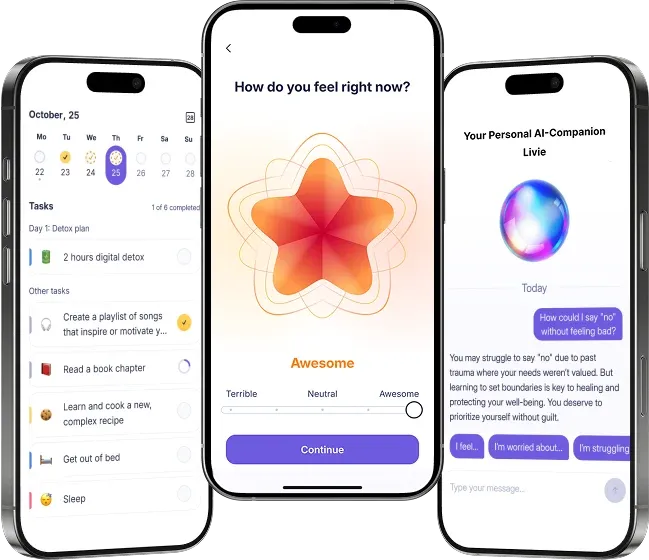
Liven's Today’s Routine can help you plan naturally rewarding activities into your day, whether it's a morning routine, a self-care ritual, or a tough-day fallback.
4. Track Your Progress for Adjustments
Most behavior change fails not because the approach is wrong, but because there's no feedback loop. You try something for a few days, can't tell if it's working, lose momentum, and slide back.
- Rate your urges, not just your actions. Instead of tracking whether you scrolled or not, rate the intensity of the urge on a scale of 1-10 before you act on it.
- Keep a daily one-minute check-in. At the end of each day, take Liven’s Journal and type one thing that felt harder than usual and one thing that felt easier.
- Set a one-week review. A weekly review gives patterns enough time to emerge and helps you see the gradual momentum you'd otherwise miss.
- Celebrate the near-misses. Log the moments you noticed the urge and paused, even if you still gave in. The pause itself is progress.
5. Give Yourself Permission to Seek Professional Support
Compulsive behaviors, such as overeating, excessive gaming, constant scrolling, or substance abuse, often emerge as coping strategies for underlying conditions like depression, anxiety, ADHD, or unprocessed childhood trauma.
Meanwhile, therapy, particularly approaches like Cognitive Behavioral Therapy (CBT), Acceptance and Commitment Therapy (ACT), or trauma-informed care, is effective for this kind of work.
If you're wondering whether what you're experiencing goes beyond a habit, Dr. Tracey Marks breaks down how to tell the difference and what your brain is doing.
Building A Healthier Relationship with Reward
The neurotransmitter dopamine itself isn't your enemy, and the goal was never to eliminate it. The goal is to rebuild a relationship with pleasure that doesn't leave you feeling worse every time.
Take it one small step at a time. Notice things. Be curious. And be as patient with yourself as you would be with someone you love who was going through this.
The self-discovery journey doesn't have to stop here. Try the Liven app (Google Play or App Store) to put these ideas into daily practice, get more insights on the Liven blog, and if you want to understand where you're starting from, Liven's self-discovery test is a great place to start.
References
- Dresp-Langley, B. (2023). Dopamine function in the global mental health context. Biomedicines, 11(9), 2469. https://doi.org/10.3390/biomedicines11092469
- Marks, T. (2024). Understanding the dopamine detox: Is it real or hype? [Video]. YouTube. https://www.youtube.com/watch?v=-_K4Uf9smi8
- Singh, N. (2024). Neurobiological basis for the application of yoga in drug addiction. Frontiers in Psychiatry, 15, 1373866. https://doi.org/10.3389/fpsyt.2024.1373866
- Wyatt, Z. (2025). How dopamine drives the new epidemic of everyday addictions. Psychiatry and Behavioral Health, 4(1), 1–6.
FAQ: Do I Have a Dopamine Addiction?
Is dopamine actually addictive?
What are the contributing factors to dopamine addiction?
Is dopamine addiction a real medical diagnosis?
What's the difference between dopamine addiction and a bad habit?
How long does it take to reset dopamine levels?
What does low dopamine feel like day to day?
Is doomscrolling a form of dopamine addiction?