Believing in Yourself Every Day: How Small Actions Lead to Big Confidence



You don't come into this world with strong self-belief; instead, it's something you develop through early childhood experiences (or later in life with a little self-help or therapy). Yet, it’s so easy to forget about it when life feels overwhelming, and your inner critic won’t quiet down.
Here is how to build the inner sense that you are capable, worthy, and strong enough to navigate your life.
Key Learnings
- Believing in yourself is a skill that can be cultivated with intention and practice.
- Thought reframing, journaling, and small daily “brave acts” enhance your self-belief.
- Surrounding yourself with supportive people and learning new skills strengthens the belief in your abilities.
- Therapy and guided strategies can help accelerate your growth in self-confidence.
What Does Believing in Yourself Really Mean?
Believing in yourself means knowing your strengths and areas that need improvement, as well as how to utilize your resources effectively and bounce back from setbacks.
A person with good self-belief knows that mistakes don’t define them; instead of succumbing to self-blame and regret, they choose to learn from the lesson and move on.
Common Barriers to Believing in Yourself
Most people run into the following roadblocks:
- Fear of failure
- Unhelpful self-talk
- Past unpleasant experiences
- Perfectionism
- Lack of supportive community
- Burnout or chronic stress
- Comparing yourself to others
- Chronic anxiety
- Feeling “behind” in life.
How to Start Believing in Yourself: Tips That Work
Below are simple, science-based strategies to help you start believing in your abilities and move forward.
1. Challenge Negative Beliefs with Reframing
“Thought reframing” is an exercise from Cognitive Behavioral Therapy (CBT) that helps one reduce anxiety. Some mental health apps like Liven even offer CBT-based courses on anxiety, burnout, and procrastination to teach you how to respond to negative self-talk with clarity and self-compassion.
Meanwhile, here is the exercise.
- Catch the thought. Let’s say your friend didn’t reply to your message, and you can’t stop thinking, “They must be mad at me.”
- Question whether it’s a fact or a fear. Is there any real proof they’re upset, or could they just be busy or tired?
- Develop a broader perspective on the situation and tolerate uncertainty about possible explanations. “Maybe they’re busy right now. I’ll wait and check in later if I’m still worried.”
2. Document Your Accomplishments as Proof of Your Capabilities
A simple pen and paper or a mental health app with a journaling feature, like Liven, can help you build your personal “I did that” archive, so you can remind yourself of all the things you’re capable of and all the challenging situations you’ve overcome.
You can include:
- Tasks you finished
- Challenges you overcame
- Moments you were brave
- A goal you achieved
- Positive feedback you’ve received.
3. Surround Yourself With People Who Lift You Up
People who see your potential, speak with kindness, and challenge you to grow can provide the support you need and demonstrate, by example, that everyone struggles, but at the same time, everyone can rise.
A few ways to do it:
- Join hobby groups that reflect your interests.
- Reconnect with friends who inspire and energize you.
- Keep a safe distance from those who communicate with toxicity.
4. Learn New Things and Master New Skills
Every new skill reminds you that you’re intelligent and resourceful enough to adapt and solve problems.
Ideas to get started:
- Take a weekend class in language learning.
- Read a book or listen to a podcast on a topic you know nothing about but are interested in.
- Start a creative hobby.
- Learn a new practical skill for work or business.
When you learn new things, your body releases dopamine, a hormone associated with feelings of reward and satisfaction. No wonder that you can easily turn hobbies into a part of your personalized dopamine management plan to boost mood and motivation.
Meanwhile, you can also use routine builders in mental health apps, such as Liven, to schedule small, confidence-building activities into your daily or weekly routine.
5. Set Realistic Goals
Create realistic expectations that are specific, measurable, and time-bound.
Let’s say you want to get more active.
- Specific: I want to exercise more consistently.
- Measurable: I’ll work out 3 times a week; each workout will be 30 minutes long.
- Time-bound: I’ll stick with this plan for the next 6 weeks.
6. Use the “One Brave Thing a Day” Rule
This idea aligns with the renowned Exposure Therapy, where one gradually faces one's fear.
How does it happen? You choose one small, manageable action each day that feels a little uncomfortable but is still doable.
For instance, if you feel anxious when talking to new people, your “brave thing” for the day might be simply saying hello to a coworker. Once you become comfortable with that level of exposure, you can take a slightly bigger step, for instance, by asking them how their day is going.
7. Start Therapy
Contrary to popular opinion, people don’t always start therapy because something is wrong with them. Many begin simply because they want to understand themselves better and learn healthier ways to cope with life’s challenges.
Here are a few approaches to choose from in the table, depending on your circumstances.
| Therapy Approach | Best For | How It Helps |
| Cognitive Behavioral Therapy (CBT) | Those who want to change persistent negative self-talk | Helps notice and reframe negative thoughts into realistic, empowering ones |
| Person-Centered Therapy (PCT) | Those seeking unconditional support and acceptance | Creates a safe space to feel truly understood |
| Solution-Focused Brief Therapy (SFBT) | Those who want short-term, goal-oriented support | Focuses on strengths and past successes to solve problems |
| Mindfulness-Based Therapy | Those prone to self-criticism or moderate anxiety | Teaches observing thoughts without judgment, which helps foster self-acceptance long-term |
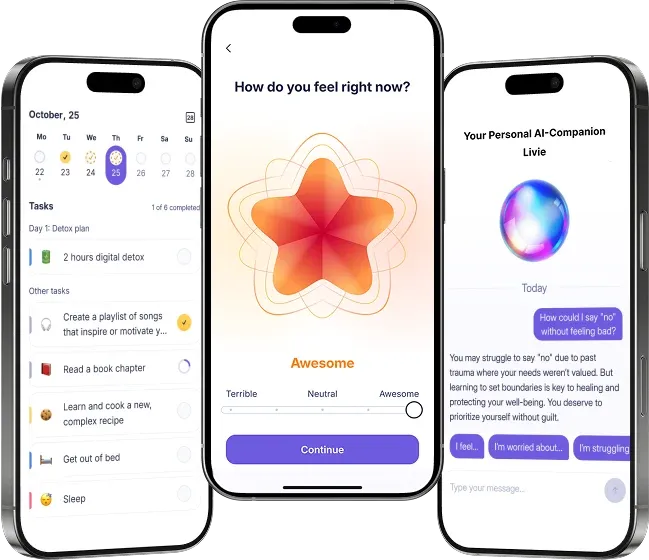
If you’re not ready for therapy but need daily support, having a 24/7 AI emotional health assistant might help. For instance, Liven’s Livie AI companion can guide you through reflection exercises, offer tips for managing stress, and help you strengthen your belief in yourself day by day.
9 Quotes about Believing in Yourself
- "Believe you can, and you’re halfway there." — Theodore Roosevelt
- “You may not control all the events that happen to you, but you can decide not to be reduced by them.” — Maya Angelou
- "Whether you think you can or you think you can't, you're right." — Henry Ford
- “You must always have faith in people. And, most importantly, you must always have faith in yourself.” — Elle Woods from “Legally Blonde”
- "Once we believe in ourselves, we can risk curiosity, wonder, spontaneous delight, or any experience that reveals the human spirit." — E.E. Cummings
- “I am not afraid of storms, for I am learning how to sail my ship.” — Amy March from “Little Women” by Louisa May Alcott
- “At the end of the day, we can endure much more than we think we can.” — Frida Kahlo
- “Faith is taking the first step even when you don’t see the whole staircase.” — Martin Luther King, Jr
- “You’ve always had the power, my dear. You just had to learn it for yourself.” — Glinda the Good Witch from “The Wizard of Oz” by Frank L. Baum
15 Resources to Support Your Self-Belief Journey
These are the resources to borrow wisdom from.
Films
- “The Secret Life of Walter Mitty” (2013). A quiet, uplifting story about stepping out of fear and into your own life.
- “Billy Elliot” (2000). A young boy learns to trust his passion despite fear, judgment, and expectations.
- “Wild” (2014). A powerful journey of rebuilding self-trust after loss.
- “The Pursuit of Happyness” (2006). A moving reminder that perseverance, self-belief, and love can carry you through the hardest seasons of life.
- “Julie & Julia” (2009). A story about finding confidence and purpose through small, consistent effort and the courage to begin.
Books
- “The Gifts of Imperfection” by Brené Brown. A compassionate exploration of self-worth, courage, and self-acceptance.
- “Mindset” by Carol S. Dweck. A classic on how beliefs about ability shape success, learning, and resilience.
- “Atomic Habits” by James Clear. Incredibly powerful for building self-trust through small wins and consistent action.
- “Self-Compassion” by Kristin Neff. A foundational book on treating yourself with kindness.
- “Man’s Search for Meaning” by Viktor E. Frankl. Deeply powerful for understanding resilience and inner strength.
Podcasts
- “On Purpose” by Jay Shetty. Conversations about purpose, mindset, and emotional growth.
- “The Confidence Podcast” by Trish Blackwell. Specifically focused on confidence, self-belief, and overcoming self-doubt.
- “Where Should We Begin?” by Esther Perel. Real therapy-style conversations that reveal how self-belief is shaped through relationships and emotional honesty.
- “Magic Lessons” by Elizabeth Gilbert. Story-based guidance on creativity, courage, and believing in your own ideas.
- “How I Built This” with Guy Raz. Stories from founders about taking risks, learning from failure, and believing in an idea before anyone else does.
Final Thoughts
Confidence develops through temperament, early relationships, and life experiences. It is something we cultivate each time we challenge a limiting belief, take a small brave action, or celebrate a win.
Sure, life brings challenges, but it’s in your power to decide how to respond to those.
Meanwhile, continue building confidence with Liven: download the Liven app (Google Play or App Store), read practical advice on the Liven blog, and check in on your mental health with free wellness tests.
References
- BBC. (2025.). Just One Thing Podcast with Michael Mosley [Audio]. https://www.bbc.com/audio/play/m000vgf0
- DecisionSkills. (2025). SMART Goals – Quick overview [Video]. YouTube. https://www.youtube.com/watch?v=1-SvuFIQjK8
- Lopez-Garrido, G. (2025, May 1). Bandura’s self-efficacy theory. Simply Psychology. https://www.simplypsychology.org/self-efficacy.html
- Purba et al. (2024). Enhancing self-confidence in low-income adolescents through person-centered therapy. Int J Indonesian Psychology. https://doi.org/10.18326/ijip.v7i1.3995
- Therapy in a Nutshell. (n.d.). Super Duper Gentle Exposure Therapy [Video]. YouTube. https://www.youtube.com/watch?v=qzpoO0oVRr8
- Yarwood, B., Taylor, R., & Angelakis, I. (2024). User experiences of CBT for anxiety and depression. Community Ment Health J, 60, 662–671. https://doi.org/10.1007/s10597-023-01196-w
FAQ: Believing in Yourself
What does believing in yourself really mean?
How can I build self-confidence if I don’t feel confident yet?
Is believing in yourself important for long-term success?
What should I do when I fail or feel discouraged?
Can believing in yourself really change your life?
How does self-belief affect relationships and the world around us?
What’s the most important thing to remember when building self-belief?