Alternatives to Therapy: Science-Backed Ways to Feel Better

There are a million reasons you might be looking for alternatives to therapy, and all of them are valid. Perhaps life feels too hectic right now, and the idea of adding weekly sessions to your calendar seems unrealistic. Maybe the waitlists and costs make it more challenging to access support when you actually need it. Or perhaps you’ve tried therapy before, but your season of life (or your budget) has shifted.
And sometimes, talk therapy isn’t your preferred way to grow. That’s okay, too.
What matters is that you’re here, curious and ready to explore what else can support your mind, your nervous system, and your emotional well-being.
In this guide, we walk you through evidence-backed, complementary, and alternative practices that you can start gently, at your own pace, without adding pressure to your already whole life.
Key Learnings
- CBT isn’t the only evidence-based model; ACT, DBT, IPT, EMDR, and existential approaches offer different benefits.
- Self-guided tools like apps, journaling, and mindfulness practices reduce anxiety and improve emotional well-being.
- Couples can benefit from creative therapies, such as narrative work and partner dancing.
- Holistic practices (art, music, nature, aromatherapy) are valid complementary tools with growing research support.
Alternatives to Therapy When You Can't Afford It
Prices are rising faster than most of us can keep up with, and traditional therapy can become expensive quickly. So if you’re exploring support that won’t strain your budget, there’s nothing to feel ashamed of.
A quick but important note: the tools we mention here are intended to help with everyday stress, emotional well-being, and self-discovery. They’re designed to support you, not replace professional care. If you're experiencing symptoms of clinical depression, please consult a licensed mental health professional for the appropriate treatment.
Sliding-Scale and Low-Cost Therapy
Best for: Individuals seeking traditional therapy at a reduced rate.
Many clinicians offer sliding-scale sessions, which means they adjust the pricing per session according to the client’s income and even life circumstances. All you have to do is ask therapists directly if they offer income-based pricing.
Community mental health centers and nonprofits often offer the same services, sometimes with no insurance required.
Employee Assistance Programs (EAPs)
Best for: Employees looking for short-term support
You don’t have to worry about cost, searching, or waitlists because most EAPs were designed to offer quick support.
EAPs offer free, confidential short-term counseling, typically consisting of 3–10 sessions per issue. They’re also a great option if you’re looking for guidance regarding burnout, workplace conflicts, or financial strain.
Group Therapy & Peer Support
Best for: People seeking a sense of community and shared coping strategies.
Group therapy (often very low-cost) and peer-led support groups (frequently free) provide a sense of community, normalize your experiences and emotions (so you no longer feel “It’s just me”), and create a safe space where you can gain practical wisdom from people living a similar story.
Organizations like the National Alliance on Mental Illness (NAMI) run free groups nationwide, both in-person and online.
Alternatives to CBT therapy
Why cognitive behavioral therapy? Because it’s everywhere, and for good reason. CBT is one of the most researched, effective approaches for anxiety, depression, PTSD, phobias, and even the emotional echoes of childhood wounds.
But sometimes the method you’ve been pouring your hope, time, and money into stops helping the way it used to. And that can feel discouraging.
If that’s where you are, there’s still room to explore. Here are other therapeutic approaches you can try if you appreciate talk therapy but want something different from CBT.
Acceptance and Commitment Therapy (ACT)
While CBT teaches you to work with your thoughts by examining them, testing their accuracy, and experimenting with new behaviors, ACT takes a different route. It’s less about changing the thought and more about changing your relationship with it.
For example, suppose you feel anxious about giving a presentation. In that case, CBT might guide you to look at the thought “I’ll embarrass myself,” evaluate its realism, and gather evidence through small behavioral experiments. ACT, on the other hand, encourages you to notice the thought without judgment, let it be there, and still move toward what matters, even with anxiety riding in the passenger seat.
Both are evidence-based approaches. They help you take a different stance toward the stories your mind tells.
Dialectical Behavior Therapy (DBT)
DBT teaches emotion-management skills and is perfect for those who deal with intense emotions, impulsive reactions, or relationship conflicts. While CBT may help you think differently, DBT enables you to act differently when emotions are high.
It’s important to note that DBT is not an alternative to CBT when it comes to treating borderline personality disorder, suicidal crises, or severe emotional dysregulation. DBT was specifically developed for these situations, offering targeted strategies to help manage intense emotions and improve coping skills. While both DBT and CBT share some common elements, DBT is designed to address more complex and immediate challenges.
Interpersonal Psychotherapy (IPT)
IPT focuses on one’s relationships, not their thoughts. It helps one understand how conflict, grief, communication issues, and significant life changes affect their emotional well-being.
Existential Therapy
For those who are asking, “What is the point of all this?”, trying existential therapy might be a good idea. This approach focuses on aspects like meaning, purpose, freedom, fear, responsibility, identity, and connection. It’s beneficial for those going through major life changes such as breakups, grief, big career shifts, and others.
Philosophical counseling
To put it simply, philosophical counseling employs tools from philosophy, such as logic, ethics, meaning, reasoning, and worldviews, to help individuals understand their conflicting values and beliefs/habits that cause existential stress.
It’s especially powerful if you’re thoughtful, introspective, and feel stuck in your own mind.
Alternatives to therapy for anxiety and depression
Below are practical, science-informed approaches that can help you manage symptoms and improve your mental health without the need for long commutes to a therapist’s office.
Mental health platforms
A 2022 review of 176 studies on digital tools for depression and anxiety, like Talkspace vs Betterhelp, found that apps can help reduce symptoms, particularly for social anxiety, OCD, and phobias. The same research shows that the most effective features include CBT-based exercises, mood trackers, and chatbots.
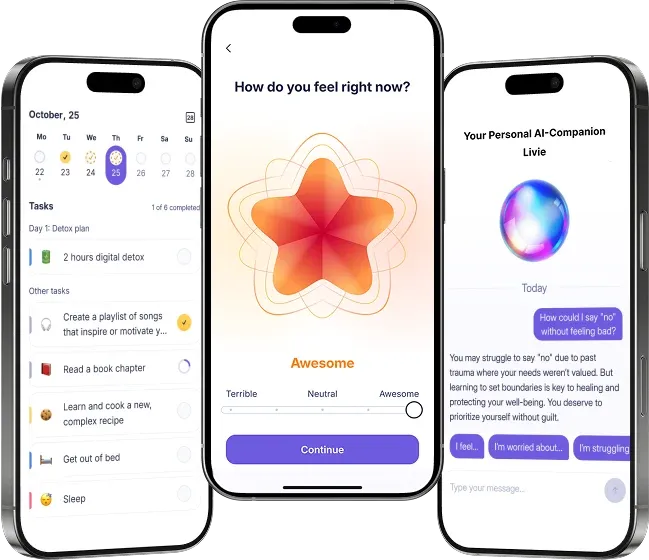
Modern mental health apps, such as Liven, integrate all these features in a cohesive, self-guided manner. Not only do they help you track your mood, triggers, and analyze patterns deeply, but they also offer short CBT-based courses on anxiety management and chatbots that guide you through coping exercises during stressful moments.
Mindful practices
Mindful practices include techniques such as yoga, meditation, and breathing exercises, which help individuals anchor in the present moment and reduce overthinking.
According to multiple studies, mindfulness practices have been shown to help lower blood pressure and heart rate, boost the immune system, and improve sleep quality, among other benefits.
Those who aren’t fans of traditional yoga and meditation can opt for Yoga Nidra, also known as "yogic sleep," during which one lies down with eyes closed and follows a guided meditation that systematically relaxes the body, leading to a state of non-sleep, deep rest.
In one study, participants who practiced Yoga Nidra slept better, woke up less at night, and performed better on memory, attention, and reasoning tasks compared to those who didn’t practice it.
Apps like Insight Timer, Headspace, or Calm are an excellent place for beginners, as all these tools offer guided meditations, breathing exercises, and Yoga Nidra sessions.
Journaling & Mood tracking
According to multiple studies, the benefits of journaling range from small to moderate. Still, researchers agree that journaling is a good complementary approach.
By the way, you don’t necessarily have to stick to the pen-and-paper method. You can opt for digital mental health apps with built-in journaling and mood-tracking features like Liven; turn journaling into a creative outlet (art journals, scrapbooking, etc.), or leave yourself voice/video notes at the end of the day.
Alternatives to Couples Therapy
Here are some evidence-based alternatives to therapy for couples that can strengthen relationships and improve communication.
Narrative therapy
This is a great approach for couples who feel stuck in negative patterns and blame cycles, and are looking to improve their communication skills or “rewrite” the story, also known as the narrative of their relationship.
Narrative therapy helps partners explore the stories they tell about themselves, each other, and their relationship, allowing them to rewrite these narratives with greater awareness and creative problem-solving.
Dancing therapy
Unlike talk therapy, dance therapy engages the body, emotions, and nonverbal communication simultaneously, allowing couples to practice connection in real-time.
A study involving couples who were already in therapy had them attend four weekly partner-dancing sessions (like ballroom or social dance) led by someone trained as both a dance/movement therapist and a dance instructor.
At the end of the study, the couples reported improved awareness of their relationship, emotional connection, teamwork, and trust.
Workshops, Retreats, and Webinars
These practices combine communication exercises, mindfulness practices, and experiential activities to help couples explore their emotions and develop effective communication skills.
This is definitely a more flexible and affordable format compared to regular therapy, which also includes hands-on exercises and group learning, along with opportunities to learn from professionals.
Free alternatives to therapy and complementary approaches
Here are a few complementary approaches that aren’t replacements for serious medical care, but still are backed by research as helpful ways to reduce stress and feel grounded.
Art therapy
As a therapeutic approach, art therapy started in the 1940s. Since then, it has been used for mental health condition support, such as schizophrenia and schizophrenia-like disorders, and for the management of chronic physical illnesses like asthma and cancer.
Meanwhile, another study shows that art therapy leads to significantly lower depression scores.
Music Therapy
Research shows that listening to calming music can reduce stress and anxiety, lower heart rate, and even reduce depressive symptoms. The researchers observed the most significant effects when sessions were 60 minutes long, individual, and there were at least 20 hours of therapy in total.
Meanwhile, another study even found that participants who listened to relaxing music for 20-30 minutes experienced reduced cortisol (the stress hormone).
Ecotherapy
Spending time in nature can reduce anxiety and depression, lower blood pressure, and improve emotional resilience (a park counts too).
A review of 42 studies shows that in the short term, ecotherapy helped with depressive symptoms just as much as regular talk therapy.
Aromatherapy
Certain scents, such as lavender, chamomile, and bergamot, help calm the nervous system.
Try using a lavender cotton pad near your pillow, smell calming oils before sleep, or simmer citrus peels or herbs on the stove. For more ideas, see this video from a certified mental health professional:
Herbal medicines
In a comprehensive review, researchers examined plants used worldwide for the treatment of depression. They found that these were the most effective:
- St. John's Wort (Hypericum perforatum)
- Saffron (Crocus sativus)
- Turmeric (Curcuma longa)
- Rhodiola (Rhodiola rosea)
- Liquorice Root (Glycyrrhiza glabra)
All these plants acted as antidepressants but came with fewer side effects.
How to Choose the Right Alternative to Therapy for You?
| If you answer “Yes” to… | Consider trying… |
| “Therapy is too expensive right now, but I still need support.” | Sliding-scale therapy, low-cost university clinics, EAPs, or peer support groups |
| “CBT isn’t helping me anymore. I feel stuck and frustrated.” | ACT, DBT, IPT, existential therapy, or philosophical counseling |
| “I want something flexible, self-guided, and available 24/7.” | Mental health apps, journaling, mood tracking, mindfulness practices |
| “We’re not in crisis, but we need support or fresh tools.” | Narrative therapy, partner dancing therapy, or couples workshops/retreats/webinars |
| “I prefer gentle, complementary tools that I can blend into my routine.” | Art therapy, music therapy, ecotherapy, aromatherapy, or herbal supports |
Final Thoughts
Therapy is one path, but not the only one. Regardless of your budget, schedule, or life circumstances, you can build a mental health toolkit that fits your needs and the season of life you’re in.
Meanwhile, you can embark on a self-discovery journey and continue exploring tools that help you feel grounded, such as the Liven app for mood tracking, journaling, and anxiety management (available on Google Play & App Store), our blog for additional insights, or free wellness tests.
Take one step at a time and stay curious.
References
- Bhandarkar, S., Salvi, B. V., & Shende, P. (2024). Current scenario and potential of music therapy in the management of diseases. Behavioural Brain Research, 458, 114750. https://doi.org/10.1016/j.bbr.2023.114750
- Eckhaus, R. (2025). Relationships in motion: Exploring partner dancing as an embodied psychotherapeutic approach for couples therapy. American Journal of Dance Therapy, 47, 23–42. https://doi.org/10.1007/s10465-024-09409-9
- El-Qirem et al. (2023). Effect of virtual reality therapy on stress and anxiety symptoms, and physiological measures among university students: An experimental study in Jordan. Current Psychology, 42, 18997–19005. https://doi.org/10.1007/s12144-022-02939-w
- Garg, P., Alambayan, J., & Garg, V. (2023). Herbal approaches in the management of mental depression. CNS & Neurological Disorders – Drug Targets, 22(1), 98–124. https://doi.org/10.2174/1871527321666220128091408
- Jenabi, E., Bashirian, S., & Bashirian, M. (2023). The effect of the art therapy interventions on depression symptoms among older adults: A meta-analysis of controlled clinical trials. Journal of Geriatric Psychiatry and Neurology, 36(3). https://doi.org/10.1177/08919887221130264
- Linardon et al. (2024). Current evidence on the efficacy of mental health smartphone apps for symptoms of depression and anxiety: A meta-analysis of 176 randomized controlled trials. World Psychiatry, 23(1), 139–149. https://doi.org/10.1002/wps.21183
- Rueff, M., & Reese, G. (2023). Depression and anxiety: A systematic review on comparing ecotherapy with cognitive behavioral therapy. Journal of Environmental Psychology, 90, 102097. https://doi.org/10.1016/j.jenvp.2023.102097
- Vora et al. (2024). Essential oils for clinical aromatherapy: A comprehensive review. Journal of Ethnopharmacology, 330, 118180. https://doi.org/10.1016/j.jep.2024.118180
FAQ: Alternatives to Therapy: Science-Backed Ways to Feel Better
What are some effective alternatives to therapy?
Are mental health apps effective for managing anxiety and depression?
How do complementary and alternative therapies improve emotional well-being?
Can alternative medicine replace talk therapy entirely?
What role does physical activity play in mental health?
How can I explore alternatives safely at home?