How Well Do AI Therapy Apps Work?



Finding a therapist can be challenging. Therapy, especially in the United States, can be expensive and often comes with long waitlists. AI therapy apps have stepped in to fill that gap, but how effective are they?
A 2025 randomized trial found meaningful symptom reductions in depression and anxiety using an AI chatbot. But a separate study found traditional therapy still outperformed artificial intelligence by a significant margin: 45% anxiety reduction versus 30%.
The truth is somewhere in the middle. These apps can help you build mental health practices at your own pace, but knowing which ones and how matters.
That’s why we reviewed the most-used AI therapy apps, looking at what they offer, who they're best for, and where they fall short.
The 7 Best AI Apps for Therapy
| App | Why pick | Platform | Price |
| Noah | It remembers your history to spot patterns across sessions. | iOS, Android | Free (limited); ~$10/mo |
| Abby | You can choose the "vibe" and specific therapy style (CBT, DBT, etc.). | iOS, Android | Free (limited); Subscription |
| Wysa | Has a clinical track record with an SOS path to human help. | iOS, Android | Free (limited); ~$11/mo |
| Earkick | No accounts or sign-ups. Open it and talk instantly. | iOS, Watch | Free |
| Woebot | Best for structured CBT "homework" and reframing. | iOS, Android | Free (via Insurance/Employer) |
| Youper | Perfect for people who want to see their mood "stats." | iOS, Android | ~$70/yr |
| Ash | Built for long, voice-first venting sessions. | iOS, Android | Free (Basic) |
| Serena | You can chat directly on WhatsApp like you're texting a friend. | ~$10/mo |
Here’s a review of the top AI therapy apps. We’ve analyzed how well they capture human psychology and included free apps and premium plans.
Note: Prices and plans are subject to change. Always check official app website for the most current pricing.
1. Noah AI
Why pick Noah AI: Instant voice therapy calls. Tap a button, and you're talking to your AI therapist in seconds, any time of day or night.
Noah is an AI emotional coach that provides 24/7 support for anxiety, stress, and the general weight of daily life. Unlike typical AI chatbots that treat every session like a new interaction, Noah uses a context layer to retain memory of your past conversations. This allows the AI to reference your history, track your emotional progress, and identify recurring patterns in your behavior.
Also, while Noah is built on evidence-based techniques like CBT (Cognitive Behavioral Therapy), it can't guarantee the same clinical effectiveness as a human therapist. We suggest you don't use it as a substitute for professional clinical care. Rather, use it to navigate the gaps between human therapy sessions.
Noah AI pros
- Remembers past conversations, so you're not starting from scratch every time
- Non-judgmental tone that users consistently describe as feeling surprisingly human
- Affordable yearly plan compared to traditional therapy costs
Things to consider with Noah AI
- The free version is limited to 7 messages a day, which can feel restrictive mid-conversation
- Some users report lag and pauses during voice calls that break the flow
Noah AI pricing
- Free: 7 messages/day
- Premium: Roughly $10–15/month or $40–50/year
2. Abby
Why pick Abby: Trained on 7,800+ therapy books and research papers
Abby is for the person who wants their support to feel less like a clinical intake and more like a personal conversation. So, depending on what you need that day, you can choose a communication style that’s warm and nurturing, strictly professional, or direct and solution-focused.
What makes it feel more like a therapeutic partner than a basic bot is its range of options. Instead of just sticking to one method, Abby is trained across various frameworks — from the structured tools of CBT and DBT to the deeper, more reflective work of psychodynamic and Gestalt therapy.
Abby pros
- Broad therapeutic framework, not just CBT
- Fully anonymous with no appointment needed
- Available in 26 languages with enterprise options for institutions
Things to consider with Abby
- It doesn't remember past conversations, so you'll have to start from scratch in each chat
- It can try to be too friendly (and over-empathetic)
- Most exercises and analytics are only available in the pro plans
Abby pricing
- Free tier available
- Premium: $19.99/month
3. Wysa
Why pick Wysa: 45+ peer-reviewed studies backing its effectiveness, which is more clinical evidence than almost any other AI therapy app on the market.
The Wysa app is built for individuals who want a tool that’s been rigorously tested and fits into a larger system of care. With over 6 million users, it’s one of the few apps in this space with a significant track record.
Instead of just a casual chat, it acts as a 24/7 happiness buddy (represented by a friendly penguin) that guides you through a massive library of over 150 exercises. It's also genuinely anonymous, requiring no personal information to get started, which matters more than people realize when the topic is mental health.
Wysa pros
- Trusted by health systems, insurers, and employers globally, not just individual users
- Fully anonymous from the start
- You can switch to a human coach at any time
Things to consider with Wysa
- Not designed for crisis situations
- No voice interaction
Wysa pricing
- Free plan available.
- Premium: $19.99/month or $74.99/year
4. Earkick
Why pick Earkick: The only major mental health AI app that requires no account, no email, and no registration.
Earkick keeps things simple with a low-commitment user flow. You don’t have to create an account or even give your name. The experience centers on a friendly AI panda that serves as a 24/7 companion for your "micro-moments." Instead of long, formal sessions, it’s built for quick check-ins where you can vent via text or voice.
It also tracks things like your mood, sleep, and even heart rate if you use an Apple Watch, helping you see the connection between your physical stress and your mental state. While it uses tools like CBT and breathing exercises to help you ground yourself, it honestly bills itself as a wellness companion rather than a clinical therapist.
Earkick pros
- It’s the easiest app to use when you are in a state of high distress and can't handle a complex UI
- Unlike most competitors, Earkick doesn't hide its core emotional support features behind a paywall
Things to consider with Earkick
- It’s iOS only
- Not suitable for crisis support or complex mental health conditions
- Focused on tracking and monitoring rather than active therapy
Earkick Pricing
- Completely free
Your Companion For a Calmer Mind
AI therapy apps aren't a replacement for professional care, and the best ones don't try to be. But for the millions of people managing long waitlists, high costs, or simply the quiet weight of everyday stress, they offer a place to show up consistently, on your own terms.
The apps on this list each serve a different kind of need. Some shine in structured therapeutic frameworks, others in clinical credibility, and others in removing every barrier to getting started. The right fit depends entirely on what you're looking for right now.
What most of them have in common, though, is a focus on the session itself. The harder challenge is to take what you've learned and apply it on a random stressful Tuesday.
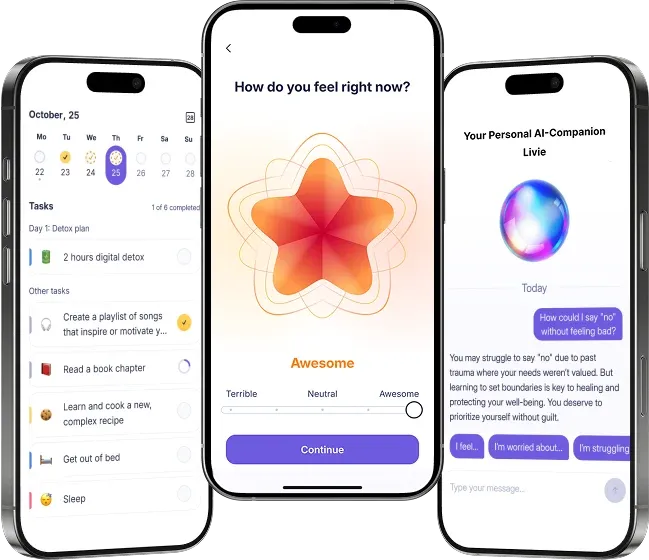
That's the space the Liven app was built for. It's a self-discovery companion designed to support your growth between sessions. Through Livie, a judgment-free companion available any time, you can log moods, process your thoughts, and build small science-backed habits that help your progress actually land in real life.
Whatever tools you choose, the most important thing is showing up.
FAQ: AI Therapy Apps
Do AI therapy apps really work for anxiety and depression?
Can an AI therapist diagnose mental health conditions?
Are AI therapy apps safe during a mental health crisis?
Are there free AI mental health apps worth using?
How do AI tools personalize mental health support?
Can AI therapy apps replace talking to a real therapist?
Who benefits most from an AI therapy app?