How to Manage Emotions at Work?




Work loves the idea of professionalism, often making it feel like you’re supposed to leave your emotions at the door before starting your day. It keeps things looking neat and controlled, but people don’t actually work that way. And to keep one's emotions continually in check is exhausting which creates its own set of problems.
Even in structured environments, emotions are always present. It's called being human! Meetings might be organized and emails carefully worded, but tone, pressure, and perception are always part of the interaction. You feel it when feedback lands a certain way or when a conversation shifts slightly.
It doesn’t take much. A quick comment from a manager, unexpected feedback, or a bit of tension with a colleague can bring up frustration, anxiety, or self-doubt. That’s normal. The goal isn’t to get rid of those reactions, but to handle them in a way that doesn’t throw you off. So you can stay in control of your response, even when the situation itself isn’t in your control.
In this guide, we’ll walk through practical ways to manage your emotions at work so you can stay steady, communicate clearly, and handle situations without letting them spiral.
Key Learnings
- Your emotions show up in everyday moments, such as during feedback, tight deadlines, and even quick Slack messages.
- Taking a short pause before responding can keep a tense email or meeting from escalating.
- The way you interpret a situation affects how you react, and adjusting that can quickly reduce stress.
- Staying calm and clear in conversations builds trust, even when there’s disagreement.
Why Emotions Matter at Work
Workplaces are inherently social environments. Every project involves communication, collaboration, and evaluation, and all of these naturally involve emotions. In fact, studies show that 45% of workers feel emotionally drained by their work, and 51% feel used up by the end of the day.
Even constructive feedback can trigger defensiveness if your emotional response kicks in before rational thinking. A rushed reply or a dismissive tone can quickly create tension with colleagues or supervisors.
When negative emotions go unprocessed, they carry forward into future interactions. Frustration can turn into sharp responses, while anxiety may lead to withdrawal.
Understanding the Emotional Cycle
Before we dive into practical strategies to manage your emotions, let's look at how the emotional cycle works and how it impacts you. Emotional responses often follow a simple pattern:
- Trigger - A sudden change, feedback, or conflict occurs.
- Reaction - The brain interprets the event, triggering emotions such as frustration or anxiety.
- Behavior - Immediate actions may be impulsive or defensive.
The key lies in what happens between reaction and behavior.
Pausing, even for a few seconds, creates space for conscious choice. This is where emotional intelligence begins to shape your response. You can take control of the situation and act more intentionally.
The CBT triangle reflects something similar: thoughts, emotions, and behaviors are deeply connected. A situation itself doesn’t directly cause your reaction, but your interpretation of it does. Once you become aware of this loop, you gain the ability to shift it.
Practical Strategies to Manage Emotions
1. Pause Before Responding
Your nervous system kicks into high gear when tension hits. A sharp email, unexpected criticism, or a deadline suddenly moving up can all act as triggers. Taking even a brief pause interrupts this automatic stress response and returns control to your rational mind.
How to practice it:
- Count to ten slowly before replying to any triggering message
- Step away from your desk for two minutes if you feel heat rising in your face
- Try box breathing: inhale for four counts, hold for four, exhale for four, hold for four
This small gap between stimulus and response is where you get your choice back. Try pausing for a moment, then respond in a calm, considered way.
2. Shift Perspective
Most workplace friction comes not from what actually happened, but from the story we tell ourselves about it. Shifting perspective means interrogating that story rather than accepting it as fact. The first version of the story is rarely the most useful one.
Questions to ask yourself:
- What evidence supports my interpretation? What contradicts it?
- If a friend described this situation to me, what would I tell them?
- What might be going on for the other person that I cannot see?
Reframing doesn't mean excusing poor behavior. It means choosing the interpretation that serves your long-term goals rather than your short-term ego.
3. Communicate Calmly
Calm communication is a signal of competence. It tells others that you can handle pressure without losing your footing, which builds trust faster than any credential.
Techniques to use:
- Lead with observation, not accusation: "I noticed the deadline changed" rather than "You changed the deadline without telling me."
- State your intention upfront: "I want to find a solution that works for both of us."
- In writing, draft your response, wait ten minutes, then edit before sending.
Your tone shapes the response you receive. Choose one that opens doors instead of closing them.
Anxiety at work has a way of following you around, into your mornings, your evenings, even the time you’re supposed to be off. When it’s high, thinking things through in the moment isn’t always easy.
If that sounds familiar, here's a practical guide about a few small shifts that can help you notice what’s happening earlier and respond in a steadier way.
4. Practice Empathy
Empathy is not about agreeing with everyone. It is about understanding the human context behind professional actions - the constraints, pressures, and fears that drive behavior.
Ways to build this mental muscle:
- Before a difficult conversation, write down three possible reasons the other person might see things differently
- Listen for what is not being said: hesitation, fatigue, or anxiety in someone's voice
- Ask directly: "What else is on your plate right now?" or "What would make this easier for you?"
When you consistently demonstrate that you see others as full human beings rather than obstacles or tools, you become someone people want to work with and support. By practicing empathy, you can see the reasons behind someone's actions that you might have taken personally otherwise.
Emotional Labor and Its Limits
By now, you've seen some good strategies to manage your emotions at work. However, this takes effort, and emotional skills also have their limits. The sociologist Arlie Hochschild talks about emotional labor - the invisible effort of regulating what we show to meet professional expectations. If you are regularly feeling drained by too much emotional labor, then it might be time to pause and rethink.
Know when to step back:
- Dread persists despite using the strategies above
- Hostility or manipulation that remains unaddressed
- Physical signs: disrupted sleep, tension, persistent dread
If you are experiencing the above signs repeatedly and your workplace has become too depressing or toxic, it might be time to seek professional support or leave that job.
Building the Habit: Your Next Step
Emotional strength is gradually developed through the small moments when you choose to pause before an immediate reaction and to show empathy rather than defensiveness. Start this week, one step at a time: notice one trigger, apply one strategy, observe what shifts. The goal isn’t to control every emotion, but to feel emotionally strong enough so that they don’t control you.
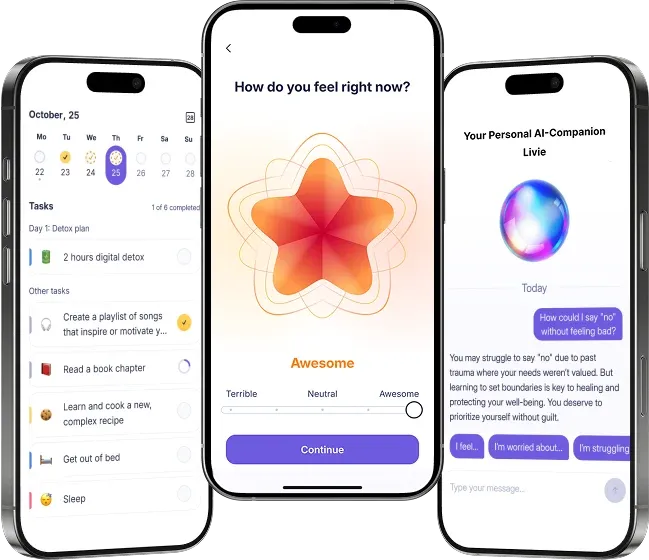
Liven’s Mood Tracker and Journal can support this process by helping you notice patterns and reflect on your reactions more clearly. Over time, difficult conversations become more manageable, and you build a steadier way of responding that stays with you beyond a single role or situation.
Sources
Peng, P., & Li, X. (2023). The hidden costs of emotional labor on withdrawal behavior: The mediating role of emotional exhaustion, and the moderating effect of mindfulness. BMC Psychology, 11, Article 332. https://doi.org/10.1186/s40359-023-01392-z
Society for Human Resource Management. (2024). Employee mental health in 2024 research series. SHRM. https://www.shrm.org/topics-tools/news/inclusion-diversity/burnout-shrm-research-2024
- Yarwood, B., Taylor, R., & Angelakis, I. (2024). User experiences of CBT for anxiety and depression: A qualitative systematic review and meta-synthesis. Community Mental Health Journal, 60(4), 662–671. https://doi.org/10.1007/s10597-023-01196-w
FAQ: How to Manage Emotions at Work
How do you manage emotions at work effectively?
Why do emotions feel stronger in the workplace?
What is emotional labor at work?
How does emotional intelligence help professionals?
What causes unnecessary stress at work?
Can emotional regulation be learned?