Career Growth Tips for Long-Term Success


You’ve done what every career article tells you to do. You show up. You work hard. You stay motivated. And yet, something still feels off. Maybe you’re stuck in roles that don’t fit you, saying yes to work that drains you. If you catch yourself asking, “Is this really it?” it can be a clear sign it's time for a career strategy makeover.
Career growth isn’t just about better performance reviews or the next promotion. It’s about understanding who you’re becoming and building a path that matches your values, energy, and emotional reality.
This article will help you shift from pushing harder to growing smarter, using self-discovery as your primary career tool.
Key Learnings
By the end of this article, you’ll understand:
- Why “just work harder” stops working after a certain point
- How a growth mindset can transform the way you handle feedback, setbacks, and opportunities
- How to build a structured, emotionally aware self-improvement plan (without burning out)
- How emotional intelligence supports better decisions, leadership, and long-term wellbeing
- How to use tools like Liven’s Mood Tracker and Journal to turn insight into daily progress
Why Hard Work Alone Stops Working
In the early stages of your career, working harder often works. You stay late, reply fast, and say yes to almost everything. You get noticed. But over time, this strategy hits a ceiling:
- There are only so many hours you can give.
- The “extra effort” stops being appreciated and starts being expected.
- Your emotional battery runs low, even while your to-do list grows.
At that point, you need to evolve from working harder to working smarter. Growth comes less from doing more than from seeing clearly:
- What kind of work energizes you, not just pays you
- Which patterns keep you stuck (overcommitting, avoiding feedback, chasing prestige)
- How your emotional habits shape your career decisions
That’s where mindset, structure, and emotional intelligence become your fundamental growth tools.
Develop a Career Growth Mindset
A growth mindset, a term coined by the famous psychologist Carol Dweck, is the belief that your abilities can be developed through effort, learning, and practical strategies, rather than being fixed traits you’re born with.
In contrast, a fixed mindset is the belief that your abilities, intelligence, and talents are inherent and unchangeable. People with a fixed mindset often avoid challenges, give up easily, and feel threatened by others' success because they believe their potential is limited. They may see failure as a reflection of their abilities, rather than an opportunity for growth.
In practice, a career growth mindset sounds like:
- “I don’t know this yet, but I can learn.”
- “Feedback is uncomfortable, but it’s also data.”
- “Their success isn’t proof I’m behind, it’s proof that what I want is possible.”
When you embrace a growth mindset, setbacks become stepping stones, and challenges are seen as opportunities to develop new skills. This mindset is essential for career growth, enabling you to continually improve and adapt as you move forward in your professional journey. Believing you have more to learn, more to give, more to achieve is also a lot less stressful in the long run!
How to Apply Growth Mindset to Your Career
1. Rewrite your internal dialogue.
Notice the phrases that show a fixed mindset:
- “I’m just not a leadership person.”
- “I’m terrible at public speaking.”
- “I always mess up interviews.”
Gently shift them into learning statements:
- “I’m learning how to lead one conversation at a time.”
- “Public speaking is a skill I can practice.”
- “Interviews are uncomfortable, but each one teaches me something.”
2. Treat feedback like a resource, not a verdict.
Feedback worry is real. It can poke at your ego and trigger the fear that you’re “not enough.” Instead of avoiding it:
- Ask for specific feedback on one project at a time.
- Separate you from the work: “This design needs changes.” ≠ “I’m a failure.”
- Look for patterns: are you hearing the same thing from different people? That’s a growth map.
3. Take ownership of your learning curve.
Your employer might care about your development, but their primary focus is still the bottom line. Your growth belongs to you, so make a commitment to yourself to actively manage your career and career development.
- Initiate 1:1s about your career path, not just project updates.
- Ask, “Which skills would make me more effective in the next 6–12 months?”
- Create a simple development plan instead of waiting for someone to hand it to you.
📖 Practice Structured Self-Improvement
Anyone can write a list of career goals. The hard part is staying with them once real life, urgent tasks, and emotional fatigue enter the chat.
Structured self-improvement means you:
- Know why you want something
- Choose a few specific skills or habits to work on
- Create realistic conditions to make progress (time, energy, boundaries)
- Adjust your plan based on how you actually feel, not how you “should” feel
1. Get Honest About Your Real Motivations
Start with one question: “Who am I doing this for?”
- A promotion to feel safer financially?
- A job title to impress your family or peers?
- A role that actually fits your strengths and values?
When your goals are fueled mainly by external approval, it’s much harder to stay resilient after setbacks. When they’re aligned with your values, you’re more likely to get back up after a rough week.
💡 Tip: Open Liven's Journal and write for 5–10 minutes about a goal you’re chasing. Ask yourself:
- “What do I hope this will change in my life?”
- “What am I afraid might happen if I don’t reach it?”
2. Learn to Say No Without Guilt
Saying "no” can be emotionally taxing. But knowing when to say "no" and how to say it, is a key career skill. Many people say yes because they’re afraid of disappointing others, losing opportunities, or being seen as unhelpful. But when you say "yes" to everything, you quietly say "no" to your own growth.
Start small:
- Protect one deep work block per week where you don’t accept new meetings.
- Before agreeing to a task, ask: “Does this move me closer to my long-term goals, or just keep me busy?”
- If a task doesn’t challenge or grow you, see if it can be delegated, rotated, or time-boxed.
3. Turn Progress Into a Routine
Too often, we over-focus on outcome-based goals and neglect the routine, daily, and weekly task-based goals. You won’t always feel like working on your career. That’s normal. Structured self-improvement involves creating systems that sustain you even when motivation wanes.
You can:
- Pick one growth action per week (e.g., ask for feedback, apply for one role, practice a skill).
- Do a 10-minute Friday reflection: “What did I learn this week? What drained me? What energized me?”
- Set a small monthly experiment (e.g., lead one meeting, share a project idea, mentor someone).
Liven’s Journey feature can support this by guiding you through a personalized learning path, helping you integrate small emotional and behavioral shifts into your everyday life.
🌱 Build Emotional Intelligence So Growth Feels Sustainable
A career can stall not because of a lack of skills, but because we undermine ourselves with our emotional patterns. Emotional intelligence (EI) is your ability to notice, understand, and manage your own emotions — and recognize how they affect other people. At work, EI shows up in places that rarely appear on performance reviews:
- How you react when plans change at the last minute
- How you handle tension with a colleague
- How you speak to yourself after a mistake
- How you make decisions when you’re tired, anxious, or overwhelmed
Research has shown a correlation between higher emotional intelligence and improved job performance, enhanced leadership potential, and more positive work relationships. It also supports long-term well-being by lowering stress and enhancing conflict resolution.
1. Build Self-Awareness in Micro Moments
Instead of waiting for a breakdown, pay attention to small signals during your day:
- Your jaw is tightening before a meeting
- Your energy drops after a specific type of task
- Your mood changes after a comment from your manager
- You consistently "hold your tongue" because you prioritise harmony over your values
Ask yourself:
- “What am I feeling right now?”
- “What story is my brain telling me about this situation?”
2. Manage Stress as a Signal
Become aware of your personal "tipping point" where pressure tips over into stress. Pressure keeps us sharp; stress does not. But stress is not the problem by itself. What matters is how you interpret it.
If a project changes for the third time, instead of silently resenting it, ask: “What problem are we trying to solve with this change?”
And if you feel overwhelmed, break tasks into smaller chunks and focus on the next right step, not the entire mountain. I'm a big fan of a micro goal. If the task is daunting, say to yourself, "I'm going to spend 20 minutes on this", before moving on to something else. You can come back to it later for another 20 minutes.
3. Nurture Empathy and Better Conversations
Empathy at work doesn’t mean absorbing everyone else’s stress. It means:
- Actively listening before jumping to defend yourself
- Asking, “What’s making this difficult for you right now?”
- Looking for shared goals, not just competing priorities
This doesn’t just make you “nice”, but it makes you easier to collaborate with, which is a real career advantage.
4. Ask Critical Questions (Even When It’s Uncomfortable)
A significant aspect of emotional intelligence is the courage to question systems, processes, and decisions respectfully.
Instead of just “doing what you’re told,” try:
- “Can you help me understand the goal behind this change?”
- “Is there a risk we might be missing if we skip this step?”
- “How could I prepare better next time to avoid this issue?”
Open questions move you from passive executor to thoughtful partner, expanding the conversation to deepen everyone's understanding of a situation. That’s a key shift in career growth.
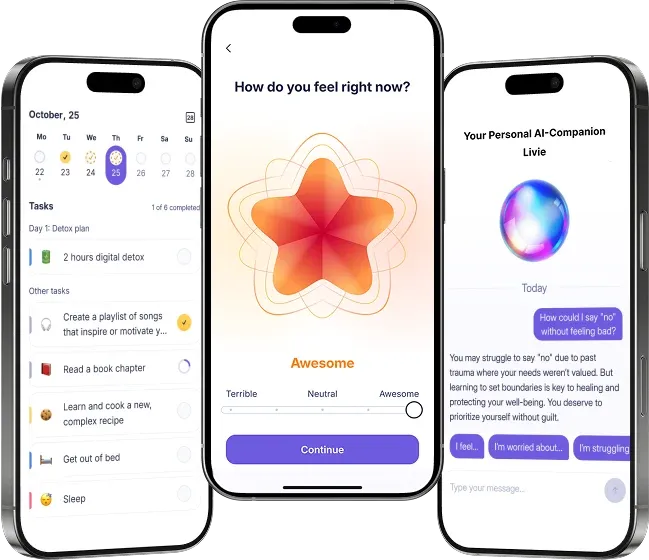
✨ Use Liven to Turn Insight Into Daily Career Habits
Career growth is easier when your tools help you pay attention to your inner world, not just your calendar.
Here’s how different Liven features can support your path:
- Mood Tracker: Identify emotional patterns associated with specific tasks, people, or environments. Over time, this helps you design a work life that respects your nervous system.
- Journal: Process tough days, feedback, and confusion in a safe space. Turn swirling thoughts into clearer decisions.
- To-Do Lists: Turn vague career goals into small, trackable actions: “update resume,” “reach out to mentor,” “read 1 article about leadership.”
- Mental Tests: Explore how you handle stress, burnout, or self-sabotage to better understand what’s really holding you back.
- AI Companion (Livie): Have a quick, judgment-free conversation when you’re overwhelmed or stuck in overthinking about work decisions.
Together, these tools help you build a career from the inside out, rather than just from the outside in.
Finding Your Way Forward
Accept that your career is not a ladder you climb in a straight line. It’s a path you shape step by step, with every boundary you set, every new skill you explore, and every honest conversation you have with yourself.
If you’ve been sending applications that go nowhere or staying in roles that drain you, that frustration isn’t a sign you’ve failed. It’s feedback from your nervous system that something needs to change.
Liven can be your companion in that change:
- helping you notice emotional patterns at work,
- staying grounded when self-doubt spikes,
- and turning small, consistent actions into visible progress.
Ready to map your next growth chapter? Take a quick check-in quiz to spot the patterns behind your reactions, and let your career path follow who you are, not what others expect of you.
FAQ: Career Growth Tips
What are the most important career growth tips?
How can I advance my career if I feel stuck in my current role?
How can I apply a growth mindset at work?
What does structured self-improvement look like in a career?
How does emotional intelligence help with career growth?
How can an app like Liven support my professional development?
How can I improve my communication skills for career growth?
How can I set effective career development plans?