
Polyvagal Theory Explained



Written by
Nadine M., Editorial Team Lead at Liven

Reviewed by
Tara Passaretti, M.S., LMHC


There are moments when your physiological and emotional reactions don’t seem to make sense.
You might shut down in a conversation without meaning to. Or feel suddenly anxious in a situation that seems objectively safe. Or notice yourself pulling away when you want to stay connected. It can feel confusing, especially when your thoughts don’t fully explain what’s happening.
Polyvagal theory offers a way of making sense of all this. It looks at how your nervous system reads cues of safety, danger, and overwhelm, often before your conscious mind catches up. Some pieces of the theory are still being debated in scientific research, and many people find its core ideas useful for understanding their own patterns around stress, connection, and emotional regulation.
In this article, we’ll explain the polyvagal theory in simple terms and show you practical ways that can help you understand and manage stress.
Key Learnings
- Polyvagal theory offers a way of understanding how the nervous system shifts between states tied to safety, stress, and shutdown.
- Most stress reactions happen automatically, shaped by how your nervous system reads safety or threat in the moment.
- The same situation can feel manageable on one day and overwhelming on another, depending on what state you're in.
- Stress regulation runs through the body as much as the mind, so working with breath, movement, rest, or connection can help just as much as the thinking work.
What the Polyvagal Theory Is About
Polyvagal theory is a way of understanding how the nervous system shifts between states of safety, stress, and shutdown.
This theory was formulated by Dr. Stephen Porges. He suggested that instead of seeing your nervous system as simply calm or stressed, it can be understood as a range of states that shape how you feel, think, and respond. These states are automatic responses designed to keep you safe, rather than something that's chosen in the moment.
At the center of this system is the vagus nerve, which connects your brain to key organs, including your heart, lungs, and digestive system. The vagus nerve plays a big role in how your body regulates itself, from heart rate and digestion to recovering from stress and engaging socially.
You don't consciously control these nervous system responses in any given moment. Over time, though, your experiences, relationships, environment, sleep, stress levels, and daily habits all shape how reactive or settled the whole system becomes.
The Three States Your Nervous System Moves Through
According to Stephen Porges's polyvagal theory, your nervous system shifts between different physiological states depending on what's happening around you and what's happening inside.
You don't choose these states. They run automatically, shaping how safe, connected, energized, or overwhelmed you feel in any given moment.
1. The ventral vagal state
In polyvagal theory, this is the state most tied to feelings of safety, social connection, and flexibility. You can think more clearly, engage with people, and stay present. Conversations feel smoother, and your body feels more settled. Life is still life, with its stressors. Your nervous system simply feels safe enough to stay open rather than defended or overwhelmed.
2. The sympathetic state
When your nervous system picks up on challenge, uncertainty, or threat, it shifts into a more activated state. This can feel like worry, restlessness, tension, urgency, or hyperfocus. Heart rate picks up, thoughts speed, and attention narrows around managing whatever's pressing.
In many situations, this response is useful. It mobilizes energy, sharpens alertness, and gets your body ready to respond. When activation stays high for long stretches, though, it can leave you feeling chronically on edge, irritable, exhausted, or unable to fully relax.
3. The dorsal vagal state
When stress gets overwhelming, prolonged, or emotionally unmanageable, some people slip into a more shut-down state. It can show up as emotional numbness, exhaustion, withdrawal, low motivation, or a sense of disconnection from yourself or others. Polyvagal theory reads this as a protective response, the system pulling back to conserve energy when stress feels like too much.
Not every experience of fatigue or withdrawal traces back to this exact state. Many people still find the framework useful for understanding why they sometimes feel immobilized or emotionally distant during long stretches of stress.
These physiological states shape how you experience daily life. The same situation can feel manageable in one state and overwhelming in another. A text message that lands neutrally when you're calm can feel threatening when you're already dysregulated. It's one of the reasons emotional reactions don't always seem to match the situation from the outside. What you're responding to is partly what's happening, and partly the state your nervous system is in when it happens. Which leaves the bigger question: what shapes those states?
What Is Neuroception?
One of the central ideas in polyvagal theory is neuroception. The term, introduced by Stephen Porges, refers to the nervous system's ability to detect cues of safety, danger, or social connection automatically, often outside conscious awareness. Your body can start responding to an environment before your mind has fully processed what's happening.
You might feel uneasy around someone without knowing why. Or you might feel calmer in a room that's familiar, predictable, and emotionally safe. These reactions happen fast, shaped by past experiences, stress levels, social cues, tone of voice, facial expressions, physical surroundings, and old associations.
Neuroception helps explain why stress reactions don't always feel rational or easy to think your way out of. Sometimes the nervous system reacts first, and the explanation comes later.
How This Connects to Stress and Trauma
The polyvagal theory is often used as a way of understanding how ongoing stress or difficult experiences can shape nervous system patterns over time. If your system has been exposed to ongoing stress or difficult experiences, it can become more sensitive. It means your system has adapted to stay alert or protective.
You might notice that you shift into worry more quickly, or that it takes longer to feel settled again. In some cases, shutdown can become a default response.
Polyvagal theory helps explain why these patterns happen. It frames them as responses that may have served you well in earlier environments, even if they’re no longer helpful in your current environment.
Changing Your Thoughts Isn’t Enough
A common experience: knowing something is safe in your head, while your body still doesn't feel safe. You can reassure yourself that everything is fine, and still notice tension, unease, or activation. The nervous system and the thinking mind run on different layers, and understanding something cognitively doesn't always shift the physical state.
For most people, regulation also runs through the body. Slow breathing, gentle movement, grounding, or even changing your environment can send new sensory signals that help the nervous system shift over time. Practices like paced breathing or exposure to cool temperatures can support vagal activity and overall autonomic regulation, helping the body settle.
How Your Nervous System Uses Co-Regulation to Feel Safe
As we've seen now, your nervous system doesn’t change to operate in isolation. It responds to everything around you, including other people. This is where the concept of co-regulation comes into play.
Co-regulation describes how your emotional and physical state can shift through a safe, attuned, or supportive connection with another person. This might happen in a conversation where you feel understood, or simply being around someone who feels calm and steady.
Social neuroscience and attachment research show that people are highly sensitive to social cues of safety and connection. Cues like tone of voice, facial expression, presence, and responsiveness can shape how safe or supported your nervous system feels in the moment.
Over time, the more often you experience safe, supportive connections, the easier it becomes to settle back down after stress. This is also why certain environments or relationships can feel grounding, while others feel draining.
Build a More Stable Relationship With Stress Over Time
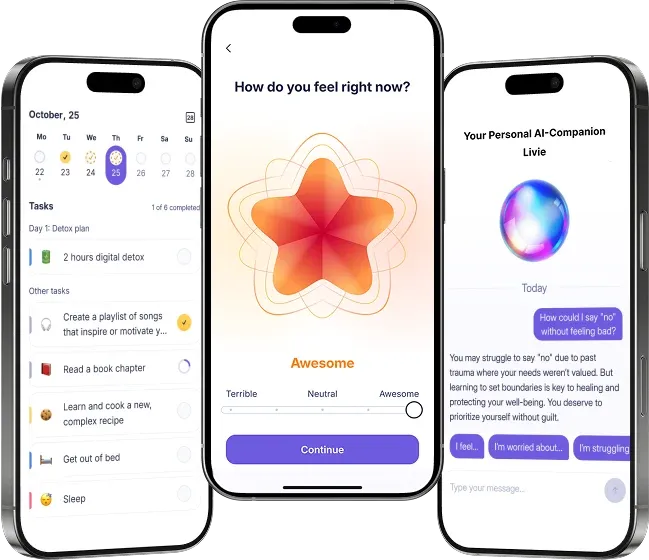
Understanding these states is one thing. Working with them is another. A good place to start is simply noticing where you are right now. You might feel calm and connected, activated and restless, or more shut down and low. That awareness alone begins to shift how you respond.
As you pay more attention to your nervous system, the reactions that once felt confusing start to make more sense.
Instead of asking what’s wrong with you, you start asking what state you’re in. That shift creates a bit more space between what you feel and how you respond. Over time, this builds a sense of stability. You’re learning to support your system in a way that feels steadier and more sustainable.
References
- Porges S. W. (2025). Polyvagal Theory: Current Status, Clinical Applications, and Future Directions. Clinical neuropsychiatry, 22(3), 169–184. https://doi.org/10.36131/cnfioritieditore20250301
- Porges, S. W. (2022). Polyvagal Theory: A Science of Safety. Frontiers in Integrative Neuroscience, 16, 871227. https://doi.org/10.3389/fnint.2022.871227
FAQ: Polyvagal Theory Explained
What is Polyvagal theory in simple terms?
What are the three states in Polyvagal theory?
Why do I react strongly even when I know I’m safe?
Can polyvagal theory help with anxiety?
What is co-regulation in Polyvagal theory?
How do I regulate my nervous system using Polyvagal theory?