How to Improve Focus and Concentration at Work




You sit down in the morning, coffee ready, brain optimistic. Today, you’ll finally stay focused.
But then, a message pops up. Someone schedules calls. You start answering emails, open 10 tabs, and suddenly an hour has passed. That’s a reality of a modern workplace. So, it’s not a surprise that you wonder how to improve focus and concentration at work.
Check out the tips below to take back control of your attention and get meaningful work done without burning out.
Key Learnings
- Focus improves when you protect your deep work time rather than multitasking.
- Short, mindful breaks restore attention better than scrolling or pushing through fatigue.
- Emotional awareness helps you understand why your focus drops.
- A sustainable routine works better than intense productivity bursts and helps prevent burnout.
The F.O.C.U.S. Method: How to Work With Your Brain, Not Against It
Most advice about focus treats it like a discipline problem. But your brain health depends on structure, rest, and emotional regulation. The F.O.C.U.S. Method brings all of that together into a system that supports sustainable productivity and well-being.
F — Fix Your Schedule Around Deep Work
It’s not about how many hours you work but how much uninterrupted thinking you get done.
1. Schedule Your Deep Work Sessions
Your brain does its best thinking in protected blocks of deep work where you give full attention to one task instead of juggling ten. Aim for 2–3 deep work sessions per day lasting about 90 minutes.
For the rest of your day, use the Pomodoro Technique to stay productive without burning out. It's simple: work in focused blocks, then rest. You can choose between 50/10 sessions (50 minutes of work, 10 minutes of rest) or 25/5 sessions (25 minutes on, 5 minutes off).
Also, remember to set a "Deep Work" status for your colleagues so they know you're unavailable.
🤔 Did you know? Nearly 6 in 10 employees report that digital tools add to their workplace stress, with video conferencing (44%), email platforms (39%), and instant messaging (36%) being the biggest culprits.
2. Focus on One Task at a Time
Regardless of what productivity gurus tell you, multitasking is only good on paper.
Research shows task switching creates mental "carryover" that drags down performance. Your brain slows down even when you just prepare to switch tasks.
So, you can prioritize the 1-3 most important tasks in the morning. Write them on a sticky note and keep them as a visible reminder of your priorities for the day.
“Sprinkle in rewards for yourself between tasks throughout your day. Rewards could include giving yourself TV or game time if you work from home, desert items and beverages, taking a walk with a cup of coffee, or some other enjoyable activity.”
O — Own Your Breaks
Scrolling between tasks doesn't count as rest because the breaks we’re talking about are short, frequent, and mindful.
Real breaks happen when you step away from the screen and let your nervous system reset.
What do mindful breaks look like in practice?
- Short meditation. Even five minutes using an app like Insight Timer or Calm is a great starting point for beginners.
- Nature walks or just stepping outside for a few minutes of fresh air.
- Somatic stretching or “desk yoga.” This is a gentle, body-focused movement that helps your muscles release physical tension.
- Breathwork. Try box breathing or 4-7-8 breathing to focus on the present moment and reset your nervous system.
- Journaling. A few minutes to offload thoughts and return to work with a clearer head.
For longer recovery, 20-minute naps or a Yoga Nidra session (a guided body-scan meditation that mimics deep sleep) can restore your energy levels more effectively than caffeine.
🤔 Did you know? Research on resilience shows it's not just about positive thinking but also emotional flexibility. People who can shift their attention away from negative emotions recover from stress faster, stay focused longer, and adapt to challenges more effectively.
C — Check In With Your Emotions
Regular emotional check-ins help you see when you need rest to prevent burnout.
Pause a few times throughout your day, notice what you're feeling, and log it.
This practice will also reveal what boosts or drains your work motivation, which, in turn, will help you gradually design your personalized dopamine management plan based on how your brain actually responds to work and rest.
U — Upgrade Your Work Environment
A cluttered desk, a noisy background, or a screen full of open tabs all compete for your attention.
- Declutter your digital workspace
- Close tabs you don't need
- Turn off all non-essential notifications
- Use an ad blocker (uBlock Origin is free and effective)
- Organize your desktop so that only active projects are visible
- Use browser extensions like OneTab or Workona to group and minimize tab overwhelm
Clean your physical workspace
Small physical adjustments, like a clear workspace, reduce mental effort before your work day even begins.
Keep Only Essentials on Your Desk
Clear your desk down to the basics: your laptop or monitor, a notebook, a pen, and your water bottle. If it's not part of today's tasks, it doesn't need to be there.
Use a Physical Planner or Sticky Notes
When your tasks (including those top 3 important ones) live on paper, your brain doesn't have to keep holding onto them. It frees up mental bandwidth for the actual work. A physical planner also keeps you off your phone, which is a win in itself.
- Choose a Quiet Workspace
- If that's possible, great. If not (say, you're working from an open office or a busy café), a good pair of noise-canceling headphones paired with a focus soundscape can recreate that same sense of separation.
Keep Water and a Light Snack Nearby
Even mild dehydration — we're talking just 1–2% below optimal — impairs attention, memory, and cognitive performance.
Plus, when you have to get up to grab water or find food, you break your flow and invite distraction.
C — Sustain Focus With a Personalized System
The goal is to create a focus system that keeps you productive and protects your well-being. A good system also acts as your personalized plan to prevent burnout. Check out what a sustainable, structured workday might look like:
| Time | Activity |
| 8:15 AM | Review your 1–3 priority tasks for the day, write them on a sticky note |
| 8:30–10:00 AM | 🔴 Deep Work Time Blocking #1 (90 min) — Deep Work status on, notifications off, one big single task |
| 10:00–10:10 AM | ☕ Mindful break — step outside, breathe, stretch |
| 10:10–12:00 PM | 2 Pomodoro sessions (50/10) + an emotional check-in during the break — secondary tasks, answering emails, etc. |
| 12:00–1:00 PM | 🌿 Lunch + emotional check-in + real rest — walk, read, nap if needed (Yoga Nidra optional) |
| 1:00–2:30 PM | 🔴 Deep Work Time Blocking #2 (90 min) — single task, full attention |
| 2:30– the end of your workday | A few Pomodoro (25/5) sessions for admin daily tasks |
| Wrap-up | Emotional check-in — log mood, journal a few sentences, close the day |
This structure gives you two deep work periods, built-in short breaks, and a clean mental close to the workday.
Final Thoughts: Look For a Calmer Way to Stay Focused
Your attention, energy levels, and ability to complete tasks respond to the environment you create, the breaks you take, and the habits you build over time.
You don't have to figure it all out at once. Start small. Pick one thing from this article and try it for a week. Then add more practices.
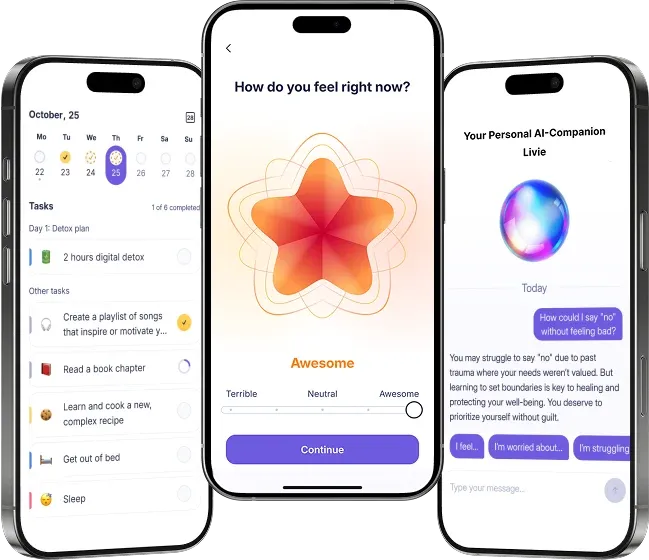
If you want to learn more about your attention, emotions, and energy, you might try the Liven app (Google Play or App Store) to build supportive routines and track your mood, get more insights on the Liven blog, or use Liven’s free wellness tests to better understand your current mental state.
References
- Farr, C. (2024). Digital workplace research exposes workplace noise crisis. Unily.
https://www.unily.com/resources/blogs/unily-research-exposes-workplace-digital-noise-crisis - Rademacher et al. (2023). Individual differences in resilience to stress are associated with affective flexibility. Psychological Research.
https://doi.org/10.1007/s00426-022-01779-4 - Sumitra et al. (2025). Hydration status and its impact on cognitive performance. International Journal of Academic Medicine and Pharmacy.
https://www.academicmed.org/Uploads/Volume7Issue2/33.%20%5B4805.%20JAMP_Mohamed%5D%20157-162.pdf - Swainson et al. (2024). Task preparation generates task-switch costs affecting performance. Journal of Experimental Psychology.
FAQ: How to Improve Focus and Concentration at Work
How much time should I spend on a single task to improve concentration?
Can these focus strategies help improve concentration in daily life, too?