What Is Neuroregulation and How to Train Your Nervous System to Find Calm




At least once in life, we've been in a situation where our heart races before a presentation, or a stomach tightens before a hard conversation. Then, some time later, we feel fine again. That return to baseline is neuroregulation in action.
Most of us never think about it until it stops working and we start wondering why we feel emotionally exhausted. It's good that neuroregulation is a skill that can be supported and strengthened.
Key Learnings
- Neuroregulation is your nervous system's dynamic ability to respond to stress - flexibly adapting and adjusting to keep you functioning, with returning to baseline as the result
- Chronic stress, poor sleep, and lack of movement may disrupt it
- Breathwork, mindfulness, and consistent daily habits can help support it
- Small, repeated practices help build long-term nervous system resilience.
What Is Neuroregulation?
Neuroregulation refers to the body's ability to modulate its own nervous system activity, particularly the autonomic nervous system (ANS). It governs involuntary functions like heart rate, breathing, digestion, and stress responses.
The ANS has two main branches: the sympathetic nervous system (SNS), which activates the fight-or-flight response, and the parasympathetic nervous system (PNS), which supports rest, digestion, and recovery.
When these two systems work in rhythm, you can face a challenge and then recover from it. When that rhythm breaks down, your nervous system can get stuck, responding to threats that no longer exist.
This stuck state is called dysregulation.
Why Neuroregulation Matters for Your Health
Thoughts and emotions don't exist in isolation. They're shaped, at least in part, by the physiological state your nervous system is in. When that system struggles to shift out of high-alert mode, autonomic dysregulation. In this mode, it can be harder to think clearly, regulate emotions, or feel at ease, even when life circumstances haven't changed.
That's one reason why someone might journal, meditate, and talk to a therapist and still feel like something isn't quite landing: supporting nervous system balance may be a missing piece of the puzzle.
The sympathetic nervous system's chronic overactivation is linked to anxiety and immune suppression. It can show up in how you sleep, how you communicate, and how you feel in your body on a given Tuesday.
Key signs your nervous system may need support include:
- Chronic tension in the jaw, shoulders, or stomach
- Trouble falling or staying asleep
- Emotional reactivity that feels out of proportion
- Feeling flat, numb, or disconnected
- Difficulty concentrating or making decisions
The Science Behind Neuroregulation
The window of tolerance
Psychiatrist Dr. Dan Siegel introduced the concept of the window of tolerance, an optimal range of arousal where we can effectively manage and process stress, emotions, and challenges. When we're within this window, we can think clearly, stay calm, and respond to what's happening around us.
When stress pushes us outside that window, either into hyperarousal (fight/flight) or hypoarousal (freeze/shutdown), regulation may become the path back. The wider this window becomes through practice, the more life can throw at you without knocking you off balance.
Neuroplasticity
One of the most important findings in neuroscience is that the brain can rewire itself, which is called neuroplasticity. Thanks to it, your brain can modify existing stress patterns - forming new pathways and gradually strengthening healthier responses over others. Practices that consistently signal safety to the nervous system can, over time, reshape how that system responds.
Science-Backed Ways to Support Neuroregulation
1. Breathwork
Controlled breathing directly influences respiratory rate, thereby producing more immediate physiological and psychological calming effects by increasing vagal tone during slow expiration.
A Stanford-affiliated randomized controlled study found that breathwork, especially exhale-focused cyclic sighing, produced greater improvements in mood and a reduction in respiratory rate than mindfulness meditation over a one-month period.
A simple place to start:
- Extend your exhale.
- Inhale for 4 counts.
- Exhale for 6 to 8.
Even 5 minutes a day is enough to begin shifting your baseline.
2. Movement
Quantitative changes in motor behavior, such as increased intensity or duration of muscular activity during exercise, alter autonomic nervous system activation and affect levels of hormones, neurotransmitters, and trophic factors that both elevate mood and help reduce stress and anxiety.
A 20-minute walk, a short strength session, or dancing in your kitchen all count.
3. Sleep
Sleep affects the functioning of every system in our body, including our nervous system. The stress-sleep cycle is a vicious one: you have trouble falling asleep because you feel stressed, and your stress can become even harder to manage because you can't sleep.
Sleep is when the brain processes emotion, recalibrates stress hormones, and restores regulatory capacity. Supporting good sleep hygiene, such as consistent bedtimes, reduced evening screens, and a cool and dark room, is one of the most foundational things you can do for your nervous system.
4. Mindfulness and Present-Moment Practices
Mindfulness works by training the brain to observe experience without automatically escalating it. Over time, this builds the pause between stimulus and reaction, and that pause is where regulation lives.
Even brief, structured mindfulness practices, e.g., 5 to 10 minutes of focused attention on breath or body sensation, can meaningfully support this over weeks of consistent practice.
5. Social Connection
As we experience positive social connections, our vagal tone heightens, contributing to better emotional resilience and physical health. The nervous system is wired for co-regulation. We genuinely help each other find balance through safe, present connection. This is why a real conversation with someone you trust can reset a hard day in a way that scrolling never will.
Building a Neuroregulation Practice
Neuroregulation is built through small, repeated signals such as a consistent morning breath practice, a daily walk, and a wind-down routine before bed. Each time you successfully shift your nervous system back into your window of tolerance, you're helping to reinforce your body's ability to self-regulate.
Small daily practices are what actually change your nervous system over time - not the one-hour sessions you heroically commit to once and then forget about.
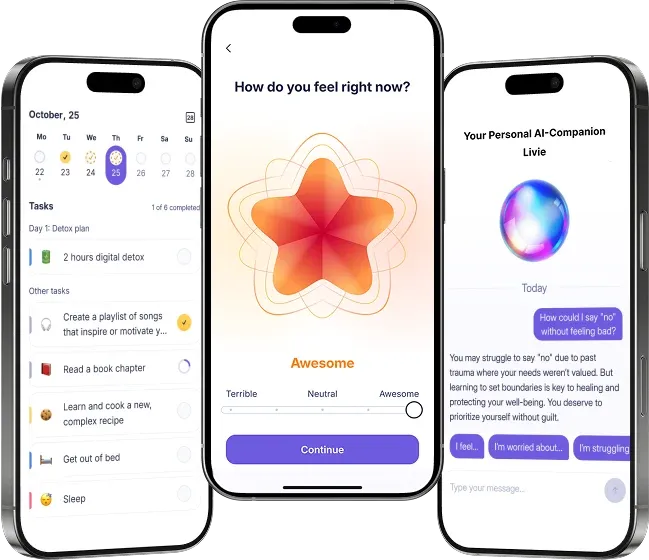
That's the idea behind Liven: breathwork, mindfulness, and emotional check-ins woven into your day in a way that actually sticks. If you are not sure where to start, your personalized plan is already waiting for you.
References
- Balban, M. Y., Neri, E., Kogon, M. M., Weed, L., Nouriani, B., Jo, B., Holl, G., Zeitzer, J. M., Spiegel, D., & Huberman, A. D. (2023). Brief structured respiration practices enhance mood and reduce physiological arousal. Cell Reports Medicine, 4(1). https://doi.org/10.1016/j.xcrm.2022.100895
- Shafir, T. (2016). Using movement to regulate emotion: Neurophysiological findings and their application in psychotherapy. Frontiers in Psychology, 7, 1451. https://doi.org/10.3389/fpsyg.2016.01451
- Silvers, J. A., Insel, C., Powers, A., Franz, P., Helion, C., Martin, R. E., & Ochsner, K. N. (2017). The neuroscience of emotion regulation development: Implications for education. PMC. https://pmc.ncbi.nlm.nih.gov/articles/PMC5096655/
- Neural Regulation - an overview | ScienceDirect Topics. (n.d.). www.sciencedirect.com. https://www.sciencedirect.com/topics/medicine-and-dentistry/neural-regulation
- Porges, S. W. (2022). Polyvagal Theory: a Science of Safety. Frontiers in Integrative Neuroscience, 16(871227). https://doi.org/10.3389/fnint.2022.871227
- Gazerani, P. (2025). The neuroplastic brain: current breakthroughs and emerging frontiers. Brain Research, 1858, 149643. https://doi.org/10.1016/j.brainres.2025.149643
Alotiby, A. (2024). Immunology of Stress: A Review Article. Journal of Clinical Medicine, 13(21), 6394–6394. https://doi.org/10.3390/jcm13216394
FAQ: Neuroregulation
What causes poor neuroregulation?
What does nervous system dysregulation feel like?
What is the connection between neuroregulation and mental health?
Is neuroregulation the same as emotional regulation?