


The vagus nerve runs from your brainstem to several major organs, including the heart, lungs, and digestive tract. It carries signals between the brain and body, which is part of why it's often linked with states of calm and recovery. Nervous system regulation runs across multiple interacting systems, and the vagus nerve is one important player rather than the whole story.
Certain practices like slow breathing, gentle movement, and social connection can support autonomic regulation and may influence vagal activity along the way. That's where vagus nerve exercises come in.
Key Learnings
- Around 70 to 80% of your vagus nerve fibers carry signals from the body to the brain, which is part of why a slow breath or a hand on your chest can shift how you feel before your mind catches up.
- When your parasympathetic system runs low, stress lands harder, and daily practices like slow breathing or humming help your nervous system find a steadier baseline over time.
- The physiological sigh (a double inhale through the nose, followed by a long exhale through the mouth) can take the edge off in under a minute, though how much it helps varies from person to person.
Why Your Vagal Tone Matters
The vagus nerve runs in both directions between your brain and body, with most of its fibers (around 70 to 80%) sending signals upward from the body. That's part of why what's happening in your breath or heart rate can shape how you feel emotionally, working through several brain-body systems together rather than just the vagus nerve.
Vagal tone is the term for how well your parasympathetic system regulates itself, often estimated through heart rate variability (HRV), the small variations in time between your heartbeats.
Higher HRV tends to mean your body adjusts more easily and bounces back from stress faster. Lower HRV has been linked with stress-related patterns like anxiety, depression, and inflammation, though many factors shape those connections.
Best Exercises to Stimulate the Vagus Nerve at Home
These are exercises to stimulate the vagus nerve that require nothing more than your body, a few minutes, and some consistency:
1. Slow Diaphragmatic Breathing
Slow breathing is one of the most accessible ways to support vagal activity. Breathing at around 6 breaths per minute creates a resonance frequency that's been linked with higher HRV and stronger parasympathetic engagement.
How to do it:
- Sit comfortably.
- Inhale through your nose for 5 counts, expanding your belly first.
- Exhale slowly for 5 counts.
2. Humming and Bhramari Pranayama
Bhramari Pranayama, sometimes called bee breath, is a yogic practice where you hum during a slow exhale.
The vagus nerve runs near the muscles of the throat and vocal cords. And when you hum or chant, the slow breathing pattern and gentle vocal vibration involved have been linked with higher HRV and relaxation. The exact mechanism is more nuanced than direct mechanical stimulation.
How to do it:
- Take a full breath in through your nose.
- On the exhale, close your lips, keep your teeth slightly apart, and hum steadily. Feel the vibration in your chest, not just your throat.
- Do 5-10 slow rounds.
You can also try vigorous water gargling for 30-60 seconds, which activates the same muscles.
3. Cold Water on Your Face
Mammals have a hardwired response to cold water on the face called the diving reflex: heart rate slows, blood redistributes, and the parasympathetic system activates almost instantly. This happens as the body prepares to conserve oxygen.
Research confirms that applying cold water to the face for as little as 5-35 seconds after a stressor accelerates the return to physiological calm.
A simple way to use this: Run cold water and splash your face 4-5 times, or press a cold, damp cloth against your forehead and cheeks for 20-30 seconds.
4. The Physiological Sigh
This is possibly the fastest-acting tool on this list. Researchers at Stanford identified a specific breath pattern the body uses to spontaneously reduce stress: a double inhale through the nose followed by a long, slow exhale through the mouth.
How to do it:
- Inhale fully.
- At the top, sniff in a second time to fully inflate the lungs.
- Then exhale slowly and completely.
5. 4-7-8 Breathing
If 5:5 breathing feels too mechanical, the 4-7-8 breathing method is a paced rhythm with a noticeably longer exhale than inhale. Like other slow-breathing techniques, it can influence autonomic nervous system activity, and the longer exhale is linked with stronger parasympathetic engagement and a steadier heart rate. This is sometimes called the vagal brake: the vagus nerve's role in slowing the heart when your body senses safety.
The seven-second hold adds a deliberate pause to the rhythm, and the structured counting gives your mind something specific to follow when it's racing.
How to do it:
- Inhale through your nose for 4 counts.
- Hold at the top for 7 counts.
- Exhale slowly and fully through your mouth for 8 counts.
- Repeat 3-4 times. The exhale is the most important part; don't rush it. Stop if you feel dizzy.
6. Orienting to Safety
Orienting to safety means moving your attention away from internal threat scanning and toward what your senses are picking up right now: the colors, sounds, and textures of the room you're in. The practice can interrupt anxiety spirals and help your system find its way back to a calmer baseline.
This kind of attention shift is a common grounding technique in trauma-informed work, used to ease hyperarousal. The cues around you (and the people in them) can also gently shift autonomic regulation, though the effects are indirect and vary from person to person.
How to do it:
- Slowly look around the room.
- Let your eyes settle on things that feel neutral or comforting: a book, a mug, a plant, light through a window.
- Notice textures, temperatures, and sounds.
- Take 60 seconds to simply be in the space you're in. This works mid-meeting, mid-argument, mid-3 AM spiral. Nobody needs to know you're doing it.
7. Side-Eye Movement
Slowly shifting your gaze from one side to the other can pull your attention out of internal loops and back into the room you're in. In structured therapies like EMDR, eye movements are used as part of a guided process to support emotional processing. The exercise can help some people feel more grounded, though it isn't a direct nervous system reset, and its effects vary from person to person.
How to do it:
- Hold your gaze as far to the right as is comfortable for 5 seconds.
- Then slowly to the left for 5 seconds. Don’t turn your head, just your eyes.
- Repeat 2-3 times.
8. Ear Massage
A small sensory branch of the vagus nerve runs near the surface of the skin in the cymba concha, a hollow at the top of your ear. Gently massaging this spot stimulates that peripheral branch and has been linked with calming effects, though the technique works through that branch rather than the main vagus nerve trunk.
How to do it:
- Use your fingertip to find the small hollow in the upper part of your ear, just above the ear canal.
- Apply gentle, circular pressure for about 60 seconds.
- You can do one ear or both.
9. Eye Contact and Safe Social Engagement
The vagus nerve is deeply tied to what researcher Stephen Porges calls the social engagement system.
Genuine eye contact, warm facial expressions, and the particular frequencies in the human voice all signal safety to the nervous system. That's part of why spending time with someone you feel safe with supports regulation. The effect is sometimes called co-regulation, the way two calmer bodies tend to settle each other.
A Note Before You Start
Your nervous system regulates more easily when you already feel relatively safe and settled. Practices like humming or slow breathing tend to be easier to lean on when you're already calm, and the consistency over time is what teaches your body the path back to a steadier state.
Many people don't feel an immediate shift the first few times they try these techniques and start wondering if they're doing them wrong. The skill builds gradually through repetition and noticing, rather than in one big moment.
A useful starting point is picking one practice and using it regularly, both in calm moments and during mild stress, so your nervous system learns the way back to balance.
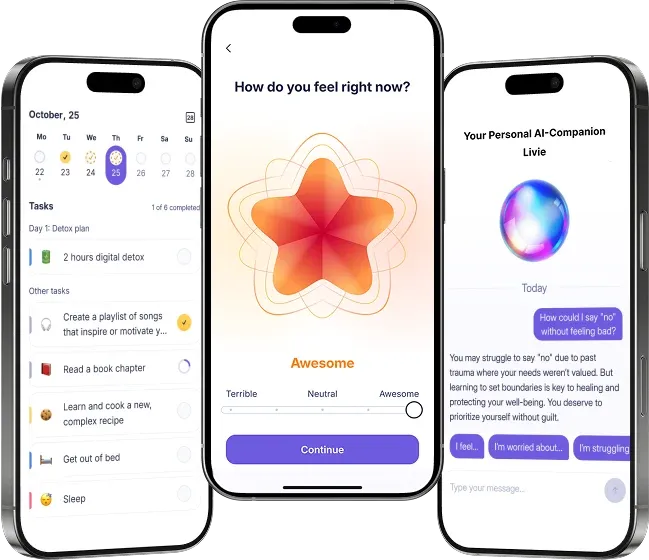
If you want to identify your anxiety triggers and explore calming techniques, take a short quiz to get your personalized plan for a calmer mind.
References
- Austelle, C. W., et al. (2024). Vagus nerve stimulation (VNS): Recent advances and future directions. Clinical Autonomic Research, 34(6), 529–547. https://doi.org/10.1007/s10286-024-01065-w
- Laborde, S., Hosang, T., Mosley, E., & Dosseville, F. (2022). Effects of voluntary slow breathing on heart rate and heart rate variability: A systematic review and a meta-analysis. Neuroscience & Biobehavioral Reviews, 138, 104711. https://doi.org/10.1016/j.neubiorev.2022.104711
- Gitler, A., Yosef, Y. B., Kotzer, U., & Levine, A. (2025). Harnessing non‑invasive vagal neuromodulation: HRV biofeedback and SSP for cardiovascular and autonomic regulation (Review). Medicine International, 5(4), 1–13. https://doi.org/10.3892/mi.2025.236
- Woo, M., & Kim, T. (2025). Effects of slow-paced breathing and humming breathing on heart rate variability and affect: A pilot investigation. Physiology & Behavior. https://doi.org/10.1016/j.physbeh.2025.114972
- Richer, R., Zenkner, J., Küderle, A., Rohleder, N., & Eskofier, B. M. (2022). Vagus activation by Cold Face Test reduces acute psychosocial stress responses. Scientific Reports, 12(1), 19270. https://doi.org/10.1038/s41598-022-23222-9
- Balban, M. Y., Neri, E., Kogon, M. M., Weed, L., Nouriani, B., Jo, B., Holl, G., Zeitzer, J. M., Spiegel, D., & Huberman, A. D. (2023). Brief structured respiration practices enhance mood and reduce physiological arousal. Cell Reports Medicine, 4(1), 100895. https://doi.org/10.1016/j.xcrm.2022.100895
- Meier, M., Unternaehrer, E., Dimitroff, S. J., Benz, A. B. E., Bentele, U. U., Schorpp, S. M., Wenzel, M., & Pruessner, J. C. (2020). Standardized massage interventions as protocols for the induction of psychophysiological relaxation in the laboratory: a block randomized, controlled trial. Scientific Reports, 10(1), 14774. https://doi.org/10.1038/s41598-020-71173-w
- Porges, S. W. (2025). Polyvagal Theory: current status, clinical applications, and future directions. pmc.ncbi.nlm.nih.gov. https://doi.org/10.36131/cnfioritieditore20250301
FAQ: Vagus Nerve Exercises
Can I stimulate my vagus nerve at home without any devices?
How do I know if my vagal tone is low?
Are vagus nerve exercises safe for everyone?
What's the difference between vagus nerve exercises and clinical Vagus Nerve Stimulation (VNS)?
Does the vagus nerve affect digestion?
Is there a best time of day to do vagus nerve exercises?