Stress and Perimenopause Connection Explained




Stress during perimenopause is one of the most commonly reported and least understood experiences of midlife. Perimenopause not only changes reproductive hormones but also alters how the body regulates cortisol, the primary stress hormone.
Understanding that connection helps make sense of the symptoms and points more clearly toward what actually helps.
Key Learnings
- Declining estrogen during perimenopause impairs the brain's ability to regulate cortisol, leading to larger, longer-lasting, and slower-to-recover stress responses.
- Stress and perimenopause symptoms create a reinforcing feedback loop, each making the other worse.
- You can't will your way through it, but targeted daily habits move the needle.
- Hormone therapy is a valid first-line option worth discussing with your doctor.
What Perimenopause Does to Your Stress Response
Most conversations about perimenopause focus on estrogen and progesterone. But there's a third hormone running quietly in the background that changes everything during this transition: cortisol, your body's primary stress hormone.
For most of your reproductive years, estrogen has been acting as a buffer for your stress response. It modulates the hypothalamic-pituitary-adrenal (HPA) axis, the brain's central stress response system. When a stressor hits, cortisol rises, does its job, and then the brain signals it to stand down. Estrogen helps keep that feedback loop efficient and tight.
When estrogen begins its erratic decline during perimenopause, that buffer weakens. Research indicates that the HPA axis becomes less regulated, which means cortisol responses can become larger, take longer to resolve, and recover more slowly after a stressor. In a biological sense, your nervous system recalibrates to a higher alert level.
This explains why things that used to roll off you, such as a difficult email, a long commute, or a change in plans, can now feel genuinely destabilizing.
Changes Nobody Warns You About
What makes stress during perimenopause particularly tricky is that it actively amplifies them, and they amplify it right back.
Here's how the loop works in practice. Fluctuating hormone levels trigger symptoms like hot flashes, disrupted sleep, and brain fog. Those symptoms trigger stress. Elevated cortisol, in turn, lowers estrogen sensitivity and further disrupts hormonal balance, making your symptoms worse. Think of it like a browser with too many tabs open, and every time you try to close one, three more load.
Excess cortisol during perimenopause is also linked to more intense hot flashes, worsened mood swings, disrupted sleep architecture, and increased central fat accumulation. Understanding that these aren't separate, unrelated problems is the first step to addressing them more effectively.
Perimenopause Stress vs. Life Stress
One of the most disorienting parts of perimenopause is that its symptoms overlap significantly with those of ordinary stress, such as Irregular periods, disrupted sleep, mood changes, fatigue, and difficulty concentrating.
The clearest indicator of perimenopause specifically is a persistent, long-lasting change in your menstrual cycle. If your cycles have shifted by seven or more days consistently, or you've gone 60 days or more between periods, perimenopause is likely playing a role. Life stress alone rarely causes cycle changes that dramatic or that sustained.
That said, the two often co-exist. Women entering perimenopause are frequently in a life stage packed with external pressure, e.g., peak career demands, aging parents, adolescent children, or significant relationship changes. This convergence of biological and situational stressors hits at the same time, making it genuinely hard to separate cause from effect.
You don't necessarily need to. What matters is recognizing that your body's stress-handling capacity has changed, and adjusting your expectations and habits.
Why Progesterone Matters
While estrogen gets most of the attention, progesterone plays its own critical role in stress resilience. Often described as the body's natural anti-anxiety hormone, progesterone has a calming effect on the brain via its interaction with GABA receptors, the same receptors that anti-anxiety medications target.
As progesterone declines during perimenopause, many people report feeling more anxious, more reactive, and less able to bounce back after a hard day. Research from a PMC review of psychological complaints across menopausal stages found that stress, anxiety, and depression are most pronounced in early perimenopause before most people even realize what's happening to their hormones.
There's also a biochemical dynamic worth knowing about: when the body is under chronic stress, it may prioritize cortisol production over progesterone. This means high stress can directly reduce the very hormone that helps you feel calm.
A Tiered Approach
There's no single fix for stress during perimenopause. But the evidence clearly points to specific strategies that work, and to some popular advice that's less useful than it sounds.
Tier 1: Foundational Daily Habits
These have the most consistent support across research and are worth building before anything else.
Sleep is not optional.
Declining estrogen disrupts sleep through effects on thermoregulation and neurotransmitter systems. Poor sleep then elevates cortisol the next day, setting up a worsening spiral. The American College of Obstetricians and Gynecologists recommends maintaining a consistent sleep and wake schedule, avoiding screens for an hour before bed, and keeping your room cool and dark. Even partial improvements in sleep quality have meaningful downstream effects on cortisol regulation.
Stable blood sugar matters more than stress foods.
Your body uses cortisol to pull blood sugar back up after a spike, which means high-sugar diets directly spike your stress hormones. You don't need a special anti-stress diet. You need meals that keep blood sugar steady: protein, fiber, and healthy fats at each meal; caffeine and alcohol kept in check; and a front-loading approach, where bigger meals come earlier in the day.
Movement rather than intensity.
Vigorous, high-intensity exercise can actually raise cortisol levels further in perimenopausal women with an already dysregulated stress response. Regular moderate exercise, e.g., walking, swimming, cycling, and strength training at a manageable pace, is more effective at burning off stress hormones and supporting HPA axis recovery. Yoga, in particular, has a solid evidence base for reducing anxiety specifically in this population.
Tier 2: Mind-Body and Nervous System Tools
- Diaphragmatic breathing (slow, belly-deep breaths) is one of the fastest and most evidence-supported ways to activate the parasympathetic nervous system and lower cortisol acutely. Even 2 to 3 minutes of conscious, slow breathing after a stressor shifts the body out of fight-or-flight mode.
Cognitive Behavioral Therapy (CBT) is worth naming directly, because many people don't realize it has a strong evidence base specifically for perimenopausal mood symptoms. Studies have found CBT to be one of the most effective non-hormonal interventions for reducing negative mood in menopausal women, outperforming relaxation techniques alone. It helps by targeting the thought patterns that amplify stress responses, which is especially useful when symptoms trigger anxious rumination.
- Social connection over isolation. When perimenopause feels overwhelming, pulling away from people is a common instinct. The science goes the other way: bonding with others releases oxytocin, which directly counteracts cortisol. Even brief, warm social interactions count.
Tier 3: Medical Options Worth Knowing
- Hormone Replacement Therapy (HRT) is the first-line medical treatment for perimenopausal symptoms. By stabilizing the hormonal environment that regulates the HPA axis, HRT can address stress at its biological root rather than just managing its downstream effects. HRT is not one-size-fits-all. The right type, delivery method, and dosage vary significantly between individuals. If you've been hesitant to explore it, that conversation with a qualified clinician is worth having.
- Non-hormonal options, including SSRIs, SNRIs, and fezolinetant, have been shown to reduce hot flashes significantly, which in turn breaks the symptom-stress feedback loop.
When to Talk to a Doctor?
Stress and mood changes during perimenopause are common, but common doesn't mean you have to white-knuckle through them. It's worth speaking with a healthcare provider, ideally a gynecologist or a menopause specialist, if:
- Your stress or anxiety is interfering with work, relationships, or daily functioning
- Sleep problems are persistent and aren't improving with lifestyle changes
- You're experiencing symptoms, you're not sure whether to attribute them to stress, hormones, or something else
- You're curious about whether HRT might be right for you
You don't need to be at your worst to ask for help. Early conversations tend to lead to better outcomes.
Building Small Habits with Liven
Here's something worth sitting with: you probably don't need to do more. You need to do the right things consistently in a way your nervous system can actually absorb.
Perimenopause is a phase that demands a recalibration. The women who navigate it best are the ones who build a steady rhythm their body can rely on. A five-minute breathing practice done daily does more than a 45-minute yoga class done once. A consistent sleep schedule beats an occasional digital detox weekend. A stabilizing breakfast every morning is worth more than a two-week clean eating challenge. Small habits, compounded over time, are how you lower the baseline.
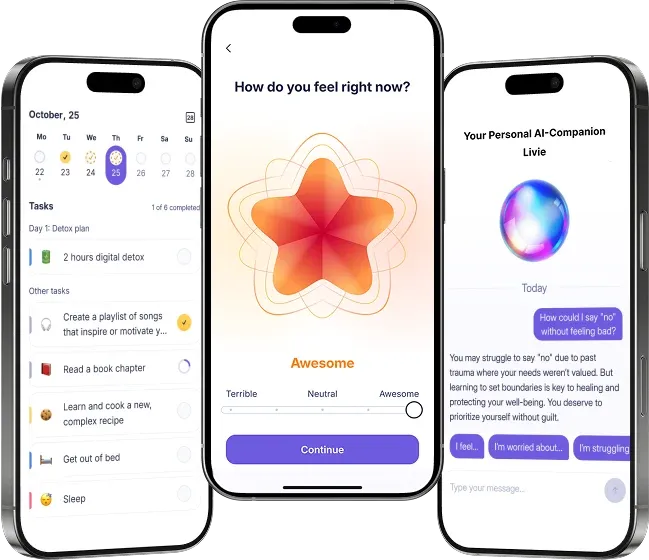
That's exactly what Liven is built for. Whether you're figuring out where to start or looking to deepen what's already working, get your personalized plan for a calmer mind and let the small things do the heavy lifting.
References
- Bromberger, J. T., & Kravitz, H. M. (2011). Mood and menopause: Findings from the Study of Women's Health Across the Nation (SWAN) over 10 years. Obstetrics and Gynecology Clinics of North America, 38(3), 609–625. https://doi.org/10.1016/j.ogc.2011.05.011
- Woods, N. F., Carr, M. C., Tao, E. Y., & Taylor, H. J. (2006). Perceived stress during the menopausal transition. Menopause, 13(4), 602–611. https://doi.org/10.1097/01.gme.0000227332.61357.9a
- Kravitz, H. M., & Joffe, H. (2011). Sleep during the perimenopause: A SWAN story. Obstetrics and Gynecology Clinics of North America, 38(3), 567–586. https://doi.org/10.1016/j.ogc.2011.05.002
- Johns Hopkins Medicine. (2025). Perimenopause and Anxiety. https://www.hopkinsmedicine.org/health/wellness-and-prevention/perimenopause-and-anxiety
- Otte, C., et al. (2009). Cortisol levels during the menopausal transition and early postmenopause: Observations from the Seattle Midlife Women's Health Study. Journal of Clinical Endocrinology & Metabolism, 94(3), 802–808. https://pmc.ncbi.nlm.nih.gov/articles/PMC2749064/
- Liisa Hantsoo, Jagodnik, K. M., Novick, A. M., Baweja, R., Lanza, T., Ayşegül Özerdem, McGlade, E., Simeonova, D. I., Dekel, S., Kornfield, S. L., Nazareth, M., & Weiss, S. J. (2023). The role of the hypothalamic-pituitary-adrenal axis in depression across the female reproductive lifecycle: current knowledge and future directions. Frontiers in Endocrinology, 14. https://doi.org/10.3389/fendo.2023.1295261
- Rukure, H., & Husted, M. (2025). Cognitive behavioural therapy for menopausal symptoms: a systematic review of efficacy in improving quality of life. BMC Women’s Health. https://doi.org/10.1186/s12905-025-04142-y
Azizi, M., Khani, S., Kamali, M., & Elyasi, F. (2022). The Efficacy and Safety of Selective Serotonin Reuptake Inhibitors and Serotonin-Norepinephrine Reuptake Inhibitors in the Treatment of Menopausal Hot Flashes: A Systematic Review of Clinical Trials. Iranian Journal of Medical Sciences, 47(3), 173–193. https://doi.org/10.30476/ijms.2020.87687.1817
Based on publicly available research as of April 2026. This article is for informational purposes only and does not constitute medical advice. Always consult a qualified healthcare provider about your individual symptoms and treatment options.
FAQ: Stress and Perimenopause
Does stress cause perimenopause to start earlier?
Can perimenopause make existing anxiety worse?
Is it possible to have normal blood tests and still be in perimenopause?
How long does perimenopausal stress typically last?
Is HRT safe for people with a history of anxiety or depression?