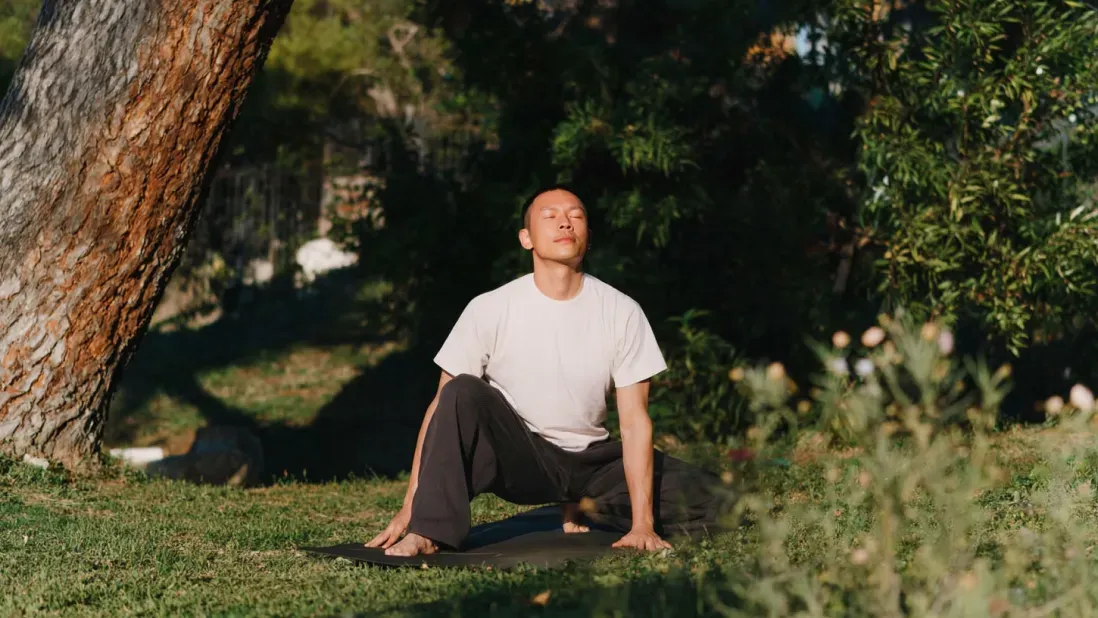



You know that feeling of carrying invisible weight? Like your body is holding onto something your mind has already moved past? Stress, old habits, traumas — they all live in the body. That’s why you might experience tension without even understanding its source.
Somatic stretching exercises are one of the most accessible ways to reconnect with yourself through mindful movement. Check out how somatic stretching differs from other mindfulness practices and the exercises you can start with today.
Key Learnings
- Somatic stretching exercises use slow, mindful movement to retrain how the brain and body communicate.
- Somatic movement works by gently releasing tension stored in the muscles.
- Regular practice can support mental health, improve body awareness, and, over time, reduce chronic stress patterns.
Somatic Stretching vs. Yoga vs. Traditional Stretching
Somatic stretching uses mindful movements to help your brain notice and release habitual muscle tension. Over time, this retrains your nervous system and improves muscle control.
Somatic exercises invite you to pay attention to what’s happening inside your body: the tight shoulder, the clenched jaw, the shallow breath. As you move slowly and notice these sensations, your brain starts to recognize and release tension that used to run on autopilot.
| Aspect | Somatic Stretching | Yoga | Traditional Stretching |
| Best For | Stress recovery, chronic pain, burnout | Flexibility, mindfulness, strength | Warm-ups, athletic preparation |
| Core Principle | Awareness-based somatic movement re-educates the nervous system | Coordinated poses combining breath, strength, and mobility | Mechanical stretching of muscles |
| Speed of Movement | Very slow movement | Slow to moderate | Moderate to fast |
| Examples of Practices | Pandiculation, Feldenkrais-inspired movements | Vinyasa, Hatha, Yin yoga | Hamstring or quad stretches |
🤔 Did you know? University students who practiced somatic therapy for 8 weeks reported feeling less depressed and better able to handle stress. Simple activities like mindful movement, breathing, and body awareness helped them understand their emotions more clearly.
7 Easy Somatic Exercises to Try
Below are 7 somatic exercises that help restore the mind-body connection and retrain your nervous system's response to stress through slow movement.
1. Pandiculation Reset, or Full-Body Wake-Up
Pandiculation mimics the instinctive stretch animals do after waking. You lightly contract muscles and then slowly release them, teaching the brain to relax tension and reconnect with the body.
The pandiculation reset helps with morning stiffness, muscle tension, and resetting after sleep or long sitting.
- Lie on your back with your arms alongside your body.
- In a slow movement, intentionally tense your whole body, hold for 3–5 seconds, then slowly, consciously release.
- Keep the release controlled.
2. Pelvic Tilts
Pelvic tilts help with lower back pain and hip tension:
- Lie on your back with knees bent and feet flat on the floor, hip-width apart.
- Slowly tilt your pelvis upward so your lower back presses into the floor.
- Then slowly lower it back down, letting your back arch slightly, and exhale.
- Repeat 6–8 times.
3. Somatic Neck Release
This exercise helps with desk tension, headaches, and shoulder tightness.
- Sit upright and slowly tilt your head, letting your left ear move toward your left shoulder.
- Don’t use your hand to push the stretch further.
- Hold for a few breaths, then slowly bring your head back to center. Repeat on the opposite side.
”Our emotions got pushed down into the body because we were never taught how to feel. Our nervous system had to hold all that unprocessed charge. That is where so much illness, fatigue, anxiety, and “mystery symptoms” begin: unfinished stress responses and trapped emotional energy living in the tissues.” — Allie Prosalova, Holistic Health Practitioner
4. Spinal Twist
Spinal Twist helps with built-up tension in the mid-back and lower back, as well as digestive sluggishness.
- Lie on your back, knees bent.
- Let both knees slowly drop to the left side while your gaze drifts to the right.
- Your right arm can extend out to the side.
- Hold for 5–8 breaths, then switch to the left side.
5. Somatic Bend
Helps with spinal mobility and helps release stored side-body tension.
- Stand with feet hip-width apart.
- Slowly raise your right arm overhead and gently bend toward the opposite side.
- Keep knees soft and avoid forcing the stretch.
- Return to the center and repeat in the opposite direction.
6. Somatic Cat-Cow
This exercise helps with spinal mobility, stress relief, and grounding. Here's how to do it:
- Come into tabletop position.
- Hands under shoulders, knees bent at hip width.
- On an inhale, let your belly drop and your chest upward, lifting your head gently.
- On an exhale, round your spine, tucking your chin and pelvis.
- Move at half the speed you think you should.
7. Somatic Hip Sway
Helps with lower-back stiffness, tight hips, and built-up muscle tension from long sitting.
- Stand with feet flat and slightly wider than hip width.
- Begin swaying your hips slowly side to side.
- Let your arms hang loose.
- Continue for 1–2 minutes.
🤔 Did you know? The Feldenkrais Method, a somatic (body-based) learning method created by physicist and engineer Moshe Feldenkrais, uses slow, gentle movements and attention to body sensations to improve awareness. An eight-day program found participants felt more self-accepting and relaxed, though larger movement studies are needed to confirm long-term benefits.
15-Minute Daily Somatic Exercise Routine
You don’t need long somatic workouts to feel the benefits of somatic movement. A consistent 15-minute practice will suffice for a beginner. Once you get comfortable with somatic movement, you can add more exercises and lengthen the sessions.
☀️ Morning Reset (5 minutes)
Start lying in bed.
- Begin with Pandiculation — one full-body tense-and-release.
- Move into Pelvic Tilts for 6 slow reps.
- Finish with Cat-Cow for 8 breath cycles.
🌿 Midday Stress Release (5 minutes)
- Somatic Neck Release on both sides.
- Side Bend left and right.
- Shoulder Roll x5.
These somatic movement techniques target where desk tension pools most. Finish with five slow, deep breaths.
🌙 Evening Unwind (5 minutes)
- Shoulder Rolls or Neck Release.
- Somatic Hip Sway for 90 seconds.
- Floor-based Spinal Twist on both sides.
- Then, the Grounding Body Scan (this step is optional; it makes the somatic stretching evening routine longer but helps you relax even better).
Somatic Exercises as Nervous System Care
Somatic practices help you rebuild trust with your body in a quiet, practical way. Rather than pushing through tension, you learn to notice it, understand it, and gradually let it soften. Over time, this creates a steadier sense of calm that carries beyond the exercise itself.
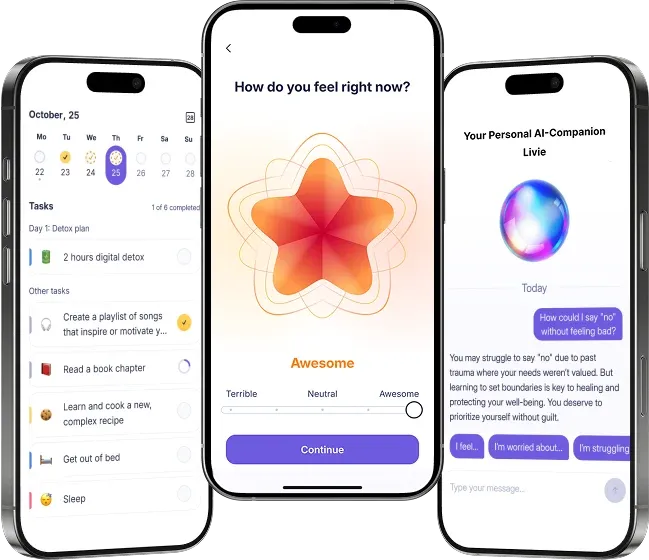
Curiosity tends to work better than pressure. If you want guidance along the way, you might explore the Liven app (Google Play or App Store), browse practical resources on the Liven blog, or take one of Liven’s free wellness tests to better understand where you are right now.
References
- Agnese et al. (2025). Effects of a Feldenkrais method-based protocol on body fluid balance and stress-related measures in healthy adult women. Journal of Bodywork and Movement Therapies, 45, 812–818. https://doi.org/10.1016/j.jbmt.2025.10.012
- Emotional transformation through the effects of somatic therapy techniques in reducing depression.(2025,). International Journal of Humanities Technology and Civilization. https://doi.org/10.15282/ijhtc.v10i1.12228
- Wildwood Mindfulness. (2024). 15 minute body scan meditation for grounding. [Video]. YouTube. https://www.youtube.com/watch?v=Nw3Kn_VvTpY
FAQ: Somatic Stretching Exercises
What are somatic exercises, and how do they differ from regular stretching?
Who can benefit from somatic exercises?
Can somatic exercises help reduce stress and anxiety?