Tired of Overthinking? Try These Gentle Self-Reflection Prompts



Reviewed by
Tara Passaretti, M.S., LMHC


You're staring at the ceiling at 2 AM, replaying one awkward comment from yesterday's meeting. Your mind feels like a browser with 50 tabs open, each one playing a different video. The spin cycle of overthinking is exhausting, and it's also one of the patterns that responds well to a quiet, low-stakes practice.
Self-reflection is that practice. Most self-reflection prompts you find online sound like job interview questions for yourself. Where do you see yourself in five years. What are your biggest strengths. They get you thinking, but not in a way that changes much.
The questions below go a layer deeper. They're built to help you notice what you've been avoiding, name what you've been feeling, and find the thread your week has been pulling at.
Key Takeaways
- Good self-reflection prompts surface what you already half-know but haven't put into words.
- Writing the answer beats thinking it. The hand slows the mind down enough to catch something.
- A few minutes most days outperforms a long session once a month.
- The point isn't insight for its own sake. It's small choices that follow from seeing things clearly.
What Self-Reflection Prompts Are For
A prompt is a small question that loosens something. Without one, your reflection circles the same three thoughts. With one, it goes sideways into territory you'd skip on your own. The best prompts feel mildly uncomfortable, which is usually the sign you've hit something worth sitting with.
Writing about feelings has steady research behind it. Expressive writing has a small but meaningful effect on depressive symptoms and psychological well-being. The act of putting feelings into words is part of the mechanism.
Daily Self-Reflection Prompts (5 Minutes)
For mornings, lunch breaks, or before bed. Pick one. Don't try to answer all of them.
- What's the one thing I'd want to be different about today?
- Where in my body am I holding tension right now, and what does it want me to notice?
- What am I avoiding that would take less than ten minutes to handle?
- Who came to mind today that I haven't reached out to in a while?
- What did I do today that felt like me?
- What did I do today that I didn't do yesterday but hoped to?
- If I had to name today's mood in one word, what would it be?
- What's something small that went better than I expected?
- What would I tell a friend who had the day I had?
- What's one thing I'm carrying that doesn't have to be mine?
Weekly Self-Reflection Prompts (15 to 20 Minutes)
For Sunday evenings or whenever your week feels worth a longer look.
- What did I learn about myself this week?
- Where did I spend energy that didn't pay me back?
- What conversation am I still replaying, and what was the theme that's coming up for me?
- What did I say yes to that I wish I'd said no to?
- What did I say no to that I'm proud of?
- Where did I show up the way I want to, and where did I not?
- What's been pulling at the edge of my attention all week?
- What would the version of me from a year ago be surprised by?
- What's one assumption I made this week that turned out wrong?
- What do I want next week to feel like?
Self-Reflection Prompts for Emotional Awareness
For when feelings are loud but unclear.
- If this feeling could speak, what would it say?
- When did I first feel this today, and what was happening?
- Is this feeling familiar? When have I felt it before?
- What's underneath the surface feeling? (Anger often covers fear or sadness. Numbness often covers overwhelm.)
- What would help right now, in this exact moment?
- Who could I tell about this, even just one sentence of it?
- What story am I telling myself about this situation?
- Is the story true, partly true, or a guess I've gotten attached to?
- What would I need to believe for this feeling to be a reasonable response?
- If this feeling stays for the next hour, can I still take care of myself?
Self-Reflection Prompts for Relationships
For working out the dynamics you're in. If the same pattern keeps showing up across different people, the prompts below are a good place to start.
- Who in my life makes me feel most like myself?
- Who do I leave conversations with feeling smaller or not heard?
- What pattern keeps showing up in my closest relationships?
- What do I need from people that I've been hesitant to ask for?
- Where am I giving more than I'm getting, and is it sustainable?
- Where am I getting more than I'm giving, and am I aware of it?
- What conversation have I been putting off, and why?
- What do I do when someone disappoints me?
- What do I do when I've disappointed someone?
- What's one thing I want to say to someone but haven't?
Self-Reflection Prompts for Work and Purpose
For the questions about how you spend your hours.
- What part of my work makes me lose track of time?
- What part of my work do I dread on Sunday night?
- If money weren't a factor, what would I keep doing? What would I drop?
- Whose career do I quietly compare myself to, and what does that tell me?
- What would I do if I weren't afraid of looking foolish?
- What's a skill I keep meaning to build but haven't started?
- Where am I waiting for permission I could give myself?
- What's one thing I'd want to be true about my work in a year?
- What's the smallest step I could take toward that this week?
- What would I regret not doing?
Self-Reflection Prompts for Self-Compassion
For the days the inner critic is loud.
- What would I say to a friend going through what I'm going through?
- Where am I holding myself to a standard I wouldn't apply to anyone else?
- What would it mean to give myself a break here?
- What's one kind thing I could say to myself that I'd believe?
- What part of me is asking for attention that I've been ignoring?
- If my inner child was asking and feeling this, what would I need?
- Where am I treating a mistake like a character flaw?
- What would self-trust look like in this situation?
- What did I do well today that I haven't given myself credit for?
- What's something I'm proud of that no one else knows about?
How to Make Self-Reflection Prompts Stick
Pick a time and a place. Most people who keep a reflection practice do it at the same time daily, in the same spot. The cue does the work.
Keep the window short. Five minutes of writing most days outperforms a long session once a month. Habits form through repeated pairing of a cue and a behavior, with control gradually shifting from conscious decision-making to automatic patterns in the basal ganglia.
Write longhand if you can. Typing is faster, which means your mind can stay ahead of your hand. Slower writing catches more.
Don't reread for a few weeks. Going back too soon makes the practice feel like a performance. Let entries cool before you look at them.
When Self-Reflection Becomes Rumination
Reflection clarifies. Rumination grinds. Reflection ends with a thought you didn't have 10 minutes ago. Rumination ends with the same thought you started with, only tighter.
If you've been writing about the same thing for weeks without movement, change the prompt. Try writing what you'd tell a friend in your situation. Try writing the kindest possible interpretation. Try ending the entry with one small action you could take in the next 24 hours.
Sometimes the mind won't loosen until the body does - a few minutes of a nervous system reset before you pick up the pen makes the prompt land differently.
For depression that doesn't shift with self-help tools, an evidence-based therapy works better than more journaling.
For some people, mindfulness practice can do what medication does. It works as well as escitalopram for anxiety and can help prevent depression relapse.
Cognitive behavioral therapy and acceptance and commitment therapy also have strong support.
A Self-Reflection Routine That Works
Three to five minutes most mornings. One prompt. One paragraph. No editing.
Sunday evenings, fifteen minutes. One prompt from the weekly list. Read what you wrote the previous Sunday if you want.
Once a month, take a longer look. Pick any three entries from the month. What was the question you were sitting with?
Pair the practice with one small daily thing you're already doing. Coffee. The drive home. Brushing your teeth. The pairing is what builds the habit.
The Long Game
The version of you that reads back these entries in six months will notice something the version writing them today can't. That's how this works. You write to leave a trail for your future self. Some of the entries will be embarrassing. Some will surprise you with how clear-eyed they were. All of them count.
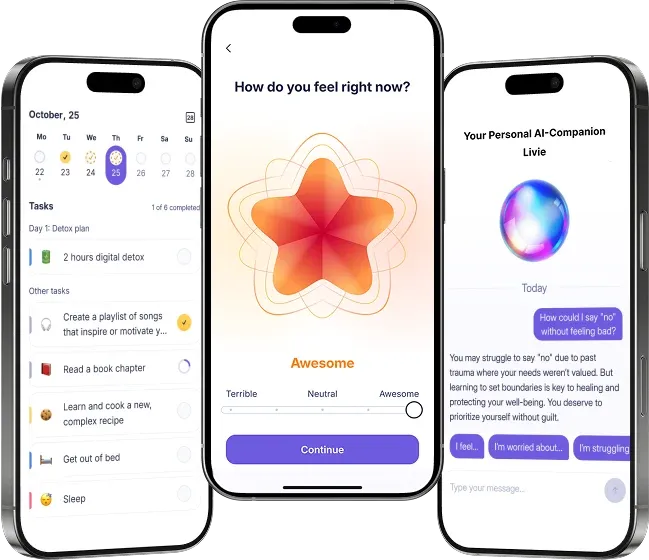
If you'd like a practice built around where you are now, Liven's short quiz puts together your personalized plan for a calmer mind with daily prompts and check-ins to make the work easier to come back to.
The questions don't change your life. Coming back to them might.
Sources
- Choi, I., Cha, Y., McCullough, M. E., Coles, N. A., & Oishi, S. (2025). A meta-analysis of gratitude interventions on mental health outcomes. Proceedings of the National Academy of Sciences, 122. https://doi.org/10.1073/pnas.2425193122
- Guo, L. (2023). The delayed, durable effect of expressive writing on depression, anxiety and stress: A meta-analytic review of studies with long-term follow-ups. British Journal of Clinical Psychology, 62(1), 272 to 297. https://doi.org/10.1111/bjc.12408
- Hoge, E. A., Bui, E., Mete, M., Dutton, M. A., Baker, A. W., & Simon, N. M. (2022). Mindfulness-based stress reduction vs escitalopram for the treatment of adults with anxiety disorders: A randomized clinical trial. JAMA Psychiatry, 80(1), 13 to 21. https://doi.org/10.1001/jamapsychiatry.2022.3679
- Kuyken, W., Hayes, R., Barrett, B., Byng, R., Dalgleish, T., Kessler, D., Lewis, G., Watkins, E., Brejcha, C., Cardy, J., Causley, A., Cowderoy, S., Evans, A., Gradinger, F., Kaur, S., Lanham, P., Morant, N., Richards, J., Shah, P., ... Byford, S. (2015). Effectiveness and cost-effectiveness of mindfulness-based cognitive therapy compared with maintenance antidepressant treatment in the prevention of depressive relapse or recurrence (PREVENT): A randomised controlled trial. The Lancet, 386(9988), 63 to 73. https://doi.org/10.1016/S0140-6736(14)62222-4
- Lally, P., van Jaarsveld, C. H. M., Potts, H. W. W., & Wardle, J. (2010). How are habits formed: Modelling habit formation in the real world. European Journal of Social Psychology, 40(6), 998 to 1009. https://doi.org/10.1002/ejsp.674
- Singh, B., Murphy, A., Maher, C., & Smith, A. E. (2024). Time to form a habit: A systematic review and meta-analysis of health behaviour habit formation and its determinants. Healthcare, 12(23), 2488. https://doi.org/10.3390/healthcare12232488
FAQ: Self-Reflection Prompts
What is the point of self-reflection?
How do I start a self-reflection practice?
What are the 3 main questions for self-reflection?
Is self-reflection the same as overthinking?
Can self-reflection reduce anxiety?
How often should I use self-reflection prompts?
Do I have to write them down?
What if I don't know how to answer a prompt?