Emotions Tracker App: Finding the Right Tool for Your Mental Health



Your calendar looks fine, your to-do list is reasonable, and yet your mood feels heavier than it should. You check in with yourself and maybe journal a sentence or two, but still can’t explain why you feel off.
If you’ve ever wished you could zoom out on your emotional life, an emotions tracker app might help you do that.
A handful of those solutions stand out for how they help people notice patterns and make sense of their feelings. Let’s see how these apps compare.
Key Learnings
- The main types of emotion tracker apps include self-discovery, CBT-based, mental health, and mindfulness tools.
- Regular mood tracking helps you spot patterns in your emotions and daily routines.
- These apps help you learn better stress-management techniques and emotional-regulation strategies.
⚠️ Disclaimer: App features and prices are subject to change. For the latest details, always check the app’s official website or app store page.
1. Self-Discovery Mood Tracking Apps
These apps can prompt reflection on values and the "why" behind your behaviors.
Liven
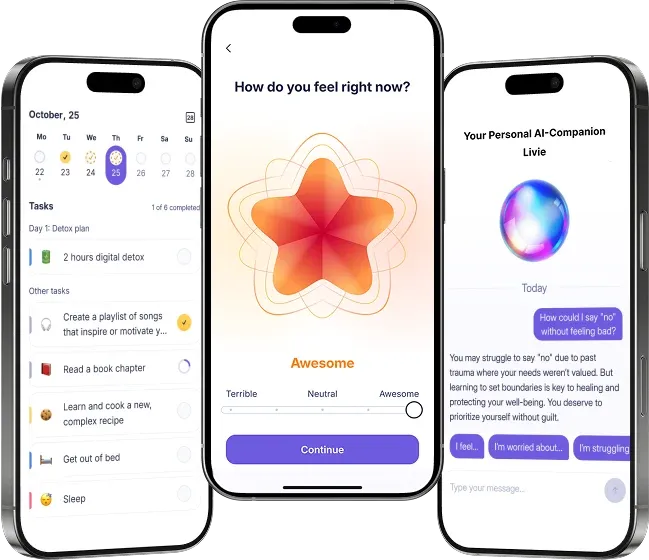
Liven is your holistic self-discovery app that acts as a lifestyle companion. It combines tools for mood tracking, habit-building, and reflection to help you spot patterns in your thoughts, mood, and behavior for better self-awareness.
Top Features
- Mood tracker with low-pressure daily check-ins
- Journaling with structured prompts
- Livie, a smart companion that helps you process emotions in real time
- Routine builder for self-care, tough days, and morning/evening routines
- Personalized content recommendations based on your current mood
You can also get your personalized dopamine management plan if you’re struggling with motivation.
Possible Drawbacks
- No meditation content.
Pricing & Plans
- The Liven app offers a weekly subscription priced at $7.99.
Reflectly
With the help of AI, Reflectly reads your diary entries and prompts deeper introspection with follow-up questions.
Top Features
- Morning motivation features to set intention and focus
- Mood maps showcasing mood patterns
- Intelligent prompts that adapt to your writing style
Possible Drawbacks
- Some users feel the content gets too repetitive and generic long-term
Pricing & Plans
- Reflectly provides a free basic plan and a Premium subscription ranging from $19.99 to $59.99 per year, depending on the platform.
Finch
As a Finch user, you take care of a virtual bird. The app encourages you to complete small, real-world self-care actions to help your bird explore and thrive.
Top Features
- Gamified self-care with a growing virtual pet
- Extremely low-bar tasks (helpful during periods of low energy or for people living with depression)
- Reflective journeys focused on confidence, grief, or resilience
Things to Consider
- Daily check-ins take more time than ones in a traditional mood tracker.
Pricing & Plans
- Finch offers a free plan with access to core features, while Finch Plus costs $9.99 per month or $69.99 per year.
2. CBT-Based Mood Tracking Tools
Decades of research show Cognitive Behavioral Therapy (CBT) helps people address negative thought patterns, and build practical coping strategies.
MindShift CBT
MindShift CBT was developed by Anxiety Canada to help users challenge negative thinking in a CBT-informed, self-guided format.
Top Features
- Belief experiments that help one test their fears in real life
- Fear ladders that break overwhelming goals into manageable steps
- Coping cards for acute stress moments
Things to Consider
- Some users report consistent lagging
Pricing & Plans:
- It's free.
Moodnotes
Moodnotes combines CBT and positive psychology to help users catch distorted thinking and reframe it in healthier ways.
Top Features
- Helps identify thinking traps like catastrophizing
- Apple Watch integration for fast mood logging
- Educational articles that explain negative thought patterns
Things to Consider
- Heavily iOS-focused.
Pricing & Plans
- Moodnotes offers a free plan that includes basic logging features, while the Premium subscription costs $9.99 per month or $39.99 per year.
Moodfit
Moodfit positions itself as “fitness for your mental health.”
The app offers smart daily goal setting and habit-based emotional support.
Top Features
- Habit checklists for gratitude, breathing, and reflection
- Custom variables (sleep, caffeine, social media)
- Medication tracking support
Things to Consider
- Some users describe Moodfit’s interface as “overwhelming.”
Pricing & Plans
Moodfit offers a free plan with access to standard tools, while the Premium subscription costs approximately $36–$40 per year.
3. Mood Trackers for Mental Health Conditions
These mental health apps help users track symptoms of mood disorders like bipolar disorder, posttraumatic stress disorder, anxiety, and depression.
PTSD Coach
PTSD Coach is a free app created by the U.S. Department of Veterans Affairs.
Top Features
- Symptom screening
- Crisis support resources
- Grounding and emotional regulation exercises
Things to Consider
- No cloud backup
- Static design
Pricing & Plans
- It's free.
Bearable
The Bearable app is a good fit for those who have to manage chronic conditions and consistently monitor their physical & mental symptoms.
Top Features
- Correlative insights (sleep, food, meds, pain, fatigue, etc.)
- Medication and habit reminders
- Professional PDF exports
- Detailed mood data analysis with charts, graphs, and weekly reports
Possible Drawbacks
- Higher-than-standard logging effort.
Pricing & Plans
- Bearable offers a free plan with unlimited logging, while the Premium subscription costs $6.99 per month or $34.99 per year.
MyTherapy App
MyTherapy focuses on medication & refill reminders and symptom tracking.
It also helps you track health metrics like blood pressure, blood sugar, and weight.
Top Features
- Smart medication reminders
- Simple health journal entries
- Monthly health reports for doctor visits
Things to Consider
- Limited emotional insight
- Not a therapy tool despite the name
Pricing & Plans
- A free app.
4. Mindfulness Mood Tracking Apps
With these apps, users can find strategies for emotional regulation that help them manage stress better.
Calm
Calm is one of the most popular mental health apps for stress management and sleep improvement.
Top Features
- A vast library of sleep stories
- Daily 10-minute guided meditations with rotating themes like gratitude or focus
- Masterclasses on mindfulness strategies
- Visually appealing interface with calming color themes and dark mode
Things to Consider
- Limited ability to analyze mood patterns or habits
Pricing & Plans
- Calm offers a free plan with very limited sessions, while Premium features are available for $14.99 per month or $69.99 per year.
Headspace
Headspace is like a mindfulness classroom on your phone with short guided sessions and multi-day courses.
Top Features
- Structured courses, which are 10–30-day programs
- “The Wake Up” — short daily videos for mindful morning routines
- Focus music to improve concentration and calm
Things to Consider
- Lacks lifestyle or habit tracking compared to apps like Liven
Pricing & Plans
Headspace offers a free trial, while the Premium subscription costs $12.99 per month or $69.99 per year.
Aura
Aura is like a Spotify for mindfulness, offering thousands of guided sessions from different coaches and tailored AI recommendations.
Top Features
- Asks your current mood and recommends a 3-minute session specific to that state
- Diverse coaches and content
- Mood logging and optional daily check-ins
Things to Consider
- Quality varies due to multiple content creators
- Limited free sessions
Pricing & Plans
- Aura offers a free plan with a 3-minute session every 2 hours, while the Premium subscription costs $11.99 per month or $59.99 per year.
Top Emotions Tracker Apps, Compared
| App | Core Approach | Key App Features |
| Liven | AI-guided self-discovery and lifestyle support | Mood tracker with daily check-ins, structured journaling, Livie AI companion, and routine builder |
| Reflectly | AI-powered reflective journaling | Intelligent prompts, mood maps |
| Finch | Gamified self-care | Virtual pet growth, low-bar self-care tasks |
| MindShift CBT | CBT-based anxiety management | Fear ladders, belief experiments, coping cards |
| Moodnotes | CBT + positive psychology journaling | Thinking trap identification, educational insights |
| Moodfit | Habit-based mental fitness | Mental health checklists, custom variables, and medication tracking |
| PTSD Coach | Evidence-based trauma support | Symptom screening, grounding exercises, crisis resources |
| Bearable | Long-term symptom and mood analysis | Smart mood data analysis |
| MyTherapy | Medication adherence and symptom tracking | Smart reminders, health journal entries, reports |
| Calm | Mindfulness and relaxation | Sleep stories, guided meditations |
| Headspace | Structured mindfulness education | Guided courses, daily videos |
| Aura | AI-personalized mindfulness sessions | Mood-based recommendations, short sessions |
Methodology
We analyzed popular mobile apps on the Apple App Store and the Android Play Store, their features, user reviews, pricing, and how each supports mood tracking and mental well-being.
Choosing the Right Emotions Tracker App
Some people benefit from structured CBT tools, others from mindfulness strategies, and many from self-discovery apps that connect mood tracking with daily routines and habits.
The key is to choose an app that fits your life and your needs.
If you’re ready to continue your self-discovery journey, you can try the Liven app (Google Play or App Store), explore deeper insights on the Liven blog.
References
- Fabillar et al. (2024). MindShift CBT app and anxiety in adults. Int. J. Multidisciplinary Research & Growth Evaluation.
- Gavrilova & Zawadzki(2023). Headspace and mindfulness mechanisms. https://doi.org/10.1007/s12671-023-02214-4
- Xia et al. (2024). CBT effects on anxiety and depression. General Hospital Psychiatry. https://doi.org/10.1016/j.genhosppsych.2024.01.006
FAQ: Emotions Tracker Apps
What is a mood tracker app, and how does it support emotional well-being?
How do the best mood tracker apps differ from other apps?