Aura vs. Calm vs. Headspace: Which One Is Right for You?



Aura vs. Calm vs. Headspace… They all look and sound great! Yet somehow, you don’t want to invest your time and money only to discover that the app isn’t a good fit for you halfway through. That’s why we've tested these apps ourselves and put together an honest, detailed comparison.
Key Learnings
- All three apps focus on mindfulness, meditation, and stress relief.
- Aura stands out for personalized, real-time emotional check-ins.
- Calm excels in sleep stories, ambient soundscapes, and relaxation tools.
- Headspace is the most scientifically studied app, offering structured courses, meditation, and therapy.
Aura: Key Features and Strengths
Aura has been on the market since 2017 and is mainly known for its highly personalized, mood-based guided meditations and mindfulness tools. Aura can be described as minimalist, warm, and customizable.
Your journey with Aura begins with a 5-minute quiz when you sign up for the app, ensuring that the recommendations you receive are highly personalized. Further, you can customize your own tabs and filters to tailor the app’s user-friendly interface to your needs.
It further collects your mood data and generates interactive graphs and charts to illustrate your mood evolution over time.
Aura offers access to various instructors and even one-on-one coaching sessions with real professionals.
Features that Define Aura
Aura focuses on mood-based personalization, stress relief, and promoting restful sleep.
- Emotional check-ins. Every time you open the Aura app, you get a question like “How are you feeling right now?” or something similar. It further tailors personalized recommendations for your current emotional state and needs.
- Coping tools for stress & anxiety. The Aura app offers short, 3 to 5-minute micro-meditation sessions, calming breathing techniques, and grounding exercises. For instance, it might suggest a grounding session if you log “Overwhelmed”.
- Similar to mental health apps like Liven, the app has CBT-informed courses on anxiety.
- Sleep support. Aura includes sleep meditations, calming music, and white noise options.
Limitations of Aura
- The app is currently available only in English.
- Most practices range from 3 to 20 minutes, which may not be the best option for users seeking long, immersive meditation experiences.
Pricing & Plans
❗️ For the latest and most accurate pricing details, always verify information on the official website.
| Plan | Price | Includes |
| Free | $0 | Limited meditations + basic access |
| Monthly | ~$11.99 | Full library: meditations, sleep, mood tracking, short courses |
| Annual | ~$59.99–$69.99 | Same as monthly at a discounted yearly rate |
| Lifetime | ~$399–$499 | One-time payment for full, forever access |
Privacy & Data
Aura tracks mood and habit data from emotional check-ins and reflections to personalize your experience. It can also collect Apple Health data, but only with your explicit permission. The app minimizes the use of third-party analytics and emphasizes the use of anonymized data.
What Studies Say about Aura
Aura currently has no published clinical outcome studies. But it does appear in broader analyses where experts evaluated the most respected meditation apps. In those reviews, Aura was mentioned alongside Headspace and Calm as an example of what high-quality guided meditation can sound like.
Aura was also one of the users' favorite mental health apps during the COVID-19 pandemic, with a 28% increase in downloads, suggesting that users turn to it in times of stress, even though formal research has not yet tested its effectiveness.
Calm: Key Features & Strengths
Calm is one of the most established wellness apps, best known for its sleep content and soothing soundscapes. Calm was built to soothe immediately with cinematic nature scenes, soft colors, and smooth animations.
The Calm app supports your wellness journey with a vast library of Sleep Stories, music, and masterclasses. It also personalizes your goals (sleep, stress, focus, etc.)
Calm is solo mainly. It doesn’t offer coaching, group meditations, or therapy.
Features that Define Calm
Calm’s core features revolve around relaxation, sleep support, and gentle daily mindfulness.
- Emotional check-ins. Calm offers mood check-ins before or after sessions and, similar to Aura, personalizes recommendations (however, less reactive compared to Aura).
- Coping tools for stress & anxiety. The app offers guided breathing exercises and body scan meditations combined with nature sounds, ambient music, and soundscapes (though some ambient environments like coffee shops or family dinners may definitely be unpleasant or triggering for certain people).
- The app also offers the Daily Calm feature — a 10-minute meditation (new one each day) centered on topics such as patience, awareness, and others.
- Sleep support. Calm definitely wins the sleep-aid competition with its vast sleep story archive, which even includes celebrity narrators, nature soundscapes, and slow-paced body scans, all designed to soothe insomnia and nighttime anxiety.
Limitations of Calm
- Limited free content.
- One can’t add friends or share progress as Calm offers a solo journey.
Pricing & Plans
❗️ For the latest and most accurate pricing details, always verify information on the official website.
| Plan | Price | Includes |
| 7-Day Free Trial | Free | Full Calm Premium access during trial |
| Annual Premium | ~$69.99/year | Meditations, Daily Calm, Sleep Stories, music, Calm Body, Masterclasses |
| Lifetime (“Calm for Life”) | ~$499 one-time | Permanent access to all Calm content |
Privacy & Data
Calm collects mood and habit information to tailor recommendations and uses a small amount of ad-tech in the background. It works with ad partners and cookies as part of its analytics approach.
While Calm allows users to delete their accounts, it retains some information for operational reasons.
What Studies Say about Calm
Calm has millions of users, but there is very little published research. In fact, only one randomized controlled study (with 83 adults aged 40–65) tested Calm directly. People in the Calm group used the app consistently (about 103 minutes a week). Seventy-one % decided to continue using it after the study ended, and almost everyone reported being satisfied (96% liked it).
Another broader study shows that both Calm and Headspace can help people regulate emotions and feel more grounded, mainly when used consistently.
Headspace: Key Features & Strengths
Headspace emphasizes structure, clarity, and routine. Headspace features a cheerful aesthetic designed to motivate and comfort, characterized by bright, friendly, playful elements with soft lines.
The app’s adaptability is course-based. Users progress through beginner → intermediate → advanced tracks, plus themed meditations like Mindful Money, Mindful Eating, etc.
Headspace includes group meditation sessions, an AI chatbot called Ebb, which, similar to Liven’s self-discovery companion Livie, supports you in managing stress and staying mindful.
On top of that, Headspace, similar to Talkspace vs. Betterhelp platforms, offers professional online therapy (since June 2025).
Features that Define Headspace
Headspace combines guided courses, focus sessions, and tools to help build routines.
- Emotional check-ins. Sessions often begin with “What do you need today?” and don’t focus on emotional logging that much.
- Coping tools for stress & anxiety. Headspace offers micro-practices as a "quick fix"; however, it generally follows a more “train your brain over time” philosophy with mindfulness-based stress reduction (MBSR) courses. It has recently introduced online therapy services (launched June 2025).
- Other than that, Headspace uniquely incorporates movement (guided runs, yoga, mindful dance breaks) as a stress-relief tool, which you can all easily make a part of your personalized dopamine management plan.
- Sleep support. Headspace is not as expansive as Calm but still offers a thoughtful nighttime library with sleepcasts, sleep stories, and relaxing music (including the bedtime content for kids).
Limitations of Headspace
- No free in-app content.
- No Headspace meditation exceeds 30 minutes — users who prefer longer-format sessions might find it limiting.
- The app does not track sleep, exercise, or other wellness metrics beyond meditation activity.
Pricing & Plans
❗️ For the latest and most accurate pricing details, always verify information on the official website.
| Plan | Price | Includes |
| Monthly | $12.99 | Full meditation, sleep, mindfulness meditation library |
| Annual | $69.99 | Same as monthly, lower price per year |
| Family | $99.99/year (up to 6 people) | Full access for all members |
| Student | Discounted | Full access for eligible students |
| Coaching | $99.99/month | 1:1 text-based mental health coaching |
| Therapy | ~$149/session | Licensed therapist sessions |
Privacy & Data
Headspace focuses strongly on behavior patterns, such as how often you use the app and which tools you engage with, to improve its personalized recommendations. Its analytics rely on standard third-party tools, similar to those used by most large wellness apps.
What Studies Say about Headspace
Headspace is the only app backed by multiple high-quality studies. A daily survey of 57 college students found that after two weeks of using Headspace (approximately 86 minutes a day), their stress and anxiety levels decreased.
Larger reviews back this up. One analysis of 15 randomized controlled trials found that 14 of them studied Headspace. In those studies, Headspace showed improvement in depression in 75% of the trials. Results for stress (23% drop), anxiety, and well-being were mixed but still promising.
Workplace studies also show fairly consistent improvements. In one study involving 132 employees, mindfulness skills, such as attention and non-reactivity, improved within the first two weeks. In another study involving 138 university employees, stress levels decreased by week 2, and coping abilities continued to improve through week 8.
Other studies have shown similar results, including reduced anxiety and stress, as well as relatively quick improvements in mindfulness skills, particularly among parents.
Calm vs. Headspace vs. Aura: Comparison Table
| Aspect | Aura | Calm | Headspace |
| Design & Usability | Minimalist, warm, customizable | Cinematic, soothing, nature-based | Bright, playful, structured |
| Best for | Personalized check-ins & Mood tracking | Sleep & Relaxation | Structured growth, movement, therapy |
| Top Features | Mood-based meditations, breathing techniques, and coaching | Daily Calm, sleep stories, body scans, soundscapes | Mindfulness courses, guided runs/yoga/dance, an AI chatbot, and therapy |
| Pricing | Free / $12 mo / $60–70 yr / $400–500 lifetime | 7-day free / $70 yr / $500 lifetime | $13 mo / $70 yr / $100 yr family / coaching $100/mo/therapy ~$150/session |
Where Liven Fits In: A Different Approach to Mental Wellness
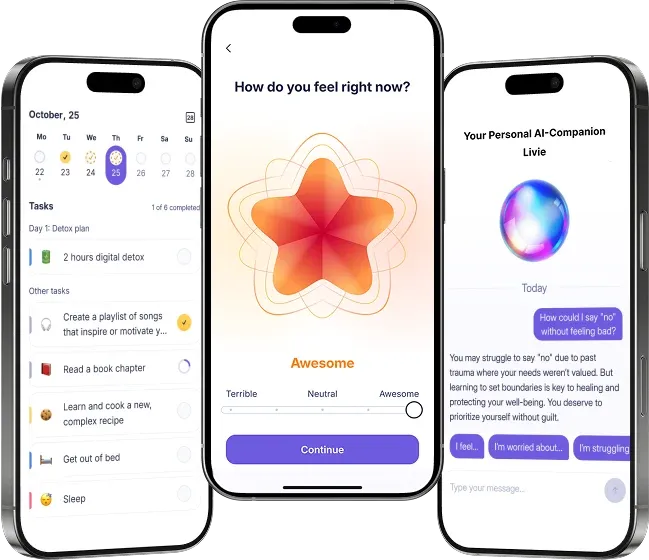
Unlike meditation-first apps, Liven focuses on self-awareness, habit change, and cognitive restructuring. Liven encourages users to act.
It offers prompts, tasks, journaling, and cognitive reframing, all of which make progress feel active and intentional. Plus, Liven’s CBT-informed courses for burnout, anxiety, procrastination, and low motivation offer practical strategies rather than passive listening experiences.
Where Calm and Aura soothe emotions in the moment, Liven helps uncover why the emotion is happening in the first place.
It focuses on:
- patterns
- triggers
- self-talk
- hidden beliefs
- loops between thoughts and behavior
Liven merges tracking, journaling, self-reflection, CBT tasks, and habit planning. This can replace:
- a separate journaling app
- a habit tracker
- a mood tracker
- a notes or therapy worksheet app
Liven can complement therapy, as it helps them capture thoughts between sessions, recognize their emotional patterns and triggers, and utilize its AI companion to process their feelings safely.
Additionally, Livie, Liven’s AI personal companion, helps users articulate emotions, recognize thinking traps, and receive structured support anytime, which is something not available in Calm, Aura, or Headspace.
Final Thoughts
Aura, Calm, and Headspace each bring something unique to the table. Aura is perfect for real-time mood tracking and personalized guidance, Calm shines with its vast sleep and relaxation content, and Headspace stands out with structured courses and therapy options.
Still, the best one for you is the one that meets you where you are.
Want to dive deeper? Keep exploring with Liven: try the Liven app (Google Play or App Store), read more on our blog, or use Liven’s free wellness tests to map your mental health journey.
Methodology
To give you an honest comparison of Aura vs. Headspace vs. Calm, we:
- Combined hands-on testing with up-to-date research.
- Used each app daily for several weeks, during which we explored meditations, sleep tools, mood tracking, and extra features.
- Reviewed scientific studies, app store data, and expert analyses.
References
- Allison, E. (2023). Using contemplative practice to sustain equitable environmental engagement. https://doi.org/10.4337/9781789905069.00021
- Burgess, A. (2023). Headspace for parents: Using a mindfulness app to manage parenting stress. http://discovery.ucl.ac.uk/id/eprint/10177993/
- Callahan et al. (2024). Real-world impact of Headspace on stress. https://mhealth.jmir.org/2024/1/e52968/
- Laird et al. (2022). Calm app feasibility RCT. https://doi.org/10.2196/30294
- O'Daffer et al. (2022). Efficacy and conflicts of interest in Headspace and Calm trials. https://doi.org/10.2196/40924
- Pierce, M. E., Mirabito, G., & Verhaeghen, P. (2024). Time on Headspace and daily mindfulness outcomes. https://doi.org/10.1080/28324765.2024.2400878
- Simpson, A. (2024). Headspace and first responder stress (Doctoral project). http://hdl.handle.net/20.500.12680/c247f197f
Wang, X., Markert, C., & Sasangohar, F. (2021). Mental health app usage during COVID-19. https://doi.org/10.1177/0018720821998110 - Wasil et al. (2022). Popular mental health apps review. https://doi.org/10.1016/j.cbpra.2021.07.001
- Zawadzki et al. (2025). Headspace RCT using ecological momentary assessment. https://doi.org/10.1093/abm/kaaf025
FAQ: Aura vs. Calm vs. Headspace
What’s the difference between Aura, Calm, and Headspace?
Are meditation apps effective for beginners?
Can I try meditation apps for free?
How do sleep stories and sleep meditations help?
What features make meditation apps worth it?
Are there costs beyond free trials in meditation apps?
How to understand if the mindfulness app is helping me?
How do I choose the proper meditation app?