Emotionally Immature Parents: Signs, Effects, and How to Heal



Reviewed by
Tara Passaretti, M.S., LMHC


You learned to read the room before you learned to read books. By 10, you could tell which tone meant the night was about to tip, which silence was safe, and which one you had to manage. That skill doesn’t disappear when you move out. It can show up later as guilt when you ask for something, dread before everyday conversations, or the habit of shrinking yourself to keep other people comfortable.
There's a name for this: emotionally immature parenting. It describes growing up with caregivers who struggled to regulate their own emotions, let alone make consistent space for yours. And it's more common than it feels. Roughly 1 in 5 children experience emotional neglect, which can shape how relationships feel later in life.
Key Takeaways
- Emotional neglect is more common than many people realize, affecting a significant number of adults worldwide.
- Emotionally immature parents often fall into a few recognizable patterns, and each one can leave a different emotional imprint.
- The effects don't always end in childhood: anxiety, chronic self-doubt, and difficulty in relationships are commonly reported well into adult life.
- Healing is possible, and it often starts by recognizing the pattern with self-compassion.
Why Emotionally Immature Parents Can Love You and Still Fail You
Emotional maturity is the ability to sit with your own discomfort without offloading it onto the people around you. For parents, that means not treating a child's bad day as a personal inconvenience or their success as a reflection of your own worth.
Emotionally immature parents struggle with exactly that. They tend to experience their children less as separate people and more as extensions of themselves - mirrors, emotional support staff, or proof of their own adequacy.
Psychologist Lindsay Gibson, author of Adult Children of Emotionally Immature Parents, describes these caregivers as adults stuck at an earlier developmental stage: reactive, self-focused, and rarely aware of it. As Gibson puts it, a parent can love a child genuinely and still be incapable of truly seeing them. Love and emotional availability are not the same thing.
When their needs and their child's clash, theirs win. Not from cruelty, but because they never learned another way. Many grew up in homes that ran the same way, so it never felt like a problem worth solving. It just felt like family.
Gibson identifies four types. Most emotionally immature parents don't fit neatly into one, but recognizing a dominant pattern helps locate which wounds go deepest:
- The Emotional Parent is reactive and unpredictable. Their feelings are always the loudest in the room. Children learn to monitor every mood shift and make themselves small to avoid triggering a storm.
- The Driven Parent loves in the language of expectation - grades, performance, image. Empathy is available only when you match their vision, so children grow up believing love is conditional on output.
- The Rejecting Parent is distant and contemptuous of vulnerability. Children learn to minimize their own feelings ("It wasn't that bad") because they figured out early that nobody wanted to hear them.
- The Passive Parent is present but checked out. They keep the peace even when the cost is protecting their child - and quietly teach them that their safety isn't worth standing up for.
What all four types share is this: the child grows up hungry for emotional connection they couldn't name and didn't know how to find elsewhere.
How to Recognize the Signs in Your Own Childhood
The signs are often clearest in hindsight:
- Your parent responded to your distress by making it about themselves ("You think you have problems?")
- Expressing emotions led to punishment, ridicule, or silence
- You felt responsible for your parent's happiness (and mood)
- Apologies were rare, and accountability even rarer ("I don't remember it that way")
- You became a confidant for adult problems you had no business carrying as a child
- Their version of love came with invisible conditions
Gibson identifies low empathy as the defining marker of emotional immaturity - not cruelty, not indifference, but a genuine inability to enter a kid's experience and stay there, especially under stress.
In practice, it sounds like this: a child is crying, and their emotionally immature parent says, "It could be so much worse," or "I'll give you something to cry about." A door closes. Repeated across thousands of small moments, it teaches the child that their feelings are a burden rather than information.
Emotionally Immature vs. Narcissistic Parents: What's the Difference?
The confusion makes sense - both can leave children feeling unseen, unheard, and quietly responsible for an adult's emotional world.
The difference comes down to scope. Emotional immaturity is a developmental gap: the parent never built the tools to regulate their own feelings or truly tune into their child's. Most of them want closeness. They just can't hold the emotional intimacy it requires.
Narcissistic personality disorder (NPD) is a clinical condition marked by pervasive patterns of grandiosity, entitlement, and a strong need for admiration, often alongside difficulties with empathy and mutual attunement.
In parenting, this can show up beyond emotional unavailability, as a tendency to relate to the child in ways that serve the parent's self-esteem needs. That might look like using the child for validation, status, or emotional regulation, and responding negatively when the child sets limits or doesn't meet those expectations.
Put simply: an emotionally immature parent may struggle with boundaries and become withdrawn, defensive, or dysregulated when challenged. A parent with pronounced narcissistic traits is more likely to respond with control, retaliation, or emotional punishment when their needs or self-image feel threatened.
This matters because the pattern you're working with shapes how you respond and how much protection you build around yourself. With an emotionally immature parent, the work tends to center on grief and adjusting expectations. With a parent who shows pronounced narcissistic patterns, it usually calls for stronger protective boundaries and trauma-focused support.
How Emotional Immaturity Shapes Your Adult Behavior
By adulthood, it stops feeling like fallout and starts feeling like personality: overapologizing, peacekeeping, overworking for scraps of acknowledgment. None of it is random.
Difficulty setting boundaries. You feel anxious or guilty when asserting your needs, because you learned early that doing so caused conflict or withdrawal.
Chronic self-doubt and perfectionism. When attunement was inconsistent early on, the inner critic learns to do the work the parent didn't, scanning for what's wrong before anyone else can catch it. Over time, that shows up as harsh inner standards, second-guessing, and trouble trusting your own read on things.
Hypervigilance in relationships. Research into childhood maltreatment shows that children raised in emotionally unpredictable homes develop a finely tuned radar for other people's moods, a survival skill that tends to follow them into every room they enter as adults. You can read the temperature of a conversation in seconds. Your own needs, meanwhile, remain harder to name.
Attracting emotionally unavailable partners. Childhood emotional neglect and abuse are linked with higher codependent traits in adulthood, partly because early disruptions in emotional attunement shape how you read closeness later. The patterns often show up as difficulty with boundaries, self-worth, and staying true to yourself inside the relationship. That's why familiar relational dynamics, especially those rooted in unpredictability or lack of attunement, can feel safe even when they aren't healthy.
Suppressing emotions to keep the peace. Conflict avoidance is a survival strategy that made sense in childhood. It becomes a liability in adult relationships that require honest communication.
If you recognize these patterns in yourself, how childhood emotional environments shape the developing brain is worth exploring.
Can Emotionally Immature Parents Change?
It's one of the most common questions adult children ask, and the honest answer is: rarely, and not on your timeline.
Change in emotionally immature parents is possible in principle. What makes it unlikely in practice is that it requires something EIPs have typically spent a lifetime avoiding: sustained self-reflection and a genuine willingness to sit with discomfort. Most don't seek it unless circumstances force them to.
Some do evolve, usually after significant loss, a health crisis, or a therapist they genuinely engage with. The change tends to be incremental and uneven, not the dramatic turnaround adult children hope for.
Healing often means relating to your parent as they are right now, while letting hope sit beside you instead of underneath you. The work is building a life that holds together, whether they change or not.
How to Heal From Emotionally Immature Parents?
Most adult children of emotionally immature parents don't arrive at a therapist's office saying "I was emotionally neglected." They arrive saying "I don't know why I can't stop people-pleasing" or "I always end up with partners who can't really show up for me."
The first useful step is simply naming what happened accurately. The child who grew up feeling unseen didn't lack worth. Their parent lacked the capacity to see them. Those are entirely different things. Confusing them is one of the most common mistakes adult children make.
Gibson observes that many adult children of EIPs spend years believing they are too sensitive, too needy, or fundamentally hard to love. Naming the dynamic doesn't excuse the parent but relocates the source of the problem.
From there, healing has no dependency on your parent changing, apologizing, or understanding what they did. Most emotionally immature parents never will. Waiting for that moment keeps you stuck in a relationship that was always on their terms.
The process starts with something less dramatic: grieving the parent you needed and didn't have. Not the parent who exists, but the one who would have asked how you were feeling and actually waited for the answer.
Gibson writes that this loss is one of the hardest to grieve precisely because it has no obvious event attached to it: no single incident or identifiable absence. There was only the slow accumulation of moments when no one was emotionally present.
That grief is real. It often goes unnamed because it doesn't look like conventional loss: there's no funeral for an emotionally absent father, no casserole brigade for the mother who couldn't apologize. But it's a genuine thing to mourn, and mourn it you can.
Four practical starting points:
- Therapy is the most evidence-backed starting point, especially attachment-informed and trauma-focused approaches that address the effects of early relational stress. Cognitive approaches can help you understand the patterns, link experiences to beliefs, and ease self-blame. Somatic and body-based work can help you notice and regulate physiological responses that were once adaptive in unsafe environments, so your system can stop bracing for impact in situations that are now safe.
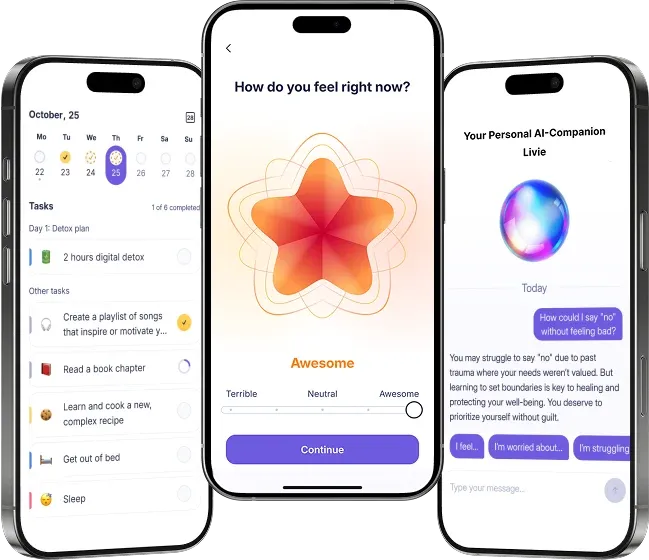
- Between sessions, thoughts don't wait for scheduled appointments. Many people find it useful to have somewhere to process them as they surface. Liven's companion Livie is designed for exactly this kind of in-between moment: a private, text or voice conversation available whenever you need to get something out of your head. Livie isn't a therapy tool or a diagnostic resource - just a private space to sort your thoughts and practice healthier patterns between sessions.
- Boundaries work best when they're specific and quiet. You don't need a confrontation or a prepared speech. "I'm going to step out if this conversation gets loud" is a boundary. So it is not answering every call, not attending every event, and not justifying every decision. The point is consistency, not volume.
- Reparenting often starts with learning to pause when you feel distress. You gently ask what you actually need in that moment, then meet that need with care. The action can be embarrassingly small: a short walk, ten minutes alone, saying no to one thing. For many people raised by emotionally immature or inconsistently attuned caregivers, the hardest part comes first: just recognizing what you need. When your emotional states weren't consistently reflected back to you in childhood, learning to read your own internal cues takes practice and patience.
- Breaking the pattern is possible even without perfect self-knowledge. Parenting in a more emotionally attuned way doesn't require perfection. It requires enough self-awareness to notice when you're about to do what was done to you, and enough pause to choose differently.
How to Know You're Making Progress
Healing from emotionally immature parenting rarely feels dramatic. There's no single moment of closure. Progress tends to show up sideways, in small behavioral shifts that are easy to miss if you don't know what to look for.
Signs you're moving forward:
- You notice the anxiety before you act on it, rather than only recognizing it afterward
- You set a limit and feel guilty about it, but hold it anyway
- You spend less mental energy anticipating your parent's reaction
- You start recognizing your own emotional state without needing a crisis to prompt the check-in
- You find yourself in a disagreement and don't immediately assume you're the problem
These are signs your nervous system is learning that safety doesn't depend on what you produce. The learning happens slowly, in fits and starts, and it's worth keeping track of along the way.
You're Not the Problem. You Never Were.
Emotional neglect in childhood is strongly associated with alexithymia in adulthood: the reduced ability to identify, understand, and describe your own emotions. In plain terms, it can feel like not quite knowing what you feel, what you want, or what you actually need. It shows up in small everyday moments: second-guessing a dinner order, struggling to name what's wrong, or saying I'm fine before you've fully checked in with yourself.
And yet. Many of those same people are also deeply attuned to everyone else. They notice when someone at the table seems uncomfortable, stay steady when things get loud, and pick up the phone at midnight when a friend is in crisis.
Over time, they became fluent in other people's emotional worlds out of necessity. That's a real skill, and a meaningful one. It just wasn't supposed to be their job at 9 years old.
Healing is often a slow, slightly unglamorous process of learning to take your own inner life as seriously as you've always taken everyone else's. With time, it can stop feeling like effort and start feeling like coming home.
Bonus Resources
Want to go deeper? These are worth your time.
- Book: Adult Children of Emotionally Immature Parents by Lindsay Gibson - the foundational text on the topic. Clear, compassionate, and unusually practical.
- Follow-up read: Gibson's Recovering from Emotionally Immature Parents shifts the focus to adult relationship strategies - ideal once you've worked through the first book.
- Podcasts:
- Being Well - "Your Parents Are Emotionally Immature. Now What?" with Dr. Lindsay Gibson.
- We Can Do Hard Things - "Healing from Emotionally Immature Parents" with Lindsay Gibson.
- Self-assessment: Not sure where you stand? Liven's Childhood Trauma Test is an ACE-based assessment that takes under ten minutes - and helps you put language to what you've been carrying.
Sources
- American Psychiatric Association. (2022). Diagnostic and statistical manual of mental disorders (5th ed., text rev.). https://doi.org/10.1176/appi.books.9780890425596
- de Heer, B. A., et al. (2024). Child maltreatment and resilience in adulthood: A systematic review and meta-analysis. Psychological Medicine. https://doi.org/10.1017/S0033291725000662
- Ditzer, J., et al. (2023). Childhood maltreatment and alexithymia: A systematic review and meta-analysis. Psychological Medicine, 53(15), 7292–7303. https://doi.org/10.1017/S0033291722003476
- Gibson, L. C. (2015). Adult children of emotionally immature parents: How to heal from distant, rejecting, or self-involved parents. New Harbinger Publications.
- Kaya, Z., Kale, K., Yağan, F., & Kaya, Ş. (2024). The mediating role of resilience in the relationship between childhood emotional abuse and emotional neglect and codependency. Children and Youth Services Review, 164, 107670. https://doi.org/10.1016/j.childyouth.2024.107670
- Kawaguchi, Y., et al. (2025). Effects of childhood maltreatment on mothers' empathy and parenting styles in intergenerational transmission. Scientific Reports, 15, Article 7787. https://doi.org/10.1038/s41598-025-92804-0
- Stoltenborgh, M., Bakermans-Kranenburg, M. J., & van IJzendoorn, M. H. (2013). The neglect of child neglect: A meta-analytic review of the prevalence of neglect. Social Psychiatry and Psychiatric Epidemiology, 48(3), 345–355. https://doi.org/10.1007/s00127-012-0549-y
FAQ: Emotionally Immature Parents
What is an emotionally immature parent?
How do I know if my parent was emotionally immature?
Can adults heal from growing up with emotionally immature parents?
What is the difference between an emotionally immature parent and a narcissistic parent?
Can emotionally immature parents change?
How long does healing take?
Is there a book on emotionally immature parents?
How do I deal with emotionally immature parents?
How do I respond to emotionally immature parents?