



It's easy to forget about our own well-being when we're running a race against all our obligations, social calls, and social media trends.
By the time we notice, our days are already packed, attention is scattered, and energy is divided into a hundred small pieces. Rebuilding your own well-being requires a steady foundation and remembering what benefits you.
This is where a structured plan can become helpful. When you approach your mental and physical health systematically, you can build your own unique, useful framework.
The action plan we offer below isn't rigid. You can move through it in any order, focus on what feels most relevant, and adjust it as your needs change.
Key Learnings
- An action plan includes self-evaluation, daily maintenance, and then physical, mental, and environmental improvements.
- Lasting improvements are only possible when you move gradually and remain honest with yourself.
- Regularly reviewing and adjusting your plan ensures it evolves with your needs and remains practical.
Your Own Well-Being Action Plan
Your action plan has five main steps; take them when you're ready and feel free to readjust them to your needs.
Check-In for Your Own Well-Being
Before making changes, it's important to assess your current baseline. Understanding where your current physical and mental health stands supports structured self-awareness.
Start by mapping key life domains and rating your current level of satisfaction or stability in each:
- Physical health
- Emotional regulation
- Workplace or academic demands
- Relationships and social connections
- Personal growth
- Rest and recovery
- Enjoyment and play
- Environment (physical and digital)
Don't overthink it; go with your gut: it is often the most accurate reflection of your internal state.
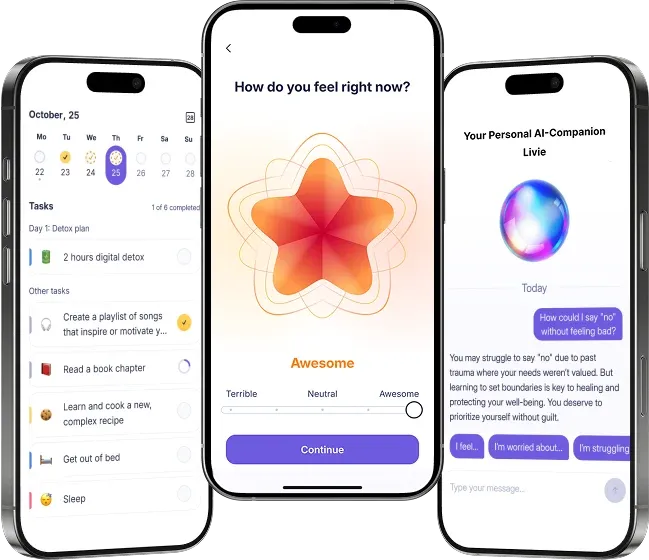
If you struggle with understanding how to evaluate these domains, you can use several of Liven's instruments for an easier solution. Liven's smart companion, Livie, can facilitate structured self-check-ins by asking adaptive questions based on your responses. This process can help bring hidden thought patterns or stress triggers into awareness.
You can also use Liven's mental well-being assessments to gain additional clarity on factors such as stress load, emotional resilience, or mood tendencies. Standardized tools provide a more objective layer of insight, which can complement your personal reflections.
Start With Daily Maintenance
Before larger changes, stabilizing your daily well-being helps you build a reliable starting point. Create your own Daily Maintenance Kit, which includes all the things that can help you daily:
- Small daily check-ins
- Short movement breaks
- A micro-meditation while listening to Liven's Soundscapes
- Connecting with someone for even a few minutes
- Mindfully tasting your fave snack or drink
- Eating at least one nutritious meal a day
- Drinking at least two cups of water a day
- Several ten-minute "doing nothing" pauses
These don't have to be significant shifts, merely gentle options to give yourself support while you prepare for bigger changes.
Physical Health Plan
Once your daily maintenance feels steady, you can begin looking at your physical health more intentionally. Begin by completing the statements below:
- My energy is lowest at: Time of the day/hour
- My sleep currently feels: Poor/Inconsistent/Fair/Restorative
- My eating pattern is: Irregular/Rushed/Balanced/Unsure
- Movement in my week looks like: None/Occasional/Structured/Overdone
- A physical symptom I’ve been ignoring is: __________
Patterns I notice: __________
After you review your answers, you can choose a focus area to build your action plan. This will help you to improve your health noticeably, but without trying to do it all at once.
□ Sleep quality
□ Nutrition rhythm
□ Movement consistency
□ Medical follow-up
□ Hydration
□ Stress-related physical tension
□ Other: __________
Once you've decided what to dedicate your time to, you can start acting on it. Let's start with a realistic and manageable goal:
- I will __________________________________________
- Frequency: _____________________________________
- Starting date: _________________________________
Sometimes, it also helps to use a daily mental health log as your well-being evolves.
Mental Health Plan
Mental health can look different for everyone. Sometimes it means sleeping well or feeling less anxious. Other times, it shows up as the ability to handle pressure, stay focused, or take initiative in areas that matter to you. In this well-being action plan, we view cognitive and emotional safety as important parts of your overall mental state.
Just as with the previous evaluation, try to answer these questions in your journal or diary:
- When I feel stressed, I tend to: avoid/overthink/isolate/overwork/seek reassurance/other: __________
- My inner dialogue is usually: critical/neutral/supportive/inconsistent
- I recover from setbacks: quickly/slowly/unpredictably
- I feel most emotionally regulated when: __________________________
- I feel most overwhelmed when: ________________________________
Patterns I notice: _____
For this part of an action plan, your social support matters too. Reflect on how your community groups or friends, family, or even colleagues help you feel connected. You can use Liven's Mood Tracker to analyze how your emotions change after interacting with others or being in different social situations. This will help you analyze your social support.
Rate each from 0-10, with 0 being no support and 10 feeling super supported:
- Emotional support from others: ___
- Sense of belonging: ___
- Time spent doing things I enjoy: ___
- Sense of meaning or purpose: ___
Once you have a better perspective of what impacts your well-being, you can decide on a specific single goal:
□ Emotional regulation skills
□ Healthier self-talk
□ Setting boundaries
□ Strengthening support system
□ Reintroducing hobbies or joy
□ Stress reduction practices
□ Therapy/coaching / guided support
□ Other: __________
When you know the direction of your focus, you can start with a small activity you intend to begin:
- I will __________________________________________
- Frequency: _____________________________________
- When I will do it: _______________________________
Environment Action Plan
Your environment strongly influences your behavior, often more than motivation alone. The spaces you move through either reduce friction or quietly increase stress. An environment audit gives you an opportunity to identify what is reinforcing your current patterns and what might be working against them.
To determine whether your space is designed for you, you can reflect on what influences your well-being daily.
- My home environment feels: calming/neutral/cluttered/overstimulating
- The space where I sleep is: restorative/distracting/inconsistent
- My workspace helps me focus: yes/sometimes/rarely
- My screen time feels: intentional/automatic/excessive
- Notifications are: manageable/constant/overwhelming
- One area in my space that creates stress is: _________________________
By reflecting on it, you can decide which environmental adjustments you can make:
□ Declutter or reorganize one small area
□ Improve sleep environment (lighting, temperature, screens)
□ Reduce notifications or screen time
□ Unfollow accounts that increase comparison
□ Set one relational boundary
□ Intentionally schedule time with a supportive person.
My chosen adjustment: __________________________________
When I will start: ______________________________________
Sometimes, we just don't know whether our actions will work out the way we expect. If you don't know what part of your life needs the most focus right now, you can take our free quiz and get your personalized dopamine management plan.
How to Use This Well-Being Action Plan
This well-being action plan isn’t meant to be completed in one sitting or followed to the letter. It's a working document, something you return to, adjust, and refine as your needs change. You might focus on one section per week, or revisit the entire plan once a month to notice shifts in energy, mood, and priorities.
Together with this action plan, Liven can be your 360-degree well-being toolkit to support you on your self-discovery journey.
Expect clarity more than instant transformation. Small, consistent adjustments often produce more stable results than dramatic changes. Some weeks will feel aligned; others may require simplification. That's normal. Use it as a guide, not a rulebook. Adapt it to your capacity. And most importantly, allow it to evolve with you.
References
- The Future of Wellness Trends Survey 2025. McKinsey & Company. (2025, May 29). https://www.mckinsey.com/industries/consumer-packaged-goods/our-insights/future-of-wellness-trends
FAQ: Well-Being Action Plan
What is a well-being action plan?
Why is it essential to focus on your own well-being?
How can I use this plan effectively without feeling overwhelmed?
Can a well-being action plan improve workplace performance?
How can this plan support conversations with a family member?
Can this approach be applied in a local community or group setting?
How often should I update my well-being action plan?