12 Self-Care Apps for When Life Feels Overwhelming



Self-care looks different for everyone. Maybe you need something in the moment when stress hits, like motivational quotes. Or maybe you want to build long-term mental resilience. Some people want tools that make them feel prepared and structured, while others vibe with a “self-care pet app” that turns wellness into a game.
But there are over 10,000 mental health and psychiatry-related apps available today. Something for everyone, but how do you find the one for you? Here are 12 self-care apps that help you take care of yourself without adding another thing to stress about.
An Overview of The Best Self-Care Apps for 2026
| App name | What you get | Best for | Platforms | Pricing |
| Liven | Therapy-backed tools for tracking moods, processing emotions, and retraining your brain. | Burnout recovery, ADHD support, and anxious overthinkers. |
| Starts at $7.99/week |
| Finch | Turns self-care into a game where completing daily wellness tasks helps your virtual pet grow and go on adventures. | Gamers, ADHD brains, and people who need fun over frameworks. |
| Starts at $9.99/month |
| Clarity | A CBT-based journaling app that guides you through structured prompts to identify negative thoughts and reframe them. | Structured thinkers who want worksheet-style CBT support. |
| $59.99 (Android); $69.99 (Apple), (Annually) |
| Fabulous | Uses behavioral science to help you build sustainable habits through the principle of "habit stacking." | Routine builders, productivity geeks, and habit stackers. |
| Starts at $19.99/month |
| Bearable | Turns daily symptom and habit tracking into correlation reports that show what's making your health better or worse. | People managing chronic conditions who need to track symptoms and patterns. |
| Starts at $34.99/month |
| Silk + Sonder | A digital self-care app offering daily affirmations, personalized journaling prompts, and access to a member community. | People who want daily motivation, guided prompts, and community connection. |
| Starts at $34.95/month |
| ToDont | Helps you focus by listing what not to do, so you remove distractions and unnecessary tasks. | Chronic over-committers and people overwhelmed by traditional to-do lists. |
| One-time purchase |
| Daylio | A bullet journal-style mood tracker where you log your mood and activities in two taps. | Anyone who wants quick mood tracking without the effort of journaling. |
| Starts at $4.99/month |
| Stoic | Combines morning planning and evening reflection with guided journaling prompts and tools like meditation and breathing exercises. | Stoic philosophy fans and people juggling productivity with mental health. |
| Starts at ~$7/month |
| Tangerine | Combines habit tracking, mood logging, and guided journaling so you know which activities make you happy or sad. | Self-care enthusiasts who want all-in-one tracking. |
| Starts at $4.99/month |
| DailyBean | A visual mood diary where you tap emoji beans and activity icons to quickly log your day. | Visual journalers and people who want cute aesthetics with quick tracking. |
| Starts at $3.99/month |
| Breeze | Use mood tracking, science-based mental health tests, and relaxation games to help you understand emotional patterns. | People managing anxiety, depression, bipolar disorder, or ADHD who want testing + mood tracking. |
| Starts at $29.99/month |
1. Liven
Best for: Burnout recovery, ADHD support, and anxious overthinkers.
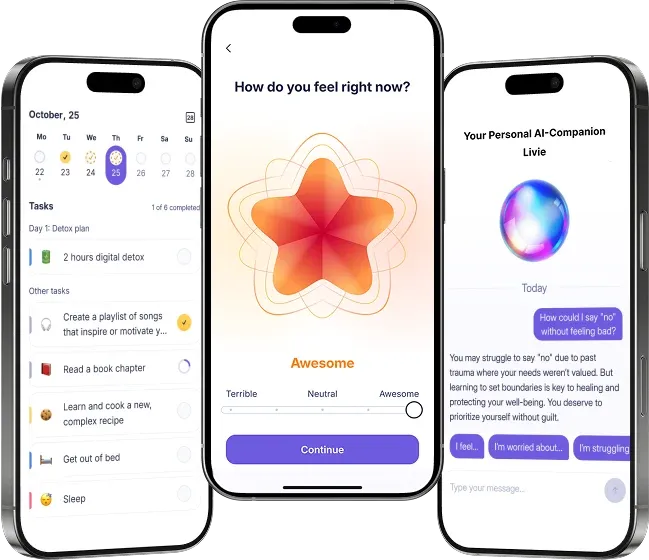
Liven takes the therapy methods clinicians use and turns them into something you can use every day. Built with licensed therapists, it's designed to help with specific stuff like managing ADHD symptoms, processing childhood trauma, regulating anxiety, and stopping self-sabotage patterns.
That includes Cognitive Behavioral Therapy (CBT), which is backed by over 2,000 studies as one of the most effective, research-supported approaches available for psychiatric disorders.
With Liven, you’re training your brain to notice patterns, sit with uncomfortable feelings instead of avoiding them, and respond intentionally instead of reacting on autopilot. Over 2.5 million people use it — some alongside therapy, others as their starting point when professional help isn't an option.
Liven Features
- Mood tracker: Log how you feel with context so you can spot what triggers you over time
- Journal: Brain-dump your thoughts to break the overthinking loop and process emotions without judgment
- Smart companion Livie: Talk or text through feelings anytime for support, validation, and a fresh perspective
- Personalized journey: Get bite-sized therapy lessons tailored to your goals, not generic wellness advice
- Mental tests: Track anxiety, stress, and emotional health with science-backed assessments that show real progress
Liven Pros
- It’s designed based on therapy frameworks therapists use in sessions
- Helps you name and understand feelings, patterns, and triggers you’ve ignored or repressed
- Includes reflective tests that encourage deeper self-exploration
- Gives you practical ways to challenge negative thoughts and reframe self-talk
Things to Consider With Liven
- Since the app follows CBT practices, people who don't find CBT a good fit for them might need to give it a try.
- Requires consistency over weeks to see results, as you’re dealing with deep behavioral patterns
Liven Pricing
- Liven Weekly: $7.99 USD
- Includes a free trial.
2. Finch
Best for: Gamers, ADHD brains, and people who need fun self-care exercises.
Finch gamifies self-care by giving you a virtual pet that grows as you complete daily wellness tasks. Instead of therapy frameworks, it uses positive reinforcement: check your mood, journal gratitude, practice breathing exercises, or set habit goals — and “Finch” (your virtual pet) goes on adventures and shares stories.
This makes it popular with ADHD users who need external motivation and people in depression recovery who benefit from gamified accountability without the weight of "doing therapy."
Finch Features
- Gamified self-care by completing daily tasks to help your Finch grow, explore, and unlock new looks and items
- Guided prompts to reflect on emotions, practice gratitude, and name what you're feeling
- Set goals and celebrate small wins to build consistency without overwhelming yourself
- Use guided breathing techniques to calm anxiety, refocus, or prep for sleep
Finch Pros
- Makes self-care feel like play, not work
- The Friends feature lets you share progress with others
- Helps you build momentum through tiny wins
Things to Consider with Finch
- It’s surface-level, so it won't help you understand why you feel stuck or process deeper emotional patterns
- Relies on novelty and gamification, so not the best option if you need more substantial therapeutic support
Finch Pricing
- Monthly subscription: $9.99 USD
- Yearly subscription: $69.99 USD
- A limited-feature free plan is available.
3. Clarity
Best for: Structured thinkers who want worksheet-style CBT support.
Clarity is a digital CBT thought record that walks you through identifying, challenging, and reframing negative thought patterns. Instead of free-form journaling, you complete structured prompts that mirror what you'd do in actual CBT therapy:
- Log your mood
- Identify the negative thought
- Spot the thinking trap — catastrophizing and all-or-nothing thinking
- Study the trigger and action
- Reframe the thought pattern
Also, some features, like guided meditation, are only available on iOS, not Android.
Clarity Features
- Log multiple moods per day with emotions and activities to track patterns over time
- Get topic-based prompts like goal-setting, gratitude, session prep, and affirmations to deepen reflection
- Explore CBT fundamentals, thinking patterns, stress, productivity, and mental health conditions with mini-lessons
- Learn more about yourself with personality tests, wellness assessments, and disorder screenings (available only on iOS)
Clarity Pros
- Pressure-free, so you don’t have to get anxious about maintaining streaks
- Helps you get a deeper understanding of CBT, especially if you’re already working with an IRL therapist
- Premium users can export all mood and journal data, making it easy to share progress with your therapist
Things to Consider with Clarity
- Can feel like homework, especially if you’re drained and already struggling with low energy
- CBT focuses on what’s happening in your life now, so you might not explore how past experiences (like from your childhood years) shaped you
Clarity Pricing
- Annual subscription: $59.99 (Android) | $69.99 (Apple)
- Limited free plan available.
4. Fabulous
Best for: Routine builders, productivity geeks, and habit stackers.
Fabulous is a habit-building app that uses behavioral science to help you create and stick to daily routines. Developed at Duke University's Center for Advanced Hindsight, it focuses on "habit stacking" — layering small actions into daily routines that compound over time. There are no therapy frameworks or deep dives into emotions. Fabulous simply teaches you how to structure your day for productivity, focus, and well-being.
Fabulous Features
- Create routines for your morning, afternoon, and evening rituals by stacking habits
- Get behavioral science-based programs on energy, sleep, stress management, and healthy eating
- Book one-on-one sessions with real coaches for personalized guidance and accountability
- Tune out distractions and enter a flow state for deep work with the Focus Timer
Fabulous Pros
- Uses proven principles of habit formation and behavior change, not just generic productivity tips
- External accountability, reminders, and clear step-by-step routines help when your brain struggles to create its own structure (like people with ADHD)
- Unlike many self-care apps, you can book sessions with actual therapists and coaches for personalized support
Things to Consider with Fabulous
- Less helpful if you need emotional processing or mental health support
- Can feel too upbeat and coaching-heavy for people who prefer a low-key, clinical approach
Fabulous Pricing
- Monthly Subscription: $19.99 per month
- Annual Subscription: $39.99 per year
5. Bearable
Best for: People managing chronic conditions who need to track symptoms and patterns.
Bearable is a symptom and health tracker designed for people managing chronic conditions or mental health issues. Created by someone with chronic migraines, it's built to help you spot patterns between:
- What you do (sleep, caffeine, exercise, medication, stress)
- How you feel (pain, fatigue, mood, focus, anxiety)
While it’s not a therapy or coaching app, you can use it to run health experiments and see if a particular habit (or treatment) makes a difference.
Bearable Features
- Log multiple symptoms, moods, and severity levels throughout the day to build a detailed health record
- See which habits, triggers, or treatments correlate with improvements or worsening of symptoms over time
- Generate shareable summaries for doctors and therapists so you can communicate patterns clearly in appointments
Bearable Pros
- Super customizable, so you can track any habit, symptom, or trigger relevant to your specific conditions
- Provides features like goals and reminders that make it easy for people with brain fog and memory disorders to track symptoms
- Correlation reports show what helps versus what doesn't
Things to Consider with Bearable
- Requires consistent daily logging to generate useful insights. If you forget to track, the data becomes unreliable.
- Focuses on data and patterns, not emotional support or therapy techniques.
Bearable Pricing
- Annual subscription: $34.99 USD
- A limited-feature free app is also available.
Start Your Journey of Self-Discovery with Liven
If you're ready to go beyond tracking moods and break the patterns keeping you stuck, try Liven. It's built for people who want emotional awareness that leads somewhere.
Whether you're already in therapy and need support between sessions, or you're starting to dig deeper on your own.
FAQ: Best Self-Care Apps
What are the best self-care apps for mental health?
Can self-care apps help reduce stress and anxiety?
Are free self-help apps as effective as paid versions?
What should I look for in meditation apps?
Can one app cover everything, or do I need different things?
How do self-care apps help with self-discovery and awareness?