Best Apps for Self-Reflection in 2026



It's 10 PM. You tap the slightly-sad-but-mostly-neutral emoji, protect your 47-day streak, and put your phone down. The low hum of overthinking from 3 PM is still there. You tracked the feeling. You never understood it. That's the gap a good self-reflection app closes.
95% of people think they're self-aware, but only 10-15% actually are. Americans spend an average of 5 hours and 16 minutes per day on their phones, so the time is already there. Five of those minutes pointed inward, with the right tool, can shift how you feel by the end of the week.
The eight apps below go from full guided programs to two-tap mood logs. Pick the level of structure that matches how you reflect.
Key Learnings
- The strongest self-reflection apps go past tracking and help you understand why you feel the way you do.
- Just 15 to 20 minutes of daily expressive writing during 3-4 consecutive days shows measurable health benefits.
- Guided prompts beat blank pages for habit-building, especially in the first few weeks of practice.
- Look for features that produce insight (pattern analysis, guided journeys, AI follow-ups). Be skeptical of streaks and badges, which can quietly turn reflection into a chore.
Why Your Brain Needs More Than a Blank Page
Anyone who's tried a paper journal knows the feeling: the empty page silently demanding a profound thought, and a slow drift into checking Instagram instead. Blank-page paralysis is one of the most common reasons people quit journaling early on.
Digital tools handle this well. Guided journaling apps give you a starting line, which removes the hardest part of the practice. James Pennebaker's foundational studies on expressive writing found that people who wrote about emotional experiences for 15 to 20 minutes a day across three or four consecutive days showed long-term health improvements, including fewer doctor visits in the following year. The structure mattered. Focused reflection on a specific topic worked. "Write whatever comes to mind" didn't, at least not as reliably.
Self-reflection apps act as a container for that focused process. A good one helps you:
- Lower the resistance to start. Prompts and short templates remove the "what should I even write?" friction that kills most journaling habits.
- Name your feelings. Affective labeling, which means putting words to what you're feeling, has been shown to reduce emotional intensity.
- Slow down racing thoughts. Writing forces you to put one word after another, which untangles the loops your mind plays on repeat.
What Makes an App for Self-Reflection Actually Worth Using
Most apps in this category look identical on the outside: a calm color palette, a mood wheel, a streak counter, a journal prompt. The differences only show up after a few weeks of use.
Here's the filter to use when you're choosing one:
| ✅ Look for | ❌ Be skeptical of |
|---|---|
| Guided programs grounded in psychology (CBT, ACT, positive psychology) | Pages of generic affirmations with no underlying framework |
| AI follow-ups that spot recurring themes across entries | Chatbots that just rephrase what you wrote |
| Mood-to-activity correlation (e.g., "your mood dips on Sundays") | Mood tracking with no context fields |
| Clear privacy policy, encryption, and no third-party data sharing | Vague "we may share data with partners" clauses |
| Personalized programs that adapt over time | Long streak requirements that feel punishing |
Once you've got the filter, the next step is choosing the actual tool. The apps below cover different reflection styles, from comprehensive guided programs to two-tap mood logs. Liven leads the list because it bundles the most categories of features in one app (journaling, mood tracking, lessons, well-being tests, and an AI companion). The rest are organized by how much structure they offer.
The Best Self-Reflection Apps in 2026
Let's take a closer look at eight self-reflection apps, each focused on a different aspect of mental well-being.
1. Liven: A Guided Companion for Self-Discovery
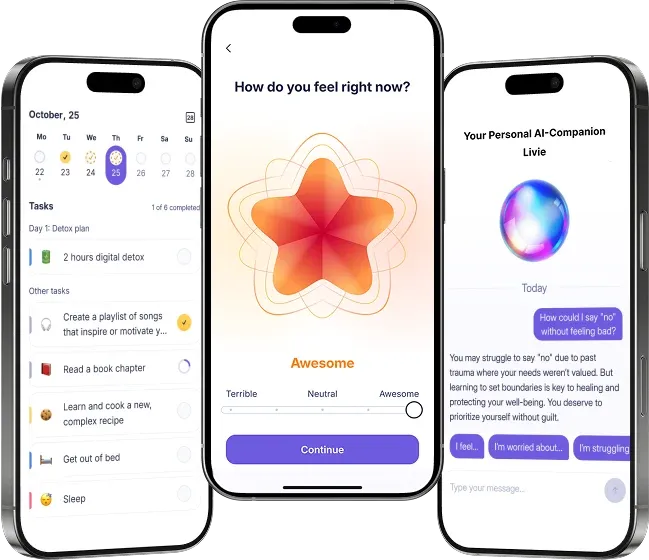
Liven treats self-awareness as a continuous practice rather than a one-time download. The app combines a personalized program (built from an initial assessment), CBT-informed and ACT-informed lessons, a journal, mood tracking with context fields, well-being quizzes, and a smart companion called Livie that helps you process emotions in the moment.
Structure level: High
Main features:
- Personalized self-discovery plan based on an onboarding quiz
- Mood tracker with an emotional menu and context fields
- Livie, a smart companion for guided reflection (text or voice)
- Journal with daily prompts
- Quizzes with a personal timeline of results
- Today's Routine: a 3-step daily check-in designed to take 10 minutes
- Focus and calming soundscapes
Best for: People who want depth over gamification and a structured path rather than a blank page.
Considerations: The app does more than casual mood tracking, so it can feel like a lot if you're only looking for a one-tap check-in.
Pricing: Starts at $7.99 per week.
2. Reflection: AI-Guided Journaling With Deeper Prompts
Reflection.app is built around an AI coach that responds to what you write with follow-up questions. Over time, it surfaces recurring themes in your entries, like a mention of Sunday dread that quietly shows up three weeks in a row.
Structure level: High
Main features:
- AI coach with personalized follow-up questions
- Library of 100+ expert-led guided programs (overthinking, gratitude, and shadow work)
- Cross-platform sync across iOS, Android, Mac, and web
- Voice-to-text journaling
Best for: Writers who want depth and pattern recognition without committing to a full personalized plan.
Considerations: Each entry is built around an AI-generated prompt, so it suits readers who want a guided structure rather than open-ended free writing.
Pricing: Free tier; premium starts at $5.75 per month.
3. Stoic: Morning Prep, Evening Reflection, Ancient Philosophy
stoic. builds its practice around a morning-and-evening rhythm, with prompts drawn from Stoic philosophy, CBT, and positive psychology. It blends journaling with mood tracking, breathing exercises, and short meditations, plus templates for specific situations like CBT thought records and pre-therapy session prep.
Structure level: Moderate to high
Main features:
- Morning and evening prompts with daily themes
- CBT-informed thought-record templates
- Mood tracking and trend insights
- Breathing exercises and short meditations
Best for: People drawn to philosophical reflection and structured daily rituals.
Considerations: The practice is anchored in Stoic philosophy, so the prompts and content reference that tradition throughout.
Pricing: Free; premium at varied tiers.
4. Finch: Gentle, Gamified, Low-Pressure
Finch turns self-care into nurturing a virtual bird that grows as you complete check-ins, breathing exercises, and small reflections. The interaction model is built around encouragement and gentle nudges rather than long-form journaling.
Structure level: Low to moderate
Main features:
- Mood check-ins with context fields
- Short journaling prompts
- Habit tracking and self-care reminders
- A virtual pet that responds to your activity
- A light social layer for sharing with friends
Best for: People who want self-care to feel kind rather than disciplined.
Considerations: The pet-care interaction is the central mechanic, so the experience leans toward gamified check-ins more than long-form writing.
Pricing: Free; premium starts at $9.99 per month.
5. Day One: A Beautifully Designed Digital Diary
Day One has been the long-form journaling standard for over a decade. It's less about prompts and more about giving you a beautiful place to write, with photo integration, location metadata, weather tags, and strong encryption. No AI, no streaks. Just a writing app that respects your privacy.
Structure level: Low
Main features:
- Long-form journaling with markdown support
- Photo, video, and audio attachments
- Weather and location metadata
- End-to-end encryption for premium users
Best for: Writers who want a quiet, well-built canvas, not a coach.
Considerations: Built as a writing canvas, not a wellness program. No built-in prompts, mood scoring, or therapeutic frameworks.
Pricing: Free tier; premium starts at $4.17 per month.
6. Reflectly: AI-Driven Daily Check-Ins
Reflectly is built around an AI-coach format, with daily questions, mood tracking, and an insight dashboard that highlights patterns in your emotional data over weeks and months.
Structure level: High
Main features:
- AI-driven daily prompts
- Mood tracking with detailed insights
- Long-term trend dashboards
- Motivational quotes (mileage varies)
Best for: People who want structure and a visually clean experience.
Considerations: Built around prompted check-ins and visual mood tracking, the deeper analytics and ad-free experience live behind the premium tier.
Pricing: Free; premium starts at $4.99 per month.
7. Daylio: A Two-Tap Mood and Habit Tracker
Daylio is built for two-tap logging. A single screen captures both a mood and an activity, and over time you get visualizations showing how your mood correlates with what you did, who you were with, and how much you slept. It's closer to a behavioral lens than a journal.
Structure level: Low
Main features:
- One-screen mood and activity logging
- Tag system for custom variables
- Statistics, charts, and goal tracking
- Passcode lock for privacy
Best for: People who hate writing but want to spot patterns in their behavior.
Considerations: Optimized for fast logging rather than long-form writing. The notes field is where any reflection text lives.
Pricing: Free; premium at $4.99 per month.
8. Grid Diary: Templated Reflection Across Life Areas
Grid Diary structures journaling around grids: career, relationships, health, gratitude, and lessons learned. Each cell gets its own prompt, so you cover multiple life domains in one short session rather than spiraling into a single topic.
Structure level: High
Main features:
- Customizable journal grids
- Library of pre-built templates
- Photos, tags, and stickers
- Passcode lock and dark mode
Best for: People who want a structured weekly review across different life areas.
Considerations: Structured around templates and prompts. Free-form journaling is possible, but the grid system is the core interaction.
Pricing: Free; premium at $2.99 per month.
Comparison Table
| App | Best for | Structure | Pricing |
|---|---|---|---|
| Liven | Long-term guided self-discovery | High | From $7.99 per week |
| Reflection | AI-coached prompts and pattern detection | High | Free; premium from $5.75 per month |
| stoic. | Morning-and-evening philosophical practice | Moderate to high | Free; varied premium tiers |
| Finch | Gentle, gamified self-care | Low to moderate | Free; premium from $9.99 per month |
| Day One | Long-form private journaling | Low | Free; premium from $4.17 per month |
| Reflectly | Prompted AI check-ins with mood dashboards | High | Free; premium from $4.99 per month |
| Daylio | Quick mood and habit tracking | Low | Free; premium from $4.99 per month |
| Grid Diary | Structured multi-area reflection | High | Free; premium from $2.99 per month |
Comparison based on publicly available information as of May 2026. Pricing reflects each app's standard published billing cycle (weekly or monthly); equivalents may vary. Features and pricing may change.
How to Choose the Right Self-Reflection App for You
The right app depends on what you want from the practice, how you like to reflect, and what matters most in the tool itself. Three quick questions to help you narrow it down.
What's your goal?
Different apps optimize for different outcomes. Match the one that fits where you actually are.
- Build long-term self-awareness through a guided program: Liven
- Reflect deeper with AI-driven prompts: Reflection, Reflectly
- Practice daily philosophical reflection: stoic.
- Capture emotional patterns quickly: Daylio
- Keep a long-form personal journal: Day One
- Build a gentle self-care habit: Finch
- Reflect across multiple life areas in one session: Grid Diary
What's your reflection style?
How you actually like to put words down matters more than the app's marketing.
- Guided prompts: Reflection, Reflectly, stoic., Grid Diary
- Free-form long-form writing: Day One
- Two-tap mood logging: Daylio
- A blend of prompts, habits, and check-ins: Liven, Finch
What's your priority in an app?
Past the basics, pick the one thing the app needs to nail.
- Structure and routine: Liven, Grid Diary, Reflectly, stoic.
- Flexibility and freedom to write what you want: Day One
- Privacy and encryption: Day One, Liven
- Depth and pattern detection: Liven, Reflection
- Speed and simplicity: Daylio, Finch
- Philosophical framing: stoic.
How to Build a Self-Reflection Habit That Sticks
Downloading an app is the easy part. What matters is what happens in weeks two and three, after the novelty wears off.
New behaviors, on average, take 66 days to become automatic. Consistency beats intensity. Five minutes a day for 3 weeks does more than one big session a month.
A few principles that work:
- Anchor it to something you already do. Habit researchers call this stacking. Coffee brewing? That's your journaling cue. Brushing teeth? Three lines of mood plus one observation.
- Lower the bar to embarrassing levels. Commit to a single prompt a day. The point is to make it impossible to say no.
- Aim for done, not deep. Some entries will be one frustrated sentence. That counts. Showing up beats showing off.
- Review weekly, not only daily. The patterns only show up when you re-read. Set aside ten minutes on Sunday to scroll back through the week.
Final Thoughts
Your phone takes most of your attention every day. It can also help you notice you've been giving it away. That's the whole point of these apps, even if the streak counter pretends otherwise.
Try one for a few weeks. You'll start to notice things you missed at the time: a mood that dips on Sunday nights, or something you keep saying you're fine about that keeps coming up in your notes. The app isn't going to give you answers, but it can show you what you've been doing without realizing it. What you do with that is up to you.
References
Eurich, T. (2018). What self-awareness really is (and how to cultivate it). Harvard Business Review.
Fogg, B. J. (2019). Tiny Habits: The Small Changes That Change Everything. Houghton Mifflin Harcourt.
HarmonyHIT. (2025). Phone screen time statistics.
Lally, P., van Jaarsveld, C. H. M., Potts, H. W. W., & Wardle, J. (2010). How are habits formed: Modelling habit formation in the real world. European Journal of Social Psychology, 40(6), 998–1009.
Lieberman, M. D., Eisenberger, N. I., Crockett, M. J., Tom, S. M., Pfeifer, J. H., & Way, B. M. (2007). Putting feelings into words: Affect labeling disrupts amygdala activity in response to affective stimuli. Psychological Science, 18(5), 421–428.
Pennebaker, J. W., & Beall, S. K. (1986). Confronting a traumatic event: Toward an understanding of inhibition and disease. Journal of Abnormal Psychology, 95(3), 274–281.
FAQ: Top Apps for Self-Reflection
What are self-reflection apps?
How is an AI journaling app different from a regular journaling app?
Can digital journaling replace a paper journal?
Are self-reflection apps a replacement for therapy?
What key features should I look for in the best app for reflection?
Are reflection apps worth it if there are just so many applications out there?
What's the difference between a mood tracker and a self-reflection app?
Is my journal data private?