Top Apps for Emotional Regulation



People turn to emotional regulation apps because they offer simple, accessible features that help them understand what they’re going through and how to ground themselves. Most often, such apps come with structured techniques, mindfulness practices, and gentle daily check-ins to help a user feel supported throughout the day.
Below are the best emotional regulation apps currently on the market: accessible, affordable, and convenient. But please keep in mind that apps aren’t a replacement for therapy. They can complement therapy, offer evidence-based exercises, and help you build healthy daily habits, but they cannot diagnose or provide crisis care.
Key Learnings
- Emotional regulation apps can help you understand your emotional patterns and respond more mindfully.
- Adults benefit from structured practices like meditation, CBT strategies, and mood tracking.
- Kids learn best through visual, playful tools designed for social and emotional learning.
Emotional Regulation Apps for Adults
The right app can act like a small support system you carry in your pocket, helping you understand your emotional patterns and regulate complex feelings.
1. Liven
Best for: Individuals seeking a warm, compassionate self-discovery companion that helps foster emotional awareness and gradually replace unhelpful habits without pressure.
Features and Value
You can think of Liven as a pocket-sized companion helping you deal with overwhelming emotions.
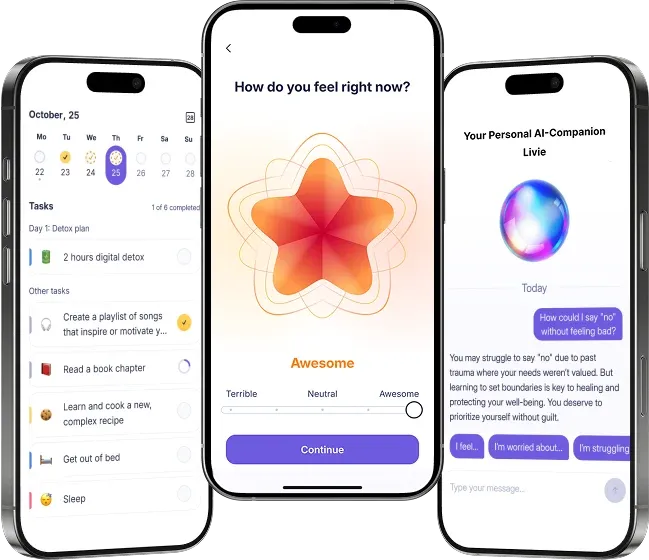
- Mood Tracker. You can use Liven’s Mood Tracker during daily emotional check-ins to identify and name your emotions and jot down the context of the situation (where you are, who you're with, what you're doing). Liven also provides you with detailed, interactive charts that analyze your mood and help you identify the prevailing emotional states and triggers.
- AI Companion. "Livie" is a supportive, deeply empathetic science-based companion always ready to listen to your worries and help you regulate difficult emotions and reframe unhelpful thoughts.
- Journaling. The Journaling feature enables users to jot down their thoughts whenever they feel like it. Don’t know what to write about? The app will offer you prompts, which is very convenient if you want to turn journaling into a daily habit but sometimes feel stuck with what to write about.
- Bite-sized mental health courses. Liven offers multiple easy-to-digest courses on burnout, worry, and procrastination, all inspired by the best principles of Cognitive Behavioral Therapy (CBT).
- Personalized well-being tests. You can always try Liven’s free wellness tests here. Meanwhile, there are more tests in the app on stress, motivation, and more that help you track changes in your emotional state over time and see how much progress you’ve made.
- Routine/Task Builder. You can choose activities for a day that help you build healthy morning and evening routines, self-care rituals, and even a bundle of supporting activities for tough days. Plus, you can make all of them a part of your personalized dopamine management plan to reap even more benefits when it comes to motivation and focus.
- Soundscapes. The Liven app also offers a library of ambient and deep-focus sounds to help you calm down, concentrate, or reset.
Pricing:
Pricing for Liven typically ranges from $19 to $29 per month, and $7.99 per week. A free trial is offered, but availability may vary depending on whether you subscribe through the web, App Store, or Google Play.
Note: For the most current and accurate pricing, always consult the official app website, the App Store, or Google Play.
2. Headspace
Best suited for: Individuals seeking to practice mindfulness and emotional regulation techniques rooted in meditation.
Features and Value
What makes Headspace special is its structured approach to teaching mindfulness.
- Over 1000 guided meditations. The app offers multiple meditations for work, relationships, and emotional health, all packed into convenient beginner-to-advanced courses.
- Courses for stress, focus, and sleep. These are multi-session courses that teach users the foundational techniques of mindfulness and CBT to build long-term emotional resilience.
- Sleep tools. Sleepcasts, sleep music, and soundscapes promote deep relaxation, helping users drift off more easily.
- Therapy + coaching options. One can access licensed mental health professionals. Let’s say you’ve tried Talkspace vs Betterhelp and now want to try something different. However, keep in mind that Headspace therapy is more expensive compared to other solutions on the market.
Pricing
Includes a 14-day trial. Subscription options include Monthly (US: ~$12.99) and Annual (US: ~$69.99). The cost of therapy is approximately $149/session.
3. Calm
Best for: People seeking to reduce stress through mindfulness practices and enhance sleep with ambient sounds and guided sleep stories.
Features and Value
Calm is a great app if you’re looking for visually satisfying content to help you relax and unwind.
- Daily emotional check-ins. The Daily Calm is a 10-minute meditation published daily, featuring a new topic each time.
- Breathing exercises & mindful movement. Calm offers a dedicated library of breathing exercises (like box breathing) and gentle mindful movement sessions (yoga and stretching) for physical relaxation.
- Sleep stories. Calm offers a library of sleep stories for adults and kids that lull listeners to sleep.
- Music & soundscapes. Bilateral music for stress relief and nature soundscapes help reduce mental fatigue.
Pricing
Calm offers a 7-day free trial for Calm Premium. Subscription options include $12.99/month or $69.99/year, plus a lifetime subscription, which is approximately $399.99 in some markets.
Free Apps for Emotional Regulation
4.MindShift CBT
Best for: Teens and adults who deal with daily worries and unhelpful thought patterns.
Features and Value
The app’s features are based on the emotion regulation strategies from Cognitive Behavioral Therapy (CBT).
- Tools for thought reframing. Includes tools like Thinking Styles and Belief Experiments to challenge and replace common cognitive distortions that fuel worry.
- Relaxation exercises. Offers guided audio sessions, including progressive muscle relaxation, focused breathing techniques, and guided imagery.
- Goal-setting and self-management. Users can set specific behavioral goals, create a Fear Ladder (a step-by-step challenge), and track their progress as they overcome avoidance fears.
Pricing
MindShift CBT is available for free download and use.
5.Happify
Best for: People who prefer positive psychology frameworks and want to rewire their thinking toward joy and meaning.
Features and Value
Compared to other tools on the list, the app helps you engage in self-care through games and activities.
- Science-based activities and games. Short, gamified activities (like "Uplift" or "Serenity Scene") are based on CBT and positive psychology and were built to encourage gratitude and appreciation.
- Guided tracks. These are structured, multi-week programs that teach users how to reframe negative thoughts and manage stress, among many others.
- Community/Social elements. A "Community Hub" is a platform where users can share their progress and interact with others.
Pricing
Happify offers a free tier. For full access to all “tracks” and premium content, there is a subscription model (Premium Plan), though the exact pricing differs across regions.
6. Insight Timer
Best for: Anyone seeking a highly flexible and free meditation tool.
Features and Value
The variety of meditation formats and mindfulness practices makes the app an excellent choice for both experienced meditators and beginners.
- Library of free meditations. Insight Timer offers over 160,000 free guided meditations and music tracks from more than 20,000 teachers worldwide.
- Meditation timer. The core feature enables you to select a session length, choose from interval bells (such as singing bowls), and customize your meditation sessions with ambient background sounds.
- Community & live workshops. Users can interact with teachers and other meditators during hourly live meditations and yoga events.
Pricing
Core features (guided meditations + timer) are free. The yearly subscription for the optional Insight Timer Plus, which includes advanced courses and offline listening, is approximately $60/year.
Free Emotional Regulation Apps for Kids
Unlike the emotional regulation apps for adults, those for kids were built with the following idea in mind: children need tools that match their stage of social and emotional learning and their attention span.
Here are a few examples of free emotional regulation apps for kids of different ages.
7. Breathe, Think, Do with Sesame
Best for: Preschool-aged children who are just beginning to learn how to identify and manage their emotions.
Features and Value
The app features playful, evidence-based tools for emotional regulation and management.
- Interactive animations with Sesame Street characters. The app features Sesame Street characters, which help kids navigate simple scenarios in a fun and engaging way. For instance, the child helps a Sesame Street monster calm down by tapping its stomach to simulate deep, slow breathing.
- Emotional vocabulary tools. The exercises teach kids to identify emotions and choose solutions for problems in specific situations (commonly, three solutions to choose from).
- Parent section/caregiver tips. A password-protected section provides caregivers with a variety of resources and strategies for helping children develop good emotional intelligence.
Pricing — free.
8. Wisdom: The World of Emotions
Best for: Children aged 4-10 who are ready to expand their emotional vocabulary and develop skills in self-reflection and self-control.
Features and Value
The app teaches kids healthy emotional coping mechanisms.
- Interactive stories. Stories are set in places like the “Kingdom of Anger” or the “Kingdom of Fear,” where children must help the inhabitants by using “superpowers,” which are calming tools.
- Reflective prompts and games. Games are designed to recognize body language, facial expressions, and vocal tones associated with different emotions.
- Actionable parenting guides. These bite-sized guides help caregivers learn how to extend social-emotional learning into their family dynamics.
Pricing — free.
9. ChillPanda
Best for: Kids (ages 6-12) who respond well to playful, visual, and interactive calming tools.
Features and Value
The app offers visual breathing exercises, simple relaxation games, and heart-rate–based calming techniques.
- Animations and exercises for deep breathing. The main character, Chill Panda, teaches children how to manage worry through simple breathing techniques.
- Relaxation games. Low-stress mini-games help kids distract from worries.
- Heart rate visualizer. The app uses the device's camera to visually detect the child's pulse. This teaches kids that their bodies change when they feel stressed.
Pricing — free.
Final Thoughts: Which App to Choose?
Emotional regulation is a lifelong journey, and as you've seen, having the right digital tools in your pocket can make this journey feel less overwhelming and far more empowering.
Now that you have a comprehensive list of accessible, affordable, and highly-rated apps—from Liven for profound self-discovery to MindShift CBT for targeted stress relief, and playful tools like Wisdom for children.
| App | Category | Best for | Key Features | Cost |
| Liven | Adults | Gentle emotional support & self-awareness | Mood tracking, AI companion, journaling, CBT mini-courses | 7-day trial; $7.99/week $19 to $29 |
| Headspace | Adults | Mindfulness & meditation beginners | Guided meditations, stress courses | 14-day trial; $12.99/mo |
| Calm | Adults | Stress relief & better sleep | Daily Calm, breathwork, sleep stories | 7-day trial; $12.99/mo |
| MindShift CBT | Adults | Worry reduction with CBT tools | Thought reframing, relaxation | Free |
| Happify | Adults | Gamified emotional well-being | Positive psychology games, guided tracks | Free tier; premium varies |
| Insight Timer | Adults | Meditation for pros and newbies | 160k meditations, timer, live events | Free core; Plus ~$60/yr |
| Breathe, Think, Do with Sesame | Kids | Preschool emotional basics | Sesame Street calming activities | Free |
| Wisdom: The World of Emotions | Kids | Ages 4-10 building SEL skills | Interactive stories, emotion games | Free |
| ChillPanda | Kids | Ages 6–12 needing visual calming tools | Breathing exercises, mini-games | Free |
Choose your starting point:
- If you are an adult focused on daily habits, download Liven or Headspace. Start with the free trials or a few free features (like Liven's AI Companion or Headspace's introductory courses) to see which interface and approach to mindfulness/CBT resonates most with your current emotional needs.
- If you are managing chronic overthinking, download MindShift CBT (free). Its direct application of Cognitive Behavioral Therapy strategies offers structured, no-cost tools for challenging and reframing your thinking patterns right now.
- If you are a caregiver seeking tools for a child, consider downloading Wisdom: The World of Emotions or ChillPanda (both are free). Introduce the app during a calm time and work through the first interactive story or breathing game together to make emotional check-ins a fun, routine part of your day.
Remember, the best app for emotional regulation is the one you will actually use. Commit to using your chosen app for just 10 minutes a day for one week. This simple, actionable commitment will help you move from reading about emotional wellness to actively building it.
References
- Laird et al. (2022). Calm app feasibility RCT. https://doi.org/10.2196/30294
- Marks, T. (2023, April 24). Emotion regulation hacks: Two powerful calming techniques [Video]. YouTube. https://www.youtube.com/watch?v=3Gr2_4RSnEY
- O'Daffer et al. (2022). Efficacy and conflicts of interest in Headspace and Calm trials. https://doi.org/10.2196/40924
- Pierce, M. E., Mirabito, G., & Verhaeghen, P. (2024). Time on Headspace and daily mindfulness outcomes. https://doi.org/10.1080/28324765.2024.2400878
FAQ: Top Apps for Emotional Regulation
What are the benefits of improving emotional intelligence with apps?
Can apps really help me manage emotions during stressful moments?
How do emotional regulation apps support kids’ social and emotional learning?
Are emotional regulation tools recommended by mental health professionals?
Can emotional regulation apps help with anger management or mood swings?
What features should I look for when choosing an emotional regulation app?
How can these apps support emotional growth and healthy relationships?
Are there good options if I only want a free version?