Mood Tracking Journal Tools That Support Emotional Awareness




Last Tuesday, you felt overwhelmed. Yesterday, energized. Today? Somewhere in between. And if someone asked you why, you’d probably shrug.
We’re human, and it’s completely normal not to feel calm or stable all the time, especially when the world around us moves so fast. A lot of this happens in the background. But once you start noticing your moods, tracking will help you identify trends over time.
If you want to better understand patterns and make sense of your emotional shifts, mood tracking journal tools can help you capture your ups, downs, and everything in between.
Key Learnings
- Mood-tracking journal tools offer clarity into daily emotional shifts.
- Paper journals, self-discovery companions like Liven, and holistic wellness apps all offer unique ways to log moods, analyze them, and review progress.
- Regular use of mood tracking tools improves emotional awareness.
Mood Tracking Journal Types to Choose From
It really comes down to what you enjoy more: paper journals or digital tools. Both offer different ways to track your mood and reflect on your experiences.
Digital Mood Tracking Journal
Digital tools make it easier to log entries anytime, from any device, and generate automatic mood charts.
Smart Companion Mood Trackers
These tools go beyond basic logging. They come with AI-powered companions that help you process emotions and develop healthier thought patterns through conversation.
Liven ⭐⭐⭐⭐ 4.1
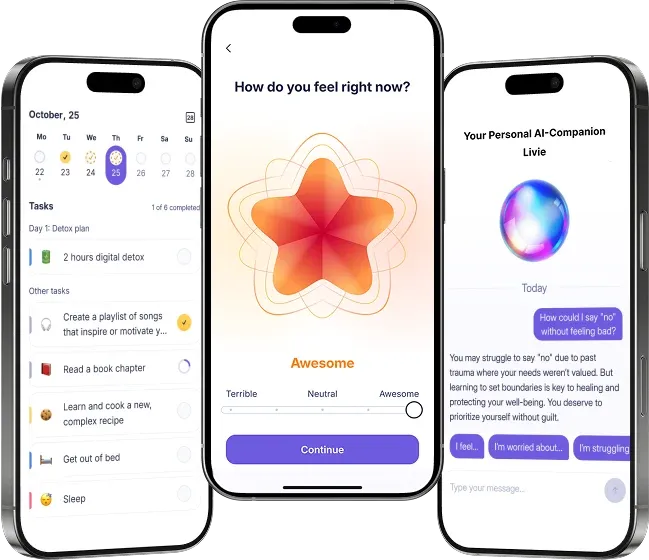
Liven app serves as a self-discovery companion that connects your moods, journal entries, routines, and insights.
This makes it easier to understand why you feel the way you do, like what triggers overthinking. As time goes on, you can spot patterns in these thoughts and build small daily habits, such as maintaining streaks in the app, to gradually break out of overthinking loops and support your well-being.
At its core, the Mood Tracker feature is simple: you log how you feel, add context, and, over time, your emotional history is displayed through mood breakdown dashboards.
In combination with the Journaling feature, you can connect your feelings with the events and thoughts that trigger them.
Then there’s Livie, the Smart Companion. She’s not a replacement for therapy. Livie is more like that grounded friend who asks good questions and helps you reflect on your reactions.
The Liven app saves your conversations with Livie as summaries, which you can review with your therapist to recognize mood patterns and work on them.
Liven also includes Structured Courses on anxiety management, burnout recovery, procrastination, and childhood trauma, so you can learn why certain emotional patterns repeat - all while your personalized dopamine management plan supports building healthier daily habits.
Everything works together to help you understand yourself and grow.
Pricing
Plans start at $7.99 per month.
Wysa ⭐⭐⭐ 3.1
Wysa is an AI chatbot that uses CBT principles to help users work through anxious thoughts and develop coping strategies. You can track moods, set goals, and receive personalized exercises.
It helps you cope in the moment with anxiety but offers less depth in reviewing long-term mood patterns.
Pricing
The AI chatbot is free for basic support, but "Wysa Premium" (which includes coached sessions) costs roughly $74.99/quarter or $10–$15/month for the app-only features.
Woebot ⭐⭐⭐⭐ 4.7
Woebot is heavily grounded in CBT principles. It checks in with you daily, asks about your mood, and offers cognitive reframing exercises.
From a psychological perspective, Cognitive Behavioral Therapy helps you identify cognitive distortions, aka automatic negative thoughts, and challenge them. Woebot automates this process in a conversational format.
Pricing
Currently, Woebot is free for individuals, funded by clinical partnerships and research grants, making it one of the most accessible CBT tools.
Minimalistic Mood Trackers
Minimalist trackers are about speed. You open the app, log your mood, maybe tag activities, and move on with your life.
DailyBean ⭐⭐⭐⭐ 4.7
DailyBean is visual and simple. You select your mood using emojis, add notes if you want, and review everything in a calendar view. Over time, your month becomes a color-coded picture of your emotional fluctuations.
It's a good option for people who don’t want heavy reflection but still want awareness. The interface is clean, intuitive, and doesn’t overwhelm you with features.
Pricing
This is a "freemium" app; the basic mood tracking is free, while "Premium" (to unlock more icons and themes) is a very affordable $1.99/month or a one-time lifetime purchase.
Daylio ⭐⭐⭐⭐ 4.8
Good for users who feel resistant to traditional journaling. You tap your mood, select activities, and the app generates charts and statistics over time.
Over weeks and months, you can review correlations between mood and habits. For example, you might discover that social time improves your mood, while late nights reduce it.
Pricing
The basic version is free, but to unlock advanced statistics and unlimited moods, the Premium subscription is about $4.99/month or $23.99/year.
Moodflow ⭐⭐⭐⭐ 4.2
If you want consistent tracking without too many extras, Moodflow is a steady option.
The app offers a clean interface and trend tracking visuals. It allows daily entries and displays long-term mood shifts in easy-to-read graphs.
It’s somewhere between minimalist and structured. Not overly clinical, not overly decorative. Just functional.
Pricing
Most core features are free, but "Moodflow Plus" (which removes ads and adds cloud backup) is priced around $4.99/month or $29.99/year.
Mood Trackers for Holistic Wellness
These platforms integrate meditation and other mindfulness practices to reduce stress.
Healthy Minds Program ⭐⭐⭐⭐⭐ 5.0
The Healthy Minds Program offers a structured, neuroscience-based approach to daily stress management. It focuses on attention, mindfulness, and compassion practices to help you measure and understand your emotional responses.
The app’s structured exercises teach your body and mind to handle stress, improve focus, and build resilience. Meanwhile, these practices nudge you to create sustainable self-care habits that stick.
Pricing
100% free (supported by donations).
Insight Timer ⭐⭐⭐⭐ 4.4
Insight Timer offers thousands of guided sessions for sleep, focus, and relaxation. Beyond mood tracking, it encourages reflection on your emotions and daily routine.
With customizable timers, calming soundscapes, and community features, the app is a flexible tool for supporting emotional progress and for discovering how sleep, mindfulness, and focus interact with your mood.
Pricing
It boasts the largest free library of meditations in the world; however, their "Member Plus" tier for offline listening and courses is $59.99/year.
Calm ⭐⭐⭐⭐ 4.1
Calm blends meditation, breathing exercises, and sleep tools to support stress regulation and overall mental health. Its programs are designed to help you step back from racing thoughts and create space in your day to reflect and recharge.
Pricing
After a 7-day free trial, Calm is strictly subscription-based, costing $14.99/month or $69.99/year, with a "Lifetime" option usually priced at $399.99.
Paper Wellness Journals
Typing is faster and more convenient, but brain imaging research shows that handwriting activates more areas of your brain than typing. It strengthens your memory, learning, and long-term brain connections. As a result, you process the data deeper and build stronger emotional awareness.
- Bullet journal mood tracker. Popular formats include grids, color-coded calendars, and “Year in Pixels.” You can literally create your own system where you decide how the tracker looks, how colors correspond to feelings, and how much space to give each entry.
- Reflective journaling. The good old-fashioned “Dear Diary” style that helps you capture thoughts and feelings. You can add a Morning Pages in the early hours (write three pages of stream-of-consciousness to clear mental clutter right after you wake up) and a Rose-Thorn-Bud exercise in the evening (write down one good thing that happened during the day, one challenge, and one thing you're anticipating for the next day).
- Circular trackers. All you have to do is draw or print a circular template divided into sections and choose a color scheme for different emotions. Each day, color in your section based on your prevailing mood. If you want an even more nuanced analysis of your emotions, try the Emotions Wheel, a circular mood chart that helps you identify feelings with greater precision.
🤔 Did you know? Writing about positive experiences, gratitude, or your “best possible self” boosts happiness and life satisfaction over time. Some types of positive writing provide stronger benefits than others, particularly gratitude letters and exercises that focus on a hopeful future.
Final Thoughts
A mood tracking journal is most powerful when paired with action. When you log your moods and review your emotional patterns, you train your nervous system to self-regulate and make better decisions.
Keep it simple, stay consistent, and continue your self-discovery journey: try the Liven app (Google Play or App Store), check the blog, or take free wellness tests to measure your progress.
References
- Feelings Wheel. (2026). Feelings wheel. https://feelingswheel.com/
- Hoult, L. (2025). Positive expressive writing consistently improves well-being, but not all techniques are created equal. [News release]. PLOS. Northumbria University.
- Marano et al. (2025). The neuroscience behind writing: Handwriting vs. typing. Life (Basel), 15(3), 345. https://doi.org/10.3390/life15030345
- Mochibujo. 8 types of mood trackers | Bullet journal [Video]. YouTube. https://www.youtube.com/watch?v=P7jN0dMKJRs
FAQ: Mood Tracking Journal
How does a bullet journal mood tracker actually help you understand your mood?
Are digital mood tracker tools more helpful than a bullet journal mood tracker?